Community solar bills languish as Michigan debates energy affordability
Oct 27, 2026 | 5:00 am ET
Description
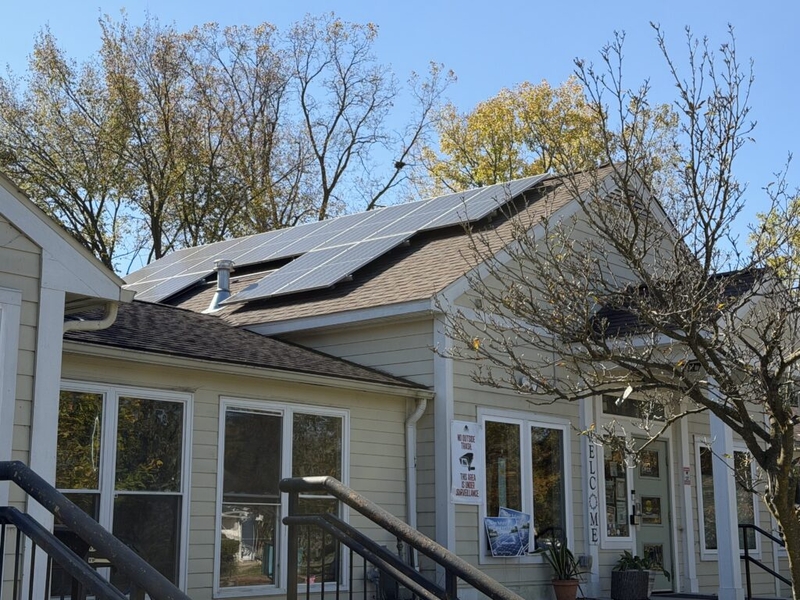
Rooftop solar panels on the Bryant Community Center in Ann Arbor on Oct. 20, 2026. (Photo by Jon King/Michigan Advance)
Since 2021, Michigan lawmakers have drafted six community solar bills in the House and Senate under both Republican and Democratic leadership, but no bill has been passed into law. Two separate House bills and two tie-barred Senate bills are currently languishing in committee with no hearings scheduled.
Polling shows strong support for community solar among Democrats, Republicans and independents alike. Yet despite that bipartisan appeal, Michigan lawmakers have struggled to advance legislation that supporters say could improve energy affordability and reliability in a state facing high energy rates and persistent power outages.
Community solar allows municipalities to develop small-scale solar projects that supply electricity to subscribers who cannot install their own panels because they rent, cannot afford the upfront costs or have unsuitable roofs. Subscribers receive credits on their utility bills for the energy generated, and some programs offer battery backup during grid outages.
Senate Bills 518 and 519 were introduced by state Sens. Jeff Irwin (D-Ann Arbor) and Ed McBroom (R-Waucedah) in 2025, with seven Democratic and two Republican co-sponsors. It was the second set of bills introduced by the senators since 2023.
The legislation would require 60% of capacity to come from projects smaller than 40 kilowatts, and no project larger than 5 megawatts of solar. The bills contain broad language about energy affordability for ratepayers and labor equity for solar project workers.
State Rep. Greg Markkanen (R-Hancock) introduced HB 4590 in June 2025 with 22 Republican co-sponsors. The bill directs the MPSC to establish rules and credits for community solar projects, including for low-income participants.
House Bill 6041 was introduced this year by state Rep. Donavan McKinney (D-Detroit) and co-sponsored by 27 Democrats. The bill contains more specifics about environmental justice and prevailing wage protections, including a 40% set-aside for low-income households. Subscriptions must provide at least a 10% utility bill savings for standard residential subscribers and at least a 20% savings for low-income households.
Neither the House nor Senate community solar proposals would override local zoning rules.
McKinney represents Michigan’s 11th district, which includes northeast Detroit. In a phone interview with Michigan Advance, McKinney said he has personally experienced fifty power outages since 2022.
“This community solar legislation provides opportunities for everyone, in particular to target underserved populations and over burdened populations when it comes to energy shutoffs and power outages. It provides more opportunities for people to produce their own energy in a clean, responsible way, and get some tax credits for it,” McKinney said.
Michigan remains one of roughly two dozen states without a community solar program.
A 2023 statewide poll of registered Michigan voters commissioned by Data for Progress found that 73% of respondents supported increasing the share of electricity produced from renewable energy sources. Rather than political ideology, the differences between lawmakers appear to center on who pays for the community solar assets, and concerns that these costs could be shifted onto nonparticipating customers.
Bipartisan bills face utility opposition
DTE and Consumers Energy contend that community solar programs would force nonparticipating ratepayers to bear the costs of community solar assets, although they declined to provide details on how this would be the case.
In a statement to Michigan Advance, DTE spokesperson Ryan Lowry points to the utility’s own solar program MIGreenPower, which allows customers to support solar and wind energy “without having to spend tens of thousands of dollars on solar panels for their homes and businesses.”
Subscribers of the MIGreenPower program can pay as little as $1 to access 21% clean energy. To achieve 100% clean energy, the average household would pay $155.52 annually.
“It is important community solar proposals do not have the opposite effect of its intended purposes – raising costs for all customers,” says Lowry.
Katie Carey, director of media relations for Consumers Energy, echoed DTE’s concerns in a statement to the Advance.
“We support community solar policies that benefit customers, but we cannot support legislation that shifts costs onto customers who do not participate, particularly those who can least afford higher bills. Our existing community solar programs are designed so participating customers pay the full costs of the program.”
Consumers Energy has two community solar programs. Based on its published 2024 solar credits, the average household would pay approximately $578 annually to subscribe to enough Solar Gardens Community Solar Program capacity to match its electricity consumption.
While subscribers of the utility-run programs do bear the full cost of the programs, they do not benefit from the lower cost of renewable energy. According to Lazard Inc.’s 2025 report, Levelized Cost of Energy+, unsubsidized utility-scale solar and onshore wind have been the lowest-cost sources of new electricity generation in the United States for a decade.
Supporters of community solar claim that energy generated in small solar fields close to end users is less expensive than utility-scale solar because it does not rely on expensive grid infrastructure for delivery.
Dr. Laura Sherman, president of the Michigan Energy Innovation Business Council, believes that utility bias toward owning energy infrastructure is baked in. “Investor-owned utilities in Michigan earn ~10% return on equity for their capital investments, so they have a strong bias to own as much infrastructure as possible.”
Who pays for community solar?
Rep. McKinney believes that HB 6041 can’t get a hearing because elected officials take campaign contributions from utilities.
“I have to say, a lot of people’s decisions come down to who’s giving the money. It’s politics, and that’s why the utilities hate our legislation. That’s why they blocked it from a hearing,” he said.
State Rep. Pauline Wendzel (R-Watervliet) chairs the House Energy Committee. In an email to the Advance, she denied that utilities had lobbied her to hold the bill. “I haven’t taken up the bill because I oppose the policy,” she writes.
Wendzel’s concerns about HB 6041 focus on who covers the costs of maintaining the electrical grid. If community solar customers are paid credits that are greater than the cost of generating the power, then the costs of maintaining the grid would be passed on to customers that do not participate in the program. Wendzel says that would be unfair because community solar subscribers also utilize the grid to deliver power.
HB 6041 proposes minimum savings for subscribers, including greater savings for low-income participants. Wendzel argues that requiring those discounts doesn’t establish whether the underlying solar generation is economical or who absorbs any shortfall.
“Whatever the credit pays beyond what a facility saves the system has to be recovered somewhere. The bill doesn’t say who pays it, and it bars charging subscribers in a way that cuts into their savings. That leaves general rates, which every customer pays,” Wendzel said.
McKinney responds that the MPSC is responsible for ensuring that costs of the law would not be shifted onto nonparticipating ratepayers, and he plans to work with the commission to ensure the law is applied equitably.
States offer different approaches to cost shifting
Community solar programs in other states demonstrate that cost shifting is a risk but is not inevitable, and depends on program design and on how the full value of electricity and grid benefits is calculated.
A study commissioned by the state of Massachusetts found that its distributed solar incentive program, which includes community solar, delivered $1.49 in direct ratepayer benefits for every dollar spent, including savings for nonparticipating households, while Minnesota found that credits in its original community solar program exceeded the value of the electricity generated and redesigned the program to address cost shifting.
In 2020, the City of Ann Arbor adopted A2Zero, a $1 billion plan to achieve community-wide carbon neutrality by 2030. To help reach its goal, Ann Arbor voters authorized the creation of the Sustainable Energy Utility, also known as A2SEU, in 2024, the nation’s first renewable, supplemental energy utility.
Rather than support the creation of off-site community solar facilities, the program finances, owns, installs, and maintains custom-built solar and battery systems at customers’ own homes and businesses. Customers remain connected to the DTE grid for any power needs that exceed the A2SEU system.
Missy Stults is the director of Ann Arbor’s Office of Sustainability Innovations, which led the creation of A2SEU. She would like it to serve as a model for other cities that do not have state laws that support community solar.
“I don’t want to just solve this for Ann Arbor,” she said. “Climate change does not care if Ann Arbor solves this problem and we do it in a way that’s not replicable or transferable to anyone else.”
Passing community solar legislation in Michigan will depend on whether lawmakers can agree on a bill credit formula that saves subscribers money without shifting the burdens of maintaining the electrical grid onto ratepayers who do not participate.
According to Sherman, customers will continue to pay a premium for renewable energy if utilities own the assets.
“Utility-owned resources are often more expensive and slower to construct than third-party-owned resources,” she explains. “Allowing for third-party owned community solar with a guaranteed bill savings would correct that problem by removing utility profits and high costs from the equation.”
Lansing, MI