New Mexico off track for 2030 greenhouse gas goal, environment official says
Oct 26, 2026 | 6:00 pm ET

Description
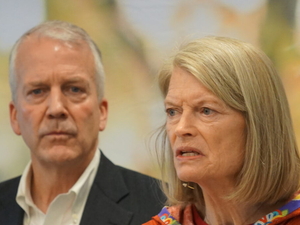
Claudia Borchert, chief of the New Mexico Environment Department's Climate Change Bureau, speaks to lawmakers on the interim Water and Natural Resources Committee on Oct. 26, 2026, about the state's progress toward meeting its greenhouse gas reduction goals. (Joshua Bowling/Source NM)
At its current rate, New Mexico won’t meet its 2030 goals for reducing greenhouse gas emissions, a New Mexico Environment Department official told state lawmakers Monday.
A 2019 executive order from Democratic Gov. Michelle Lujan Grisham charged New Mexico environment officials with reducing the state’s greenhouse gas emissions by 45% in 2030, relative to 2005 levels. The New Mexico Environment Department late last year published a “Climate Action Plan” that outlined more than three dozen steps for New Mexico to not only meet that goal but to also achieve carbon neutrality by 2050.
NM Environment Department unveils ‘Climate Action Plan’ to reach net-zero emissions by 2050
Claudia Borchert, chief of NMED’s Climate Change Bureau, on Monday told lawmakers on the interim Water and Natural Resources Committee that the state’s greenhouse gas emissions declined by 21% between 2005 and 2023.
While that’s a substantial cut, she and several lawmakers noted that it’s far short of the 45% goal.
“Current policies don’t have us getting to our desired outcome,” she said.
Her department’s plan outlines 45 steps the state can take to meet those goals, including decarbonizing electric grids; promoting energy-efficient building codes; and enhancing forest health and expanding post-fire recovery programs.
While state leaders in the Environment Department and the New Mexico State Land Office have spent recent years prioritizing efforts to curb oil and gas spills, plug abandoned wells and embrace renewable energy sources, some proposed developments could impact the state’s ability to hit its climate goals. Earlier this year, energy experts spoke before the Water and Natural Resources Committee and said that hyperscale data center proposals in New Mexico threaten to undo more than 20 years of progress on air quality, largely because of proposed “microgrid” energy sources that would power the data centers with fuel cell systems, natural gas pipelines and more.
The state’s shortcomings at meeting its reduction goal prompted concern from state Rep. Tara Lujan (D-Santa Fe).
“We really need to buckle down,” she said, citing New Mexico’s recent major weather events — including catastrophic flooding in San Juan County and a tornado in Santa Fe — as evidence that climate change is an urgent threat to the state. “It’s beyond critical. It’s a crisis.”
Lujan Grisham’s administration has prioritized regulations that tamp down on pollution in a number of industries. Last year, for example, she credited the state’s strict methane rules for bringing New Mexico’s emission levels down to half of those in neighboring Texas.
The state’s largest industrial sources of emissions still include the oil and gas industry, Borchert said Monday. They also include transportation and agriculture. About 83% of transportation emissions come from on-road vehicles, she said, noting that large trucks make up the biggest share of vehicles contributing to that total. In fact, passenger vehicles account for just 12% of the industry’s emissions, according to Borchert’s presentation.
New Mexico leaders have also heavily invested in renewable energy projects in recent years, including the SunZia wind project, which is the largest wind farm in the nation.
However, Rep. Randall Pettigrew (R-Lovington) questioned whether it’s prudent for renewable energy projects in New Mexico, such as the SunZia wind farm, to sell their power to other states. He also questioned whether keeping energy from that project would help New Mexico offset the emissions of other energy sources, he said.
“Let’s go back and do some course correction,” Pettigrew said.
Santa Fe, NM