Feds may build border wall through South Texas refuge as original plan stalls in court
Oct 26, 2026 | 6:12 pm ET
Description
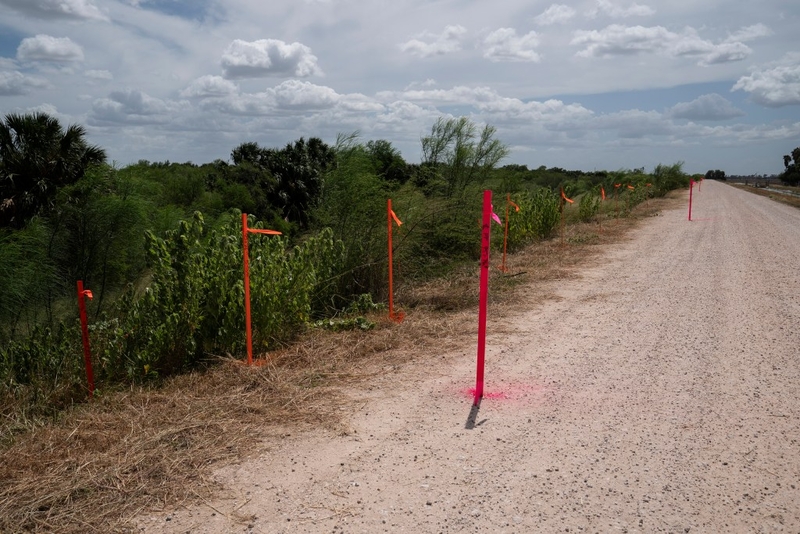
Survey stakes mark the proposed location of the border wall at the Santa Ana National Wildlife Refuge near Alamo on July 8, 2026. (Gabriel V. Cárdenas for The Texas Tribune)
Subscribe to The Y’all — a weekly dispatch about the people, places and policies defining Texas, produced by Texas Tribune journalists living in communities across the state.
McALLEN — A section of border wall that the federal government planned to build along a beloved South Texas wildlife refuge could end up cutting through the refuge instead.
The federal government is considering changing its plans for a border wall that it intended to build on a levee that runs adjacent to the Sana National Wildlife Refuge. The change is an attempt to resolve a legal dispute in which government contractors are accused of trespassing on property near the refuge belonging to Hidalgo County Irrigation District No. 2.
During a hearing in federal court on Oct. 14, Assistant U.S. Attorney Lance Duke said the federal government was considering taking up the suggestion proposed by the irrigation district to relocate the border wall currently under construction.
“My client is in the process of looking into, basically, moving the wall from its current expected path — where we were originally planning to go through [the irrigation district’s] property — and instead move it through the wildlife refuge,” Duke said. “We recognize that will probably just create additional litigation from other interested parties.”
A spokesperson for the U.S. Customs and Border Protection did not confirm the agency was considering relocating the wall through the refuge but said it was aware of the lawsuit.
“CBP remains committed to enhancing border security at Santa Ana National Wildlife Refuge, while continuing coordination with the U.S. Fish and Wildlife Service and other relevant federal and state partners,” the spokesperson said. “CBP is aware of the pending litigation and remains confident in its legal authorities and assessments.”
In July, CBP moved forward with plans to construct 2.8 miles of border wall on a levee located adjacent to the wildlife refuge.
However, the irrigation district, a public corporation that distributes water to cities, farmers and ranchers, alleged that government contractors trespassed on their property during construction, specifically on the 60 feet of land it owns on either side of an irrigation canal.
The irrigation district sued Spencer Construction LLC and Royal Concrete Products LLC in September, seeking a restraining order against the contractors to halt construction.
A state district court in Hidalgo County issued a temporary restraining order against the contractors on July 30, which a federal judge extended after the U.S. government removed the case to federal court. A temporary restraining order is still in place.
During a hearing in August, the general manager of the irrigation district, Anthony Stambaugh, testified the contractors did not ask permission to enter onto their property.
He added that the presence of a border wall within their property would tighten the space around the canal, making it difficult for crews to conduct maintenance or repairs on the canal in a timely manner.
Lance Kirby, the attorney for the irrigation district, told the judge the issue would be resolved if the border were built 15 to 20 feet south of the current alignment.
“It’s music to my ears. It’s what we’ve been hoping for and asking for all along,” Kirby said in response to Duke’s announcement.
However, Duke had argued that Texas trespass law could not prevent the federal government from building a border wall on land it does not own. He added that a border wall at the proposed location was inevitable, even if the federal government had to move forward with condemnation.
The Santa Ana National Wildlife Refuge, sometimes referred to as the jewel of the national wildlife refuge system, is a 2,000-acre haven for wildlife that sits along the Rio Grande, south of the city of Alamo.
It’s a well-known and treasured destination for many who grew up in the Rio Grande Valley where school field trips to the refuge are like a rite of passage.
Its property has been a potential target for border wall construction since President Donald Trump first began pushing forward his border security agenda in 2017.
Border wall plans there activated members of the community to hold public demonstrations to spare the refuge from construction. Then in 2019, congressional lawmakers succeeded in protecting the refuge and other sensitive areas by assuring that appropriated funds could not be used to build a border wall there.
However, during Trump’s second term, CBP has been able to work around those restrictions through the One Big, Beautiful Bill, Trump’s signature funding bill which bypasses the appropriations process to fund border wall construction.
“I am concerned by reports that the federal government may reroute approximately 2.8 miles of border wall through the Santa Ana National Wildlife Refuge,” said U.S. Rep. Henry Cuellar, a Democrat from Laredo who was among the lawmakers who had secured protections for the refuge and other areas.
Cuellar added language to the Homeland Security Appropriations bill the 2027 fiscal year that would preserve those protections, but Congress is unlikely to take up the bill for a vote until the end of the year.
“I support strong border security, but there are better ways to secure our border than building through a wildlife refuge or cutting communities off from the Rio Grande,” Cuellar said, adding that the government should be investing in Border Patrol personnel, technology, intelligence, ports of entry, and infrastructure that address border security needs.
“DHS and CBP need to be transparent about any proposed change in the alignment at Santa Ana, including where the funding would come from, how the refuge would be affected, and what alternatives are being considered,” Cuellar said.
Reporting in the Rio Grande Valley is supported in part by the Methodist Healthcare Ministries of South Texas, Inc.
Austin, TX