Annual Kansas Speaks survey shows distrust in politics but support for Gov. Laura Kelly
Oct 26, 2026 | 5:37 pm ET
Description
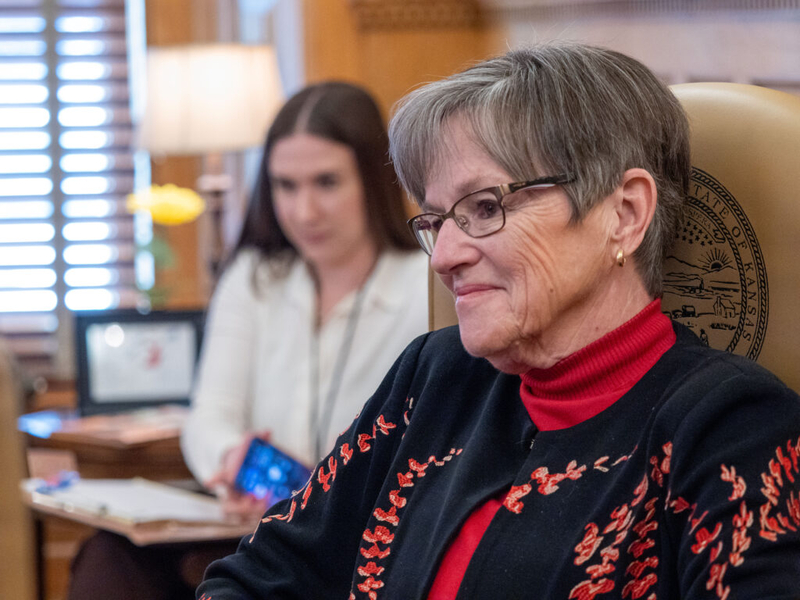
Gov. Laura Kelly answers a reporter's questions during a Feb. 24, 2026, interview in her office at the Statehouse in Topeka. (Photo by Sherman Smith/Kansas Reflector)
TOPEKA — Gov. Laura Kelly remains the most-liked politician in Kansas, as public support crumbles for U.S. Sen. Roger Marshall, President Donald Trump, the Republican and Democratic parties, and politics at large.
The Docking Institute of Public Affairs at Fort Hays State University released its annual Kansas Speaks survey on Monday, which examines public opinions about politicians and a wide range of topics.
The survey found found unwavering support for Kelly, the two-term Democratic governor who will leave office in January, with 46.9% of state residents satisfied with her performance. That level and consistency of support makes her an outlier when compared with Republicans such as Marshall, whose approval fell from 34% in 2024 to 26% this year, and Trump, whose approved dropped from 43% last year to 33% in this year’s survey.
Alex Middlewood, who chairs the political science department at Wichita State University, and Michael Smith, a political science professor at Emporia State University, provide questions for the survey and analyze the results. Middlewood said she was surprised by Kelly’s approval rating, especially after Sen. Ethan Corson, the candidate she endorsed for the Democratic nomination for governor, lost the primary.
At the same time, the survey found high levels of distrust in Congress and national politics. Even 26% of Republicans say they aren’t happy with Marshall, and 21% of Republicans don’t like Trump.
“It is certainly not a good result for a democracy,” Middlewood said. “As a political scientist, of course, I would hope that that spurs people to actually participate in this election. But there is so much voter apathy, and when you have high levels of corruption, or perceptions of corruption, like that, and you have high levels of dissatisfaction, what often happens is that people just don’t participate because they don’t think that their voice matters. They don’t think that voting is going to change anything. Where, again, as a political scientist, that is not true.”
She said those who participate in politics see how they can make change and have higher levels of trust in government.
“When voters have distrust, they’re less likely to participate,” she said. “And so, it’s really this mutually reinforcing cycle where people don’t participate because they don’t have trust. But then they have lower levels of trust because they’re not participating and they’re not seeing any change.”
On the issues
The weighted online survey results are based on 603 adults who answered 57 questions between Sept. 23 and Oct. 16. They survey examined attitudes on quality of life, economy, sin taxes, Medicaid expansion, family and medical leave, marijuana, abortion, immigration, education, homelessness, guns, petition initiatives, and data centers.
“Ours is one of the first honest-to-goodness public opinion surveys I’ve ever seen asking people about data centers in a way that’s not clearly meant to lead toward a preferred answer for an interest group, pro or con, and I think that’s kind of a big deal. I’m kind of proud of that,” said Emporia State’s Smith.
The survey shows most people are wary of data centers.
A little more than a third said they were aware of a proposal to put a data center in their community. Most were concerned about energy and water usage and the AI made possible by data centers. More than 40% were concerned about data centers being targeted by terrorists or foreign governments, as well as the heat they generate, land use and noise. About one-third were concerned about new solar installations to power data centers.
About 40% said they thought data centers would have a negative impact on the economy in the community where they were located, while 30.5% anticipated a positive impact.
“In communities like Emporia and others, there are people organizing against the data centers,” Smith said. “And the argument you’re always going to get is, well, that represents the activists. You get a couple hundred people at a town hall meeting in a town with a population of 20,000 … it’s a tiny percentage of the population. Now we have data about just regular folks, not activists, and overwhelmingly, it’s showing they’re pretty concerned about data centers.”
On other issues:
- About two-thirds support Medicaid expansion, but only about one-third say they think about it a lot as a political issue.
- About two-thirds support legalizing medical marijuana, and nearly 60% support recreational use.
- Most people had favorable views of “legal immigrants,” while 42.8% believe “illegal” immigrants are a danger to public safety.
- About 75% were comfortable with supporting K-12 schools with their tax dollars, and 53.8% said funding education was more important than cutting taxes. About 37% preferred to cut taxes.
- Most Kansans don’t think people should be able to carry a handgun without a license or permit. They also don’t want guns on college campuses. Wide majorities support keeping guns from people who are dangerous to themselves or others. They also support background checks on sales at gun shows. About 42% said there was a gun in their houses.
- Nearly 69% support paid family and medical leave, while 11.4% oppose.
- A little more than 51% support giving Kansans the ability to place questions on the ballot through petition initiatives, while 12.2% oppose the idea. When informed that bordering states have petition initiatives, 58.4% supported the idea while 7.7% were opposed.
Kansas life
About half of the survey respondents said Kansas is a good or excellent place to live, a less favorable view than in past years, while 14.4% said they plan to leave the state.
Few people think the state’s economy is good. About half think it is getting worse. And when asked to rank the most important issues, 45% said the economy was No. 1.
“We wanted to ask, are people actually feeling the economy in their cost of living and what they are paying week to week,” Middlewood said.
The answer: “Kansans are feeling higher cost of living, and so we can make the assumption” that it will influence their votes, she said.
Topeka, KS