As South Texas Republicans brace for losses, Ryan Guillen’s career offers a possible roadmap back
Oct 26, 2026 | 6:00 am ET
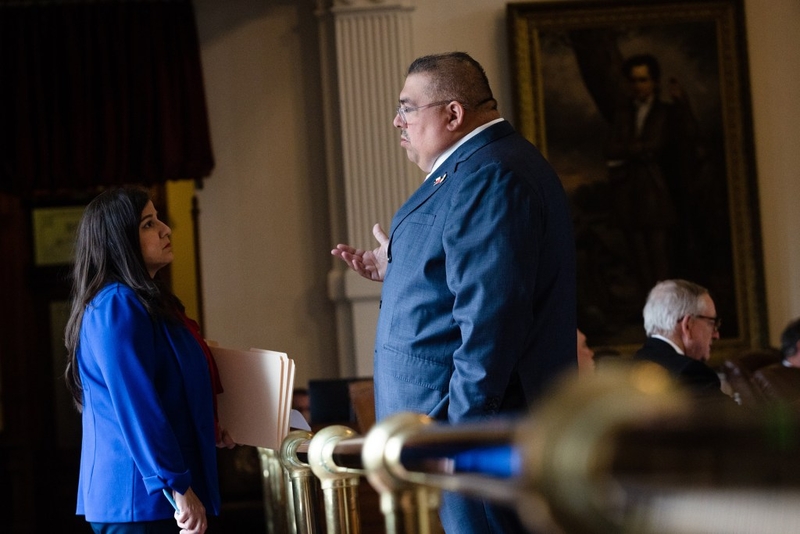
Description
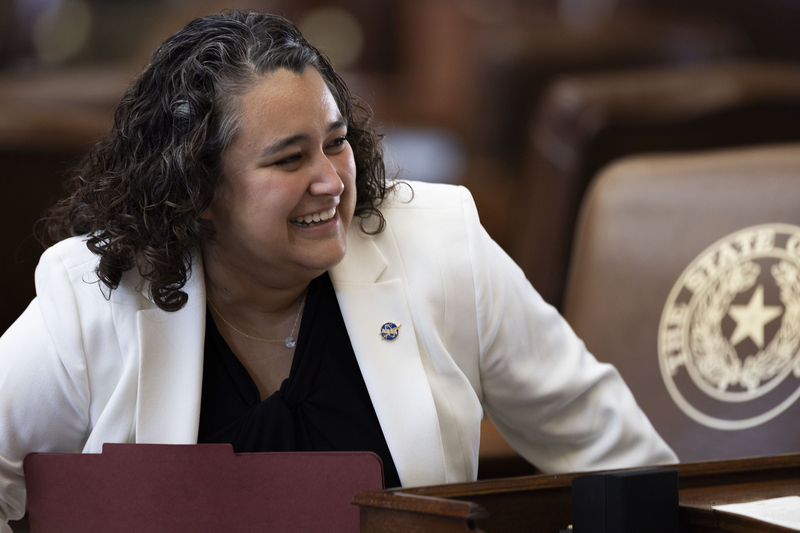
State Rep. Ryan Guillen, R-Rio Grande City, speaks with an aide on the House floor at the state Capitol in Austin on May 22, 2023. (Evan L'Roy/The Texas Tribune)
No pocket of the country better captured the Republican Party’s courting of Latino voters two years ago than South Texas’ Starr County, a border community that’s 97% Latino and in 2024 voted for a Republican presidential candidate for the first time since 1896.
On Nov. 3, most polls suggest, many of the voters who drove that shift may revert back to the left.
“There’s gonna be a correction. There’s no question about it,” said state Rep. Ryan Guillen, a Republican whose district is anchored in Rio Grande City, the Starr County seat. “There will be a shift. To what degree? That’s the big question.”
For a quarter century, Guillen has sat at the forefront of South Texas politics. He leads the Texas House’s Hispanic Republican Caucus, but spent almost two decades as a Democrat in the Legislature before switching parties in 2021. The move was a natural fit, albeit one that came with initial apprehension, for a lawmaker who advocated for more border security money as a young lawmaker and supported the state’s near-total abortion ban as a veteran Democrat. Like much of the region he represents, Guillen leaned conservative before he associated with the Republican Party.
That distinction is at the heart of this year’s election in South Texas, a heavily Latino region that is again at the center of the political universe. Some Republicans read their 2024 gains there as an embrace of their party, while others in the GOP say it was a sign of voters rejecting then-President Joe Biden’s handling of the economy and the border, rather than a wholesale embrace of MAGA politics. What’s clear heading into November’s midterm elections is that Latino voters are poised to abandon the Republican Party to an extent. If that comes to pass, Guillen’s career and centrist brand may provide a roadmap for the GOP to regain that lost ground.
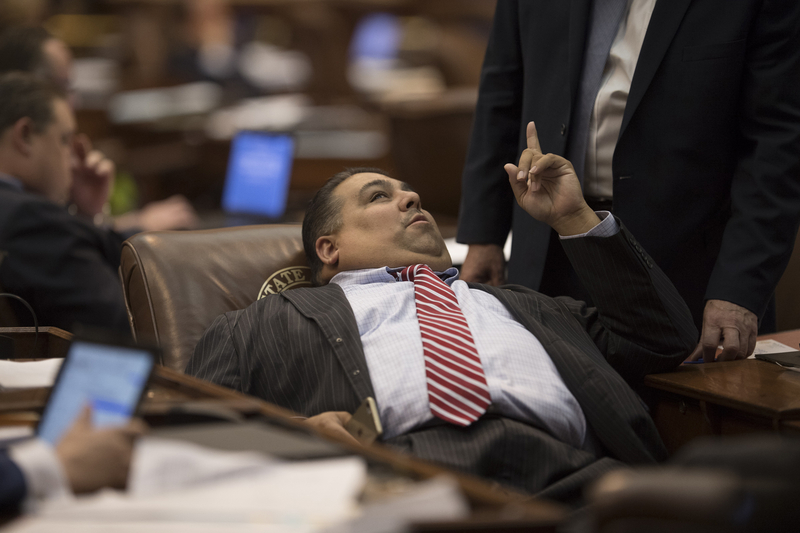
The 48-year-old is regarded by his colleagues as a workhorse who has maintained strong relationships across the aisle, evident in the 22 bills he passed last session — tied for the top mark in the House. He takes pride in passing nonpartisan legislation that tackles constituents’ problems, while also casting his vote for socially conservative policies championed by his Republican peers.
“He’s a level-headed man,” said former House Speaker Dade Phelan, a Beaumont Republican who spent months persuading Guillen to switch parties. In Guillen’s first term as a Republican, Phelan tapped him to chair a high-profile panel created to oversee firearm proposals in the first session after the Robb Elementary School shooting in Uvalde. “And I think he did — I know he did an excellent job.”
Guillen’s reputation as an unflappable moderate stands in sharp contrast to the MAGA firebrands at the top of this year’s GOP ticket. Ken Paxton, the Republican nominee for U.S. Senate, has run a campaign against Democratic nominee James Talarico hedged on a bet that voters want to hear about Talarico being too radical on every issue from trans rights to his diet, which Republicans incorrectly accuse of being restricted to plant-based foods.
Guillen, himself up for reelection, is measured in his prediction and thinks that the repercussions in store for the GOP would have been felt by whichever party was in power under the current economic conditions. As he sees it, Republicans are in charge in Austin and Washington, so they will receive the blame.
But bigger picture, Guillen said, people in the region are conservative, and the GOP’s baseline with South Texas Latino voters remains higher than it was before the recent rightward shift.
“Overall, I believe they are very much in favor of candidates and people that they like, that they appreciate, that they trust, that they can work with — and that goes much farther than a party label,” he said. “And as long as that’s the case, I think we’re gonna be OK.”
Jason Villalba, a former GOP state lawmaker who was once seen as a symbol of the party’s growing appeal to Latinos, now leads the Texas Hispanic Policy Foundation, which studies Hispanic Texans’ voting patterns.
As Villalba sees it, Republicans mistook their success two years ago as an endorsement of culture-war politics and Donald Trump. Instead, he sees Latino voters who were upset over their pocketbooks and what the GOP came to describe as an “open border.”
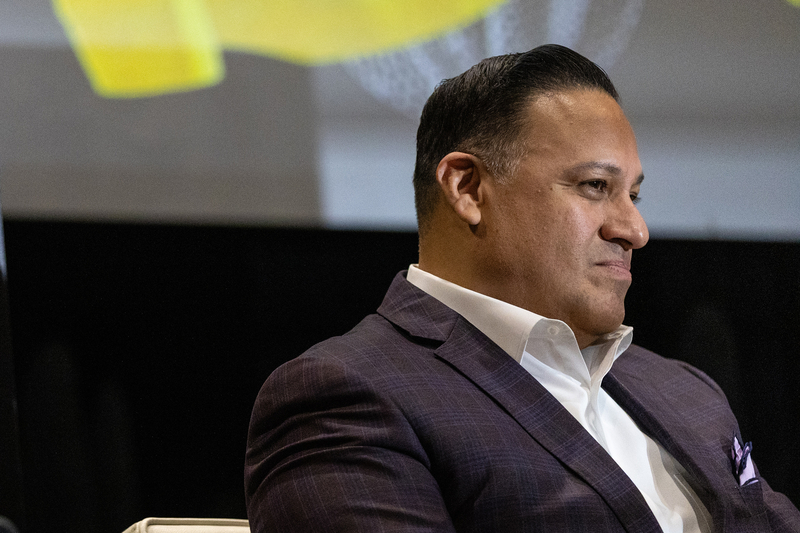
“There’s no question that Hispanics are not beholden to one party or the other,” Villalba said. “They don’t vote based on the color of the jersey, you know, they vote based on who is able to best benefit the community and the family in a meaningful way that has an impact on the family checkbook, and on issues like inflation, and education, and jobs.”
Trump vowed to deport the “worst of the worst” criminals and bring down the cost of living. Nearly two years into his second term, many of the same voters have seen their neighbors deported and higher prices at the pump and grocery store.
Guillen’s House District 31 stretches from the border in Zapata and Starr counties all the way north to San Antonio’s southeast suburbs. Its most common jobs are in education, healthcare, social services, retail and construction. Roughly seven out of 10 residents are Hispanic.
Across the Rio Grande Valley, business leaders report empty construction sites and unfinished projects since Trump returned to office. Educators have been counting vacant desks, as children skip school out of fear of being swept up in immigration raids. Small-business owners say fewer Mexican tourists are crossing into American border towns to buy their goods.
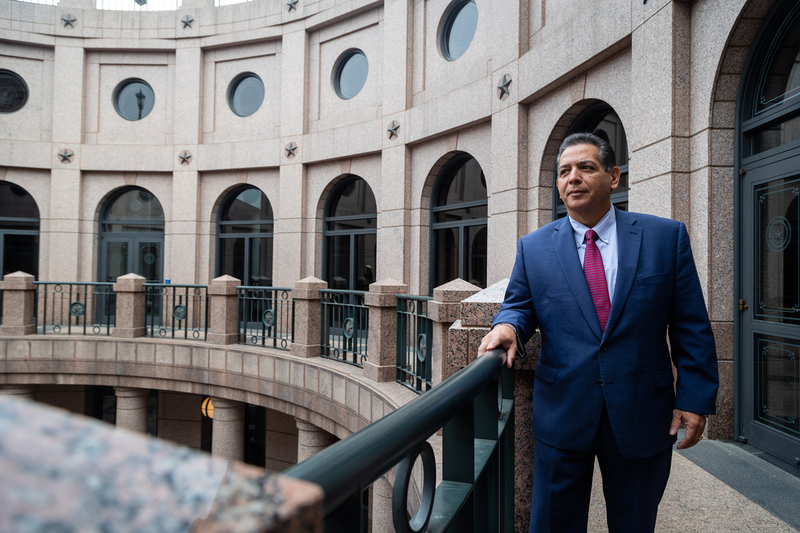
“The party has to really look at how it’s affecting the Hispanic voter,” said state Rep. John Lujan, a San Antonio Republican whose district abuts Guillen’s — whom he described as a mentor-like figure. “I’m pro-United States, I’m pro-Texan, and I want people coming in the right way and stuff. But man, we gotta do things differently than the way we’re doing it right now.”
Lujan, who relinquished his San Antonio-area House seat for an unsuccessful run for Congress, said that since he lost his primary, more people have approached him with a version of the same confession: “Hey man, let me tell you, I voted for you, but man, I don’t know if I can continue on with your party because of this.”
In some corners of House District 31, Guillen said, residents see the Trump administration’s immigration crackdown as a “job well done.” Elsewhere, people feel “it was done in a very extreme way that was unnecessary.”
“I think there’s valid arguments on all sides,” he said.
Holding the line
Guillen still campaigns like he’s going to lose, and he advises younger Republicans to do the same, those GOP peers said. Consider state Rep. Denise Villalobos, one of Democrats’ top targets in South Texas.
The Republican flipped her Corpus Christi-based district, whose eligible voting population is 71% Hispanic, two years ago by outperforming the top of a ticket led by Trump. Of the more than 80 Republicans in the Texas House, Villalobos knows she is the “No. 1” target for Democrats. And of all the endangered GOP incumbents, she said, Guillen is helping her the most.
He’s been sharing tips and tricks from decades in politics. He told her sending constituents birthday notes can go a long way. She did, and learned “it goes miles.” As graduation season approached last spring, Guillen helped her track down graduating seniors and make them mini diplomas.
“Things like that that you can do to truly connect with your community, that the big political machines don’t think of every day that aren’t like traditional campaigning — it’s just connecting with your voters,” Villalobos said in an interview. “Ryan really drilled in us how important it is to continue to stay present within your community — even once elected, even if it’s not the campaign cycle yet.”
Guillen has also given Villalobos $67,100 through his Frontera Texas PAC, a significant chunk of the $905,100 she has raised this year to protect her seat. As of early October, Gullen’s PAC had also given $92,500 to state Rep. Janie Lopez, a San Benito Republican also near the top of Democrats’ target list and, like Villalobos, a recipient of Guillen’s counsel.
The help may prove insufficient. Down-ballot candidates in competitive contests are often the most exposed when their party performs poorly at the top of the ticket. In 2018, when then-U.S. Rep. Beto O’Rourke came within three points of unseating U.S. Sen. Ted Cruz, Democrats flipped 12 seats in the Texas House.
Recent polls have shown Talarico leading Paxton among Latino voters by wide margins with upwards of 60% support from the bloc. A handful of surveys have been more measured, suggesting a smaller leftward shift.
In interviews, Lopez, Villalobos and state Rep. J.M. Lozano, another Hispanic Republican from the region, said they are banking on their constituents knowing them and their records.
None downplayed the risk of losing Latino voters.
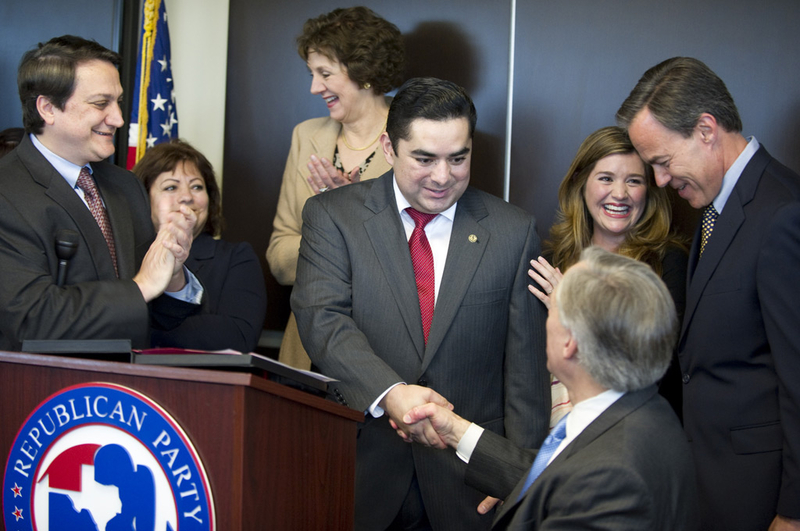
Lozano, who like Guillen was once a Democrat, called the Republican Party’s outreach to Hispanic voters “anemic.” Following Cruz’s near defeat in 2018, he said, he started ringing alarm bells to donors and power brokers, warning that the party needed candidates who cared about growing the GOP, not just appealing to a base that votes in primaries.
“There might be some bad losses this November,” Lozano said. “I pray that AG Paxton wins in November. The only reason why is because I don’t want to see Texas turn blue. That’d be the beginning of it.”
Rooted in Starr County
Guillen grew up both in the Rio Grande Valley and at the Texas Capitol.
He was first elected in 2002, at 24. He had followed his father into teaching agriculture and later running the family feed store. By then, the Guillens were local fixtures in the ranching community. When Guillen’s mother, also a teacher, died in a crash, Guillen and his sister sued Firestone over faulty tires, a case locals still remember. The siblings eventually reached a settlement with Firestone.
“They’re very beloved,” said Claudia Alcazar, 58, who was the Starr County GOP chair when Guillen switched parties. Guillen’s father taught her agriculture and she remembers him as a “real stand-up-straight, good old boy, you know, cowboy — a real one.”
Guillen grew up in that mold, she said, noting that he “does a lot for the community.”
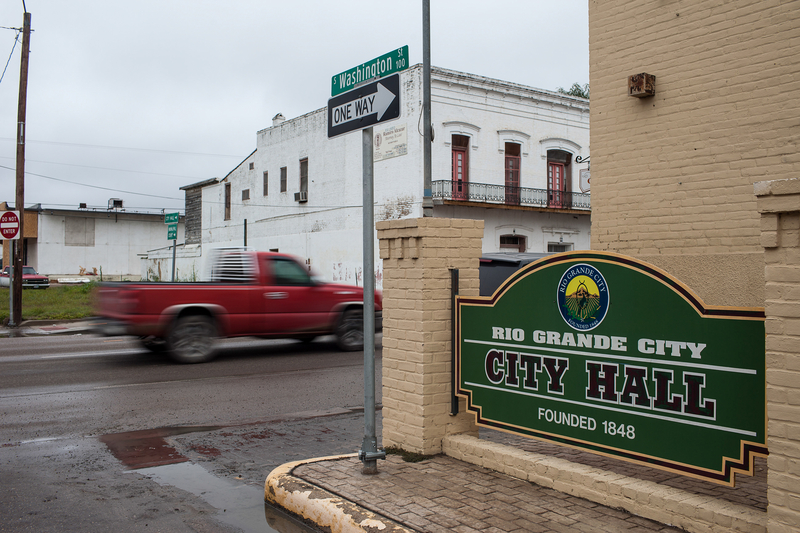
Guillen’s priorities haven’t changed much since he first ran. He campaigned on border issues and school finance and told a reporter during his first session that his top priorities were the budget and improving economic conditions.
“I have bills I want to carry, but a big part of my job this year will be trying to preserve the state services that go to my district,” Guillen said at the time. “I want to do the best job I can for my district and the people of Texas.”
At the Texas Democratic Party’s 2004 convention, party leaders held up Guillen, along with fellow Texas House members Joaquin Castro and Trey Martinez Fischer, as the future of the party. Castro is now a congressman and Martinez Fischer has been a leading Democrat in the state House, where he still serves. (Asked for an interview for this story, Martinez Fischer responded in a text: “Not sure you can print what I would say.”)
“The only difference between when he got there and now is he knows a hell of a lot more,” said state Rep. Richard Peña Raymond, a Laredo Democrat who has sat next to Guillen on the House floor since January 2003 — a state record for deskmate longevity, they both say.
Their families go back generations, and in the Capitol, Raymond and Guillen are often next to each other on the center of the ideological spectrum, too.
“He’s about as easy to work with as anybody,” Raymond said. “He’s gonna want to work with you. It doesn’t matter who you are.”
The party switch
The biggest difference between then and now, of course, is Guillen’s party.
After the Legislature redrew state House districts in 2021, the Democratic legislator was convinced he should retire instead of running for a district reconfigured to be more Republican, he said. For months, Phelan tried convincing Guillen to switch parties instead.
“Every speaker wants to have a party switcher,” Phelan said, recalling that he also understood the veteran lawmaker’s reservations. “If you were at the Dallas Cowboys for 20 years and you go to the Philadelphia Eagles, that’s probably tough, right?”
Guillen said he backed out “probably four or five times.” He worried about surviving a modern GOP primary after being a Democrat for so long, how his constituents would take it and what it would mean for his family. The last call with Phelan worked.
“I’ve always been very conservative. You know, I felt it was the right time,” Guillen said.
Boosted by a flood of money from Republican donors and support from GOP state leaders, Guillen survived a primary challenge and coasted to another term. Among his new donors was El Paso businessman Woody Hunt, a longtime GOP donor who gave him $10,000 in 2022.
“His focus on economic opportunity and our state’s future are priorities that matter to me,” Hunt said in a statement. “I’m pleased to support public servants who are committed to strengthening our communities.”
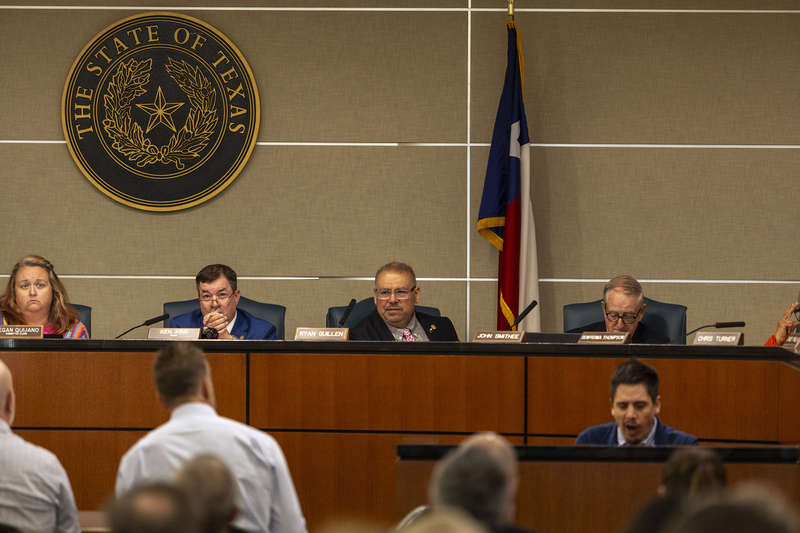
In his first session as a Republican, Guillen played a crucial role in firearm and immigration legislation. On top of chairing the special gun committee, he carried a key Republican bill to create a state border force that ultimately did not pass, yet drew him early criticism from previous allies.
Phelan said Guillen’s personality, conservative bonafides and South Texas roots made him the ideal candidate for the assignments.
“I think someone in that area of the world needed to shepherd those issues through,” he said. “That was a very sensitive subject matter at the time.”
Mark Jones, a Rice University political science professor, said that “if we were going to look for one person to represent the center of the ideological spectrum in the Texas Legislature, it would be Ryan Guillen.”
“The prototypical South Texas politician finds himself or herself to the right of most of their colleagues in the Democratic Party or to the left of most of their colleagues in the Republican Party,” Jones said. “And that reflects what South Texas voters like to see.”
Disclosure: Rice University has been a financial supporter of The Texas Tribune within the past five years. The Texas Tribune is a nonprofit, nonpartisan news organization that is funded in part by donations from members, foundations and corporate sponsors. Financial supporters play no role in our journalism. Find a complete list of them and more information about our financial and disclosure policies here.
Austin, TX