In a quiet Maryland election year, all eyes turn to Lower Shore district
Oct 26, 2026 | 6:48 am ET
Description
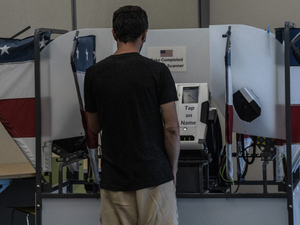
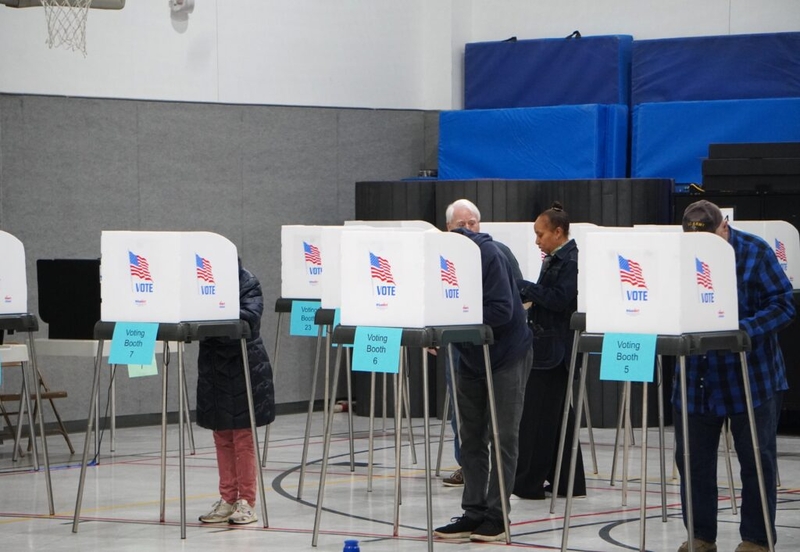
Voters cast their ballots Thursday at Honeygo Community Center in Baltimore County. With few competitive races on the ballot, attention is turning to the more competitive legislative subdistricts. (Photo by William J. Ford/Maryland Matters)
Across the U.S., the upcoming election is being described, by American voters and pundits of every political stripe, as an existential exercise.
In Maryland, not so much.
Here in this mid-Atlantic land of Middle Temperament, there are no competitive statewide elections. Only one U.S. House race has garnered attention in recent days, but only because of Rep. Andy Harris’ (R-1st) combative behavior after a contentious public forum, but that’s unlikely to affect the outcome.
The fate of the ballot measure impacting Democrats’ ability to gerrymander Harris into oblivion in a future election is uncertain. But there is no conceivable circumstance under which Democrats lose their 34-13 edge in the state Senate or their 102-39 advantage in the House of Delegates.
Even with most contests a foregone conclusion, however, there are still a handful of races for state House and Senate seats this year that are considered competitive and merit attention.
The hardest-fought House races are largely in subdistricts, with a smaller universe of voters – which potentially makes them more volatile and easier to influence.
One of those is District 38B in Wicomico County, where Wicomico County Councilmember Josh Hastings (D) is challenging appointed Del. Barry Beauchamp (R). Democrat Kamala Harris carried the district by 7 points in the 2024 presidential election.
Most General Assembly contests not likely to be competitive — again, experts say
The Beauchamp-Hastings race is taking place amid multiple political crosscurrents in Wicomico County, including an ongoing civil war between County Executive Julie Giordano (R) and some other area Republicans.
“I think people are interested [in the District 38B legislative election] even though there’s not a lot of up-ballot stuff that’s turning people out,” said Mike Dunn, president and CEO of the Greater Salisbury Committee, a civic organization that co-sponsored a candidate forum earlier this week.
But with so few competitive races on the docket across the state, it means the Beauchamp-Hastings election is getting an inordinate amount of attention from outside forces. It’s something the two candidates have discussed among themselves.
“We are a little uncomfortable with some of the attention that’s come into this race,” Hastings said during Tuesday night’s candidate forum, noting that most of the spending is coming “from the other side of the [Chesapeake] Bay.”
A super PAC looking to boost internet gaming in the state is investing heavily in the race to oppose Beauchamp and support Hastings – part of a spending spree in Maryland from the PAC that has topped $3 million overall and continues to rise.
The political arm of the Maryland State Education Association is also spending in the race, on Hastings’ behalf. House Republican and Democratic campaign committees are similarly involved.
Beauchamp, 65, a local businessman and member of the Wicomico County Republican Central Committee, is a political ally of Giordano’s. He was appointed to the House in September 2024, after then-Del. Carl Anderton (R) joined Democratic Gov. Wes Moore’s administration in an economic development role.
Hastings, 44, is seeking to retake the House seat that former House Appropriations Chair Norman Conway (D) held for 28 years until he was ousted by Anderton in 2014. But in an interview, Hastings eschewed partisan arguments.
“The broad public despises the two-party system and what it espouses,” he said. “We need to focus on democracy more than political parties.”
Hastings said he would sponsor legislation to create open primaries in Maryland and said he plans to vote against Question 3, the ballot question that would make it easier for legislative Democrats to redraw the state’s congressional map mid-decade.
Beauchamp in an interview and in public appearances has made similar claims to bipartisanship. During the forum this week, he explained that he was wearing a purple tie because he represents all of the constituents in his district.
“You serve everyone when you’re serving in this seat,” Beauchamp said.
He also noted that in his “gerrymandered” district, “I start 7 points behind,” and has to tailor his message accordingly.
Hastings, a two-term councilmember who has worked in agriculture and for conservation organizations, is touting his resume and 400-year family history on the Lower Shore. He argued that he is uniquely equipped to deliver for the district given his ties to and history of working with Democrats, Republicans and political independents. He said his principal focus if voters send him to Annapolis will be affordability and economic development.
But Hastings conceded that he could benefit from the current political environment, with growing voter antipathy toward President Trump and some of the local Republican infighting – which could jeopardize Giordano’s bid for a second term as county executive, even though she’s currently favored to hang on.
In his social media posts, mailers and digital ads, Beauchamp has vowed to protect farmers and watermen and to preserve an Eastern Shore lifestyle that he implies is threatened by Annapolis politicians and bureaucrats.
“Truth is, I could sit in that machine with my dog over in the shade, and that’s the perfect life,” Beauchamp said in one Facebook post, which features a picture of him operating heavy construction equipment. “Instead, I am choosing to serve my community when they need me most. I’m not doing it for a title. I’m doing it because the Shore deserves someone in Annapolis who has actually built things here and will fight to keep our way of life.”
He also argued in an interview that unlike Hastings, he already has a record of accomplishment in Annapolis, as a member of the House Appropriations Committee. “I feel like I have found my footing and have made some pretty good connections and have good relationships with people on both sides of the aisle.”
At the candidate forum Tuesday night, the audience at Salisbury University and watching on community cable TV could have been forgiven for not immediately knowing which candidate was the Democrat and which was the Republican. Only when it came to a conversation on taxes and spending did any significant differences on issues come through, with Beauchamp attacking State House Democrats for high taxes and onerous regulations.
Beauchamp also argued that for all of Hastings’ talk of political independence, the Democrat will have to follow the party line if he is elected to the House.
Each candidate has topped $100,000 in fundraising for the contest. Through Oct. 18, Beauchamp reported raising $111,937 and spending $75,256. Hastings raised $102,539 and spent $99,322. Beauchamp had more money available for the final days of the campaign, reporting $36,781 on hand as of Oct. 18 compared to Hastings’ $7,326 war chest.
The House Democratic Caucus Committee and the Republican House Caucus Committee are also sending literature to voters on their candidates’ behalf. The GOP mailer hits Hastings for his ties to Moore and other Western Shore Democrats.
But the race has been roiled by the heavy spending of American Future PAC, a national political entity connected to the internet gaming industry that supports Democratic legislative candidates across the country. Through Oct. 20, the PAC has reported spending at least $202,630 to defeat Beauchamp and another $38,687 to boost Hastings.
The PAC in its mailers argues that Beauchamp voted for measures in the House that will lead to property tax hikes and against programs that are meaningful for Lower Shore residents. Other spots seek to tie him to Trump. (The industry has a similar national PAC that supports Republican legislative candidates.)
Beauchamp has responded that his vote was against the overall state budget, because of its reliance on higher taxes and fees, not because he opposed particular programs or funding measures. He notes that Del. Sharee Sample-Hughes, an Eastern Shore Democrat, also voted against the state budget this year.
Early in his campaign, Hastings vowed not to accept corporate PAC money for this race – a pledge he says he has kept. The American Future PAC ad spending is being made independently of Hastings’ campaign – the two committees are not allowed to communicate – and enables Hastings to keep his promise even if he is benefiting from the corporate spending.
“I don’t even know who they are,” Hastings asserted in an interview. “But they certainly are working hard to make sure Mr. Beauchamp doesn’t return to Annapolis.”
Both candidates said they have talked with each other about the tenor and tone of the race – at the start of the campaign and in more recent days. Both vowed not to personally attack each other and both have marveled at the intensity of the attention their contest has received from outside groups.
But Hastings said he believes Wicomico County voters would be seeking change this year regardless of the heavy outside spending in his race.
“I think you’re going to see a very strong vote against the status quo in Wicomico County,” he predicted.
Annapolis, MD