Tolls on Mobile Bridge and Bayway project become election issue in coastal Alabama
Oct 26, 2026 | 6:01 am ET
Description
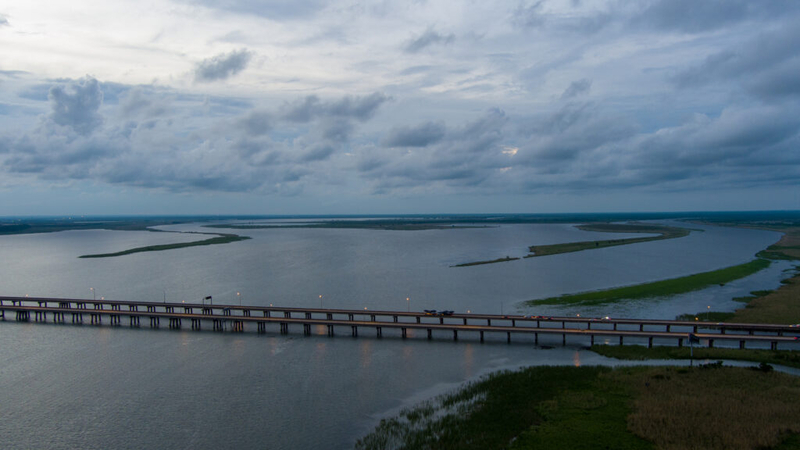
The Mobile Bay causeway and city skyline at sunset. A new Mobile bridge and Bayway is expected to be completed by 2031, but a plan to pay off federal loans with tolls has become a major issue in coastal Alabama as Election Day approaches. (Getty Photos)
If there’s one issue that can bring Democrats and Republicans together in coastal Alabama, it’s the plan to impose tolls on the new bridge and Bayway project to cross Mobile Bay.
Republicans equate it to imposing a tax that disproportionately affects locals. Democrats express concerns about placing an additional cost on the working class during a period of high inflation.
“I believe we have already paid for these roads with our federal tax dollars, our state tax dollars,” said Danielle Duggar, the Republican nominee for Alabama House District 96, in an interview on Wednesday.
Her opponent, Democratic nominee Terri Osborne, also opposed the tolls.
“If a toll has to be imposed, it should be as low as possible for the shortest amount of time, especially on the residents of Baldwin and Mobile counties who have to commute back and forth across the bay,” she said in an interview on Wednesday.
Local and state officials have recognized the need for another route for commuters to cross Mobile Bay since the early 2000s as traffic through the Wallace Tunnel, a key artery for Mobile, increased. The bridge would offer commuters another option and, ideally, relieve traffic in the tunnel.
The project is being funded with a federal loan; money from tolls would be used to repay it. While no tolls would be charged until the first phase is completed, expected in 2031, commuters and House Democrats from the area have concerns that the tolls automatically increase annually without a cap.
Former Mobile Mayor Sam Jones, now a Democratic state representative for the city, said he would not have preferred the toll either.
“I would think that with Mobile and Alabama being considered one of the reddest of red states, we shouldn’t have to pay a toll,” he said in an interview on Wednesday. “With our Congressional delegation in Washington, our Senate delegation, if we had Sen. (Richard) Shelby, we probably would not have had a toll, but now, someone is suggesting we borrow tax dollars and pay interest on our own tax dollars to get the bridge built. I have a problem with that.”
Other Alabama House Democratic candidates banded together to express their opposition to the tolls in a Facebook post.
“This bridge should be uniting the region, not putting a tear in our pocketbooks,” said Rep. Adline Clarke, D-Mobile.
The project
All agree that the new project is needed to address the traffic congestion along Interstate 10 at peak travel times. The project also aims to reduce roadway crashes, provide a direct interstate route, address the impact of the ships on traffic and minimize the effects of storms and sea level rise.
According to a grant application for the project, the Wallace Tunnel, built to accommodate about 35,000 vehicles per day, now sees 65,000 vehicles per day on weekdays. It increases to 75,000 vehicles per day on the weekends. By 2040, traffic is projected to be 95,000 vehicles per day.
The project aims to give commuters another option to cross the river. According to a fact sheet from ALDOT, the first phase of the plan is to build a bridge with six lanes, three in each direction, and to restripe the existing Bayway from four lanes to six. The second phase of the project would create a new six-lane Bayway.
“The one thing it does for the city of Mobile, it keeps from blocking the tunnels,” said Jones. “When you block the tunnels, you block up traffic in downtown Mobile, you back up traffic on the Bayway. It has a purpose, it is needed.”
ALDOT said in a statement that the tolls are necessary “for the project’s financial viability.”
“Its Phase I cost is roughly double the entire state of Alabama’s transportation budget, and rapidly rising inflation on construction materials further limits the state’s ability to fund the project without revenue sources,” the statement said.
The construction cost for the first phase is about $3.2 billion. Details and financing of the second phase of the project still need to be finalized. The project will be paid for in part by two federal grants totaling $675 million. ALDOT will contribute at least another $250 million.
The remaining amount will be obtained from a $2.52 billion federal loan called the Transportation Infrastructure Finance and Innovation Act. The tolls would service that loan and other debts associated with the project.
A long process
Residents and officials hesitated to impose user fees in the past. The project requires the metropolitan planning organizations to include the project in their transportation plans for it to move forward. In 2019, the Mobile Metropolitan Planning Organization had tabled a vote on the project. The Eastern Shore Metropolitan Planning Organization voted 8-1 to remove the project that prevented it from moving forward.
“It was that they were advertising that the toll would be $6 in each direction,” said Jack Burrell, Fairhope city councilman and chair of the Eastern Shore MPO, in an interview earlier this month. “There was no mention of a monthly pass.”
However, the MPO wrote a letter to Gov. Kay Ivey to resurrect it in 2021.
“The traffic congestion just to make a simple trip across the bay on a Friday or any given weekend, you have to plan for a couple more hours for your trip,” Burrell said. “I think the need to solve our traffic congestion was the reason that we needed to pursue a solution.”
Under the current proposal, commuters can pay for a $60 monthly unlimited ALGO Pass that will not increase in price for the first decade once tolls are in effect. Those who decide not to purchase the monthly plan but have an ALGO Pass who drive passenger vehicles will pay $3 per trip.
Commuters who do not have an ALGO account but use another system for paying tolls will pay $7.70. Those not on any plan will pay $15.40 per trip. No tolls will be implemented until the project opens in 2031.
Burrell said he was open to considering a toll but wanted it capped at $2.50 and pressed to preserve non-toll routes. He also wanted to remove the option for a public-private partnership.
ALDOT considered partnering with a private firm to help pay for the cost of the project and allow a firm to charge a fee for crossing the bridge, but that plan was abandoned.
“In that agreement, it was stated that they could toll any access across the bay, now and into the future,” Burrell said. “We found that totally unacceptable. With the new framework, that went away and we preserved toll-free options.”
Burrell also said he wants to ensure all toll money is used for the project and not disbursed to other spending by the state.
ALDOT said that toll prices will eventually increase to help pay for the federal loan. The monthly pass will remain $60 for the first 10 years but will increase after that. Other toll options will increase each year as soon as the toll takes effect. It will be either 5% or the change in the CPI for the south region, whichever is higher for the first 10 years. It will then be 2.5% or the CPI for the south region, whichever is greater, after that.
Republicans praised President Donald Trump for opening the financing option for the project.
“Thanks to President Trump and Secretary (Sean) Duffy’s leadership, we are seeing real progress,” U.S. Sen. Katie Britt, R-Alabama, said in a video on the ALDOT website regarding the project. “I have been proud to work alongside them to ensure that Alabama’s priorities are heard in Washington.”
Jones laid the blame for the cost and tolls on the president’s administration.
“I have been listening to the president say we have trillions of dollars in tariffs, let’s spend some of it on the bridge,” he said. “Let’s delegate some of that to infrastructure and put some of it toward the bridge.”
Local House Democrats in their video linked the toll to U.S. Sen. Tommy Tuberville, R-Alabama, because he helped secure the federal loan.
“We were promised a flat toll of $2.50, but Sen. Tuberville raised that to $3,” Jones said in the ad. “And now Trump’s new federal loan locks us into automatic increases based on inflation.”
The campaign for Tuberville referred the Alabama Reflector to an article from al.com that said Tuberville opposed the tolls and he would work to reduce them.
Duggar and Sen. Chris Elliott, R-Josephine, have proposed legislation that would give drivers a chance to claim a tax credit for tolls, capped at $15 million a year for five years.
Local officials are resigned to accepting the tolls to help alleviate traffic that continues to be a problem.
“We don’t want any tolls, but we understand the situation that we are kind of in,” said Daphne Mayor Robin LeJeune. “We hope that the federal government will come in with additional funding. We hope whoever the next governor is will work with the next ALDOT director and work to limit tolling.”
Montgomery