Golden built a reputation as an outlier, but his potential successors are taking a different tack
Oct 26, 2026 | 4:57 am ET
Description
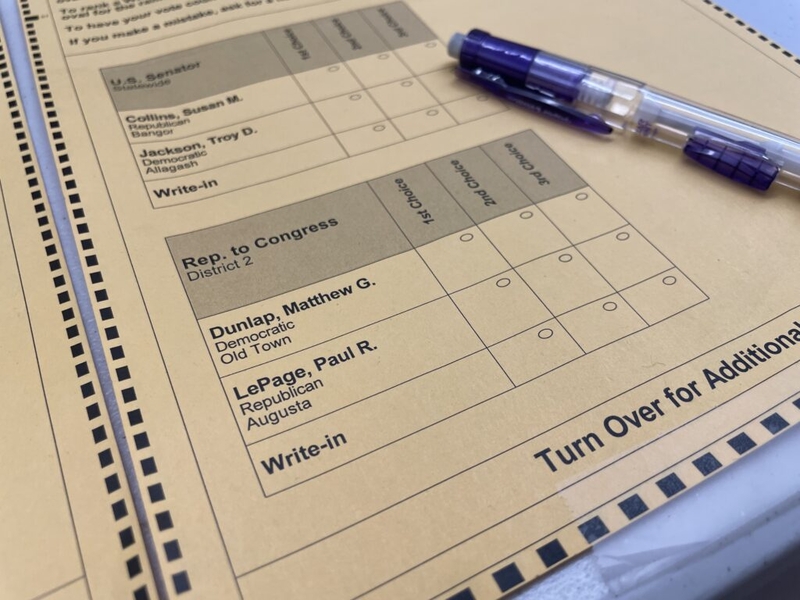
Maine's 2026 November ballot lists the candidates for the 2nd Congressional District, Democrat Matt Dunlap and Republican Paul LePage, along with space for a write-in candidate. (Photo by Kaitlyn Budion/Maine Morning Star)
Compromising the geographic majority of the state north of Augusta, the district has routinely split tickets, reelecting Golden while backing President Donald Trump each time he has run for president.
Much of that has been credited to Golden’s position as a moderate Democrat who works across the aisle, casting votes with Republicans more than the vast majority of his party. While occasionally angering Democratic House leadership, such as over his recent endorsement of a Republican colleague, Golden maintained strong party support throughout his four congressional elections.
In the Bangor Daily News op-ed announcing his decision not to run, Golden himself noted that the district has resisted national trends, writing, “as competitive as it is, it remains true that most people are neither diehard right-wingers or resistance progressives.”
But neither candidate seeking to replace Golden has tried to emulate his unique relationship with his party. Instead, Republican Paul LePage has campaigned hard on the backing of national party leaders. And while Matt Dunlap is more progressive than Golden on many issues, the Democratic party was slow to back him, and Dunlap hasn’t embraced their support on the campaign trail.
Golden did not respond to questions about his bipartisan approach or his potential successors, but in the op-ed announcing his retirement, he wrote, “I have spent almost eight years in Congress opposing the forces of polarization. This is critical to fair leadership in a district like Maine’s 2nd, where robust ideological diversity requires elected officials who are willing to represent the district as it truly exists — not as their party’s most vocal extremes might wish it did.”
In the conservative-leaning district, it will soon be apparent which approach voters prefer.
Golden himself was not impressed by Dunlap or LePage, writing last fall, when they were the only two who had announced their run, that they “are a far cry from being standard bearers of the generations that will inherit the legacy of today’s Congress.”
The race has implications beyond Maine, as it is one of a few dozen races considered a toss up or leaning slightly towards either Republicans or Democrats.
The Cook Political Report earlier this month moved the race in Democrats’ favor, now considering it leaning Republican, making it one of just 11% of House races considered somewhat competitive.
That uncertainty is drawing outside attention. Data from AdImpact, analyzed by the Wesleyan Media Project, found that from Sept. 28 through Oct. 11, $5.67 million was spent in the 2nd District. And of that, $4.53 million came from outside groups.
LePage and national Republicans
Numerous national Republican figures have made stops in Maine to campaign with LePage, lauding his experience serving two terms as governor. Throughout his campaign, LePage has also emphasized his relationship with President Donald Trump.
I know him personally, and I will say right now, I will be able to get into the Oval Office,” LePage said during the Oct. 1 debate. “My opponent will not.”
Across appearances, party leaders have offered effusive support of LePage and painted him as a common-sense Republican — even as they said LePage would be an independent voice for Maine.
During an August rally at the Bangor airport, Vice President JD Vance highlighted what he described as LePage’s record of combating fraud in state programs.
State and national Republicans have alleged widespread fraud in Maine’s healthcare programs and have tried to make it a key issue throughout the midterm campaign, despite the most recent federal review finding that Maine’s payment error rate was lower than the national average.
“I need the help, ladies and gentlemen,” Vance said. “You got to send Paul to help me.”
Minnesota Republican Tom Emmer, who serves as majority whip in the U.S. House of Representatives, similarly touted LePage’s experience during a roundtable discussion in September.
“The fact that you have already served, you have already stood in the crosshairs and dealt with these public issues, the fact that you would be willing to offer yourself again in this capacity … you guys know what’s right for Maine,” Emmer said.
And Republicans are doing more than just campaign appearances to support LePage. According to Federal Election Commission data on independent expenditures, several Republican political action committees are spending to boost his candidacy.
From September to mid-October, Elon Musk’s America PAC spent more than $160,000 to support LePage, and the No Going Back PAC, an affiliate of Trump’s MAGA Inc. super PAC, spent nearly $200,000 in support of LePage.
And in just one week this month, the Safety and Affordability PAC, another Trump affiliate, spent $3.5 million opposing Dunlap.
But even as those national leaders emphasize LePage’s support for the GOP’s agenda, they have also attempted to portray him as someone who would prioritize the state above the party.
“A guy like Paul LePage, he is not a go along to get along politician,” Vance said. “He is an independent-minded guy, but he is independent for you.”
And that’s a point that LePage himself has emphasized on the campaign trail. When asked in August how he would navigate a situation where Maine interests conflict with Republican priorities, he said constituents will come first.
“I navigate it for Maine businesses. Period,” LePage said. “And I spoke to Speaker (Mike) Johnson this week, and that conversation came up. I said I’m going down there, number one to help Maine business. Number two is to help the party.”

Maine Morning Star asked the LePage campaign how he would respond to voters who feel his closeness to party leaders conflicts with his independent rhetoric, and how LePage would follow Golden’s record of bipartisan work.
In a statement, campaign spokesperson Brent Littlefield pointed to the former governor’s record in office.
“Gov. LePage just this year worked with Congressman Golden to help pass legislation protecting Maine’s lobstermen and women,” Littlefield said, referring to a bill Golden introduced that would continue shielding lobstermen from new regulations to protect North Atlantic right whales until 2035.
Littlefield also said that as Waterville mayor, LePage worked with a Democratic city council as well as Democratic leaders when he served as governor, though that relationship was often fraught.
House Speaker Mike Johnson of Louisiana has also made two appearances in CD2, an August press conference alongside LePage and several fellow members of Congress and a Get Out the Vote stop in Bangor.
“There are a lot of people running for Congress this cycle,” Johnson said in August. “There is no one who is as qualified as this gentleman is … He’s one of the most qualified, competent people who have ever run for the House of Representatives in the history, since 1789.”
It’s a rebrand for a man who in 2016 called himself ‘Trump before Trump’ and has a history of controversial remarks, including some that made national headlines while he was governor.
In 2011, the state NAACP criticized the then-governor for turning down invitations to Martin Luther King Jr. Day events. In an interview, LePage responded, “Tell them to kiss my butt.”
In 2016, LePage left an obscenity-filled voicemail for a Democratic state legislator and later told reporters he would have liked to challenge the Democrat to an armed duel.
“And we would have a duel, that’s how angry I am, and I would not put my gun in the air, I guarantee you, I would not be (Alexander) Hamilton,” LePage told the Portland Press Herald at the time. “I would point it right between his eyes, because he is a snot-nosed little runt and he has not done a damn thing since he’s been in this Legislature to help move the state forward.”
And in 2022, LePage threatened to “deck” a Democratic Party staffer recording him on video.
But that was not the way Vance portrayed the former governor in Bangor.
“So I’m going to say very simply, my friends, everything that we’ve accomplished over the past couple of years, it could be undone if you send a lot of crazy people to Congress to fight against us,” Vance said. “Send Paul LePage to Congress, and let’s get to work to save our country.”
Johnson struck a similar tone during the campaign stops, describing the 2nd District race as “a contrast between common sense and crazy.”
“Paul LePage represents common sense,” Johnson said.
In his attempt to return to the Blaine House in 2022 , LePage sought to erase his fiery image, with the campaign presenting him as a more mellowed, policy-focused candidate. That has continued into the 2nd District race, with the former governor holding relatively few events with the press, often sticking to written remarks at those appearances and during the two debates with Dunlap.
When asked at an August press conference about a comment from Dunlap, LePage seemed to refer to his history of off-the-cuff, controversial statements as he paused in the middle of his response, and said, “I’m changing my habits here.”
Dunlap and Democrats
Across the aisle, Dunlap has had a much more tepid relationship with the Democratic Party — they opposed him in the primary and were slow to back him in the general election. And even though the party is now on board, Dunlap doesn’t tout that support as much as LePage, at times keeping the party at arms length, and is much more likely to focus on what he’s hearing from voters.
“I don’t really think Mainers are gonna get swayed by the same DC politicians who got us into this affordability crisis,” Dunlap told Maine Morning Star last week. “I have a good working relationship with the (Democratic Congressional Campaign Committee) and I’m grateful for their support, but I’m focused on the people of this district above anything else.”
Dunlap, the state auditor and former secretary of state, was at odds with national leaders even before he officially began his campaign.
When he was first considering his run last fall, national Democrats were reportedly irked that he would challenge Golden in the primary. And the DCCC, the official campaign arm of House Democrats, made it clear the group would support Golden.
And after Golden announced he would not seek reelection last November, national Democrats were still not on board with Dunlap. In December, a source familiar with Democratic recruiting efforts said the DCCC was still looking for the “strongest possible” candidate to represent Maine, eventually endorsing his primary opponent, Maine Sen. Joe Baldacci.
Dunlap criticized the DCCC for endorsing in the primary, and said the party was trying to influence the race.
“It’s undemocratic for national establishment Democrats to put their thumb on the scale in any primary,” Dunlap said in a May statement. “Just like in certain other races across Maine this year, they won’t decide this one — the people of Maine will.”
In the primary and the general election, Dunlap’s stances are not always in lock-step with the national party. He’s a strong advocate for Medicare for All, but doesn’t support gun control measures.
“People are obsessed with labels like progressive or conservative and I don’t think they’re really helpful,” Dunlap said. “I led a pro-Second Amendment group for sportsmen, and I probably own more guns than every member of my party combined in the House. But I also support Medicare for All because in a rural district like this, our healthcare system is failing us and leaving people behind.”

It’s another way that Dunlap has made it clear that he isn’t relying solely on the Democratic Party — its reputation or its support — to win the district. And Dunlap said he thinks that approach is an advantage in rural Maine.
“I’ve heard from thousands of voters, and I think people respect that I show up, I listen, and I’m gonna do my best to fight for them,” Dunlap said.
The primary ultimately went to a ranked-choice count, and although Baldacci led in the first two rounds, Dunlap came out ahead in the final round of tabulations, winning by less than three thousand votes.
However, the DCCC was notably slow to shift its support.
Jordan Wood, another primary candidate, posted a social media video in late July where he called out the party for not endorsing Dunlap, and said national Democrats were “f-ing up another race in Maine and they need to stop.”
“They are just sore losers, they’re upset that the candidate that they incorrectly backed in the primary lost,” Wood said. “And so they’re just ignoring our district. It’s sabotage.”
But at a press conference a few days later, Dunlap said he wasn’t concerned about it, making clear the campaign wasn’t waiting for a green light from the national party.
“I think people have been frustrated by the delays, but we are doing very well,” Dunlap said. “We’re very competitive. We’ve been doing well on the campaign trail with our fundraising and generating a little bit of support here and there.”
The DCCC eventually added Dunlap to the organization’s ‘Red to Blue’ program in late August, and endorsed him in the race.
“He’s the independent, Maine-first leader the Second District needs to lower costs, protect affordable health care, and stand up to the billionaires rigging the economy against working families,” DCCC Chair Suzan DelBene said in a press release.
And since, the party has shown up for Dunlap. According to Federal Election Commission data on independent expenditures, the House Majority PAC, the Democrats’ major super PAC, spent a whopping $7.1 million in the last month to oppose LePage.
But it’s not the only group spending on Dunlap’s behalf. The Campaign for a Family Friendly Economy and National Nurses United for Patient Protection have also been active in the District, underscoring that he isn’t relying solely on the party.
The Campaign for a Family Friendly Economy spent more than $450,000 in September and early October, and National Nurses United for Patient Protection spent $385,000 on digital ads and production last month.
Even with Democratic Party support, Dunlap doesn’t spend much time explicitly campaigning on it and at press conferences, debates and town halls, he is much more likely to turn the conversation to voters and their personal experiences.
“I’m gonna do what’s best for Maine, regardless of where my party stands on the issue,” Dunlap said. “Just last month a former GOP state senator was on local TV praising my work as auditor because I stood up to my own party when they got it wrong. That’s the kind of leadership I’ll bring to Washington.”

Augusta, ME