Voters will decide whether to expand a tax relief program for Georgia farmers
Oct 22, 2026 | 7:13 pm ET

Description
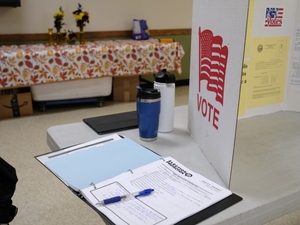
A voter card is inserted into one of Georgia's ballot-marking devices. Election workers in Bartow County, Georgia conducted their pre-election tests of the voting equipment on Oct. 6, 2026. Maya Homan/Georgia Recorder
Georgia voters will have a chance to weigh in on a ballot measure that would expand a property tax relief program to include those who own larger swaths of farmland.
The proposed constitutional amendment, which passed the Legislature in 2025 with broad bipartisan support, is the first question on the ballot. It would alter the Conservation Use Valuation Assessment, a tax relief program that allows farmers to pay property taxes based on the land’s productivity instead of the fair market value of the land, which could be much higher. Under it, landowners must keep the land in a qualifying use like agriculture or timber for 10 years in exchange for a reduced property tax rate.
If voters approve the constitutional amendment, owners of tracts of land up to 4,000 acres could be eligible. Currently, the tax perk is limited to farmers who own up to 2,000 acres. The average farm size in Georgia is 253 acres, according to the Georgia Farm Bureau.
Proponents pitch the amendment as a necessary adjustment to a program that was first approved by voters through a 1990 constitutional amendment to help family farms, many of which are multi-generational, grapple with rising land values and development pressure. Opponents question whether the program should be expanded to include larger operations or worry that schools and local governments could see decreased revenue as a result.
State Rep. Chas Cannon, a Moultrie Republican, said his own family has seen benefits from the original program. His family has owned the same tract of land since 1912, and he said that over the last 30 years his family has been able to avoid selling parts of their land for commercial use or redevelopment.
“We’ve been able to hold the tract together in its entirety over 114 years …. so you’re able to keep that land together. You’re able to keep it in conservation, and I think that’s a benefit to obviously our agricultural industry and to conservation,” Cannon said.
Cannon is also Colquitt County’s county administrator, and he said that if the amendment passes, it likely won’t have a major impact on local revenue. He said that most tracts over 2,000 acres, which aren’t very many, are likely taking advantage of the program by breaking up large farmland among other individuals, like family members, to qualify for the tax relief program.
“I think from the fiscal orientation, there really won’t be that much of an impact because, number one, there’s not that many family farms that are over 2,000 acres, and the second thing is that those that are very likely already have that land in some kind of CUVA. It’s just in a different LLC, but it’s related to the original underlying 2,000 acres,” Cannon said.
Adam Belflower with the Georgia Farm Bureau said updating the program is important because “that’s not an ideal way to have to do business,” saying that it adds layers of bureaucracy that add “headache or a barrier that you want to have to deal with.”
Ballot amendment would pave the way for dedicated funding to upgrade Georgia’s 911 system
“it kind of creates an extra level of burden on the landowner who’s trying to manage their asset portfolio,” Belflower said.
He added that only family-owned farms and individual taxpayers are eligible for the tax relief program and that large corporations and investors are barred from taking advantage of it. He added that while people tend to associate family farms with small operations, many family farms have grown to be large scale.
“There’s a lot of very successful family farms in Georgia that because of the commodity they grow, they just have a bigger operation to stay profitable. As margins get thinner; they have to scale, and they’ve got to cover more acres,” Belflower said.
According to the Georgia Conservancy, the program has been essential to preserving agricultural lands across Georgia and helping families keep their farmlands, especially at a time of soaring development that’s reaching rural parts of the state.
And while concerns were raised that many farms taking part in the program in rural areas of the state are not under threat of development like properties in more urban areas of the state, Belflower said that the program helps farmers make a profit on their land. He added that even in rural parts where there is less development, forces that could push a landowner to sell that land still exist.
“It might not be 2,000-home subdivisions like it is in metro Atlanta, but it may be a solar project,” Belflower said. “A lot of these counties down here in southwest Georgia have some of the highest acres of land going into solar of any part of the state. So there are still competing land uses and competing development uses.”
According to the Georgia Department of Revenue’s 2025 property tax administration annual report, nearly 200,000 parcels across Georgia take advantage of the existing tax relief program that together saw about $13.8 billion in property taxes eliminated in 2024. About $330 million had to be picked up by other taxpayers, like homeowners and businesses, so local governments could balance their budgets.
A spokesman for the state association that represents counties at the state Capitol said it’s unclear what impact the change would have on local government funding.
Tim Lowrimore, the head of the Georgia Forestry Association, argued that the 2,000 acreage limit is outdated. He said that because of smaller profit margins and more costly equipment, many successful family farms have had to modernize by scaling operations and consolidating land to remain competitive.
“The program’s acreage limit hasn’t changed since voters created it in 1990, even as land values and the pressure to sell have climbed. Amendment 1 would give more of those families the option to keep their land in farming and forestry rather than selling it for development,” Lowrimore said in a statement.
Atlanta, GA