Trump administration asks to reconsider Ocean City offshore wind permit
Oct 16, 2026 | 4:56 pm ET
Description
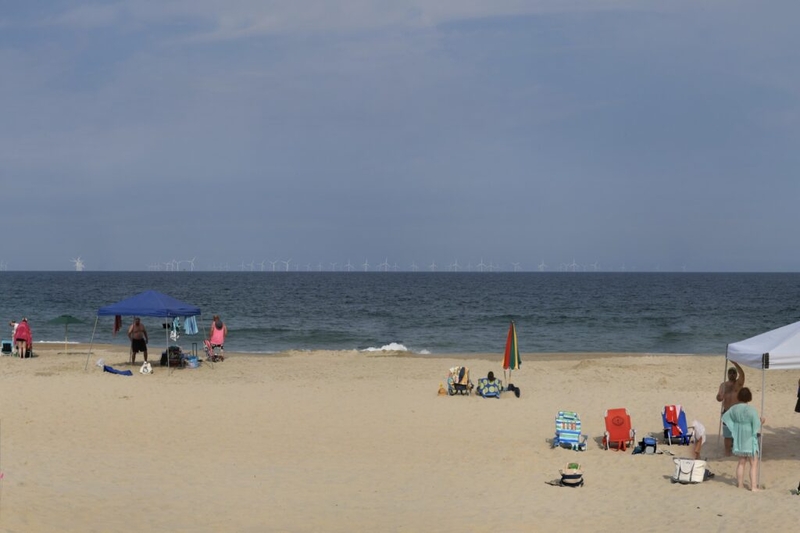
A simulation of what the US Wind windfarm might look like from 84th Street in Ocean City. (Screengrab courtesy US Wind)
Months after first threatening to do so, the Trump administration has officially filed a request to reconsider the construction permit it issued to an offshore wind project proposed off the coast of Ocean City, Maryland.
It’s just the latest episode in President Donald Trump’s battle against offshore turbines since returning to office last year. The Republican administration has halted coastal wind leasing, issued stop work orders to projects under construction and spent billions to buy back wind leases previously issued to developers.
When it comes to the Ocean City project, proposed by US Wind, the federal government is arguing that the project did not receive adequate consideration under a federal law known as the Outer Continental Shelf Lands Act.
In their filing, Department of Justice officials cited possible adverse impacts of the project on: the North Atlantic right whale, “scenic and visual resources, some commercial fisheries, and scientific research.”
The administration is requesting to remand the permit “without vacatur,” meaning it would remain in place while the Department of the Interior reconsiders it.
The request sits before Baltimore U.S. District Judge Stephanie Gallagher in a case originally filed nearly two years ago by the Town of Ocean City, opposing the construction permit for the project.
At first, the federal government defended its permit, issued by the Bureau of Ocean Energy Management, a subagency of the Department of the Interior. But after Trump took office, the feds did an about-face. In August, officials first signaled to Gallagher that they planned to request permission to reconsider it.
US Wind protested, asking Gallagher to issue an injunction preventing the federal government from revoking its permit. But Gallagher declined to do so, ruling that US Wind must “wait to see” whether the Interior Department “makes some decision that has some legal consequence.” Only then could US Wind challenge it, she ruled.
In a statement, the Town of Ocean City applauded this week’s filing from the Trump administration.
“The federal government has now told the court that its prior review and approval of the Maryland offshore wind project did not adequately address how the project’s significant impacts on ocean views, fisheries, marine life and other uses of the ocean are consistent with federal law,” the statement read. “Ocean City has raised these concerns from the start, and we welcome this acknowledgment.”
But US Wind said Friday it is “confident that a court will uphold” its permits’ validity, and “prevent any adverse action against them.”
“After over a decade of analysis, several federal agencies properly issued final permits to the project, which is one of the largest new energy projects in the region,” Nancy Sopko, US Wind’s vice president of external affairs, said in a statement.
In its filing, the federal government argued that the permit should be remanded because of the Outer Continental Shelf Lands Act, meaning a few of Ocean City’s other concerns with the project are moot.
But the government did take issue with Ocean City’s claims against the National Marine Fisheries Service. It argued that the court should drop the town’s claims against the agency, commonly known as NOAA Fisheries, calling some “blatantly inaccurate.”
The town argued that the agency did not adequately consider possible harm to the North Atlantic right whale because of the construction. But the federal government argues it did consider the possible impacts to the marine mammals — and determined they would be minimal.
While experts at NOAA fisheries acknowledged that the whales could “experience temporary behavioral disturbance and associated physiological stress resulting from construction noise,” their documentation states that “all of these impacts . . . are expected to be temporary with normal behaviors resuming quickly after the noise ends” and are “not expected to affect the long term health of any whale or its ability to migrate, forage, breed, or calve.”
The agency also required construction crews for the project to follow certain rules to minimize disturbance to whales, including seasonal restrictions on pile driving and the requirement to use noise attenuation devices.
In sum, the agency “sufficiently analyzed all potential impacts to [Endangered Species Act]-listed whales from the Project and reasonably concluded that the Project is not likely to jeopardize the continued existence of ESA-listed whales,” reads the filing.
Annapolis, MD