Ag commissioner candidates tackle tariffs, farm crisis, data centers during debate
Oct 16, 2026 | 5:00 pm ET
Description
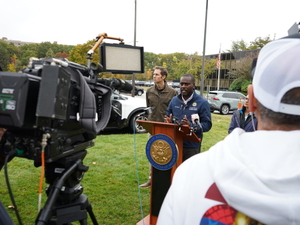
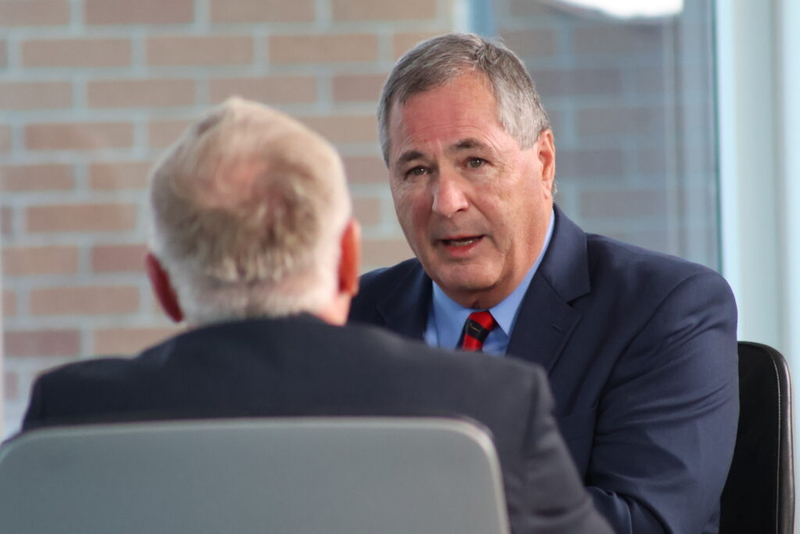
Republican Agriculture Commissioner Doug Goehring responds to his opponent, Democratic nominee Vern Thompson, during a debate on Oct. 13, 2026. (Photo by Jacob Orledge/North Dakota Monitor)
Republican Agriculture Commissioner Doug Goehring sparred with Democratic challenger Vern Thompson on tariffs, the farm crisis and more during a debate recorded this week.
The debate also crystallized a key difference in how the two candidates view the role of government when it comes to overseeing the development of data centers and other industries.
“The state of North Dakota has failed the people of North Dakota in this industry,” Thompson said. “People want government to work for them, not against them. And what’s happening right now is that government is working against them.”
Thompson has used the data center issue to gather momentum in his campaign to become the first Democrat elected to statewide office in North Dakota since Heidi Heitkamp’s U.S. Senate victory in 2012. He said during the debate, hosted by Rob Port and Chad Oban of the Plain Talk Podcast, there needs to be some basic regulation at the state level to help local governments navigate the permitting process for billion dollar projects like data centers.
Goehring said data center developers need to do a better job explaining the purpose of their facilities, what the infrastructure demands will be and what benefits the projects can bring to communities. But he also emphasized that the government should not get in the way of a private property owner who wants to develop their land.
“Respecting people’s private property rights also means we can’t stop you from doing certain things as long as it’s legal,” Goehring said.
Thompson said the rights of others affected by the project, such as nearby landowners or other community members, need to be respected and they deserve to have a say. He said local control needs to take precedence.
“A township should have the right to decide if they want industrial development in their township, irregardless of who sells the land,” Thompson said. “If we don’t have that, we’re losing part of the fabric that made North Dakota the state it is.”
Goehring said he is not a fan of NIMBY, or Not In My Backyard, attitudes that have led townships and other local governments to decide to exclude or place unreasonable restrictions on certain industrial development.
“It doesn’t respect private property rights. You can have reasonable and responsible zoning in place,” Goehring said. “We have to look at this, be balanced, reasonable, and we have to respect people’s ability and rights.”
Goehring is a third-generation farmer who has served as agriculture commissioner since being appointed in 2009. He has been elected four times. Thompson runs a trucking business in Fargo, spent years as a farmer and is a former state legislator.

Commissioner’s role
The candidates also disagree on how vocal an agriculture commissioner should be in proactively developing policy solutions. Thompson said Goehring and other statewide officials have failed the people of North Dakota on data centers and other issues, like the ongoing farm crisis, by not being more active.
“Nobody wants to do anything outside of their lane. Nobody wants to advocate. Nobody wants to work together,” Thompson said. “That’s how you solve problems. You work together. But right now, we have most everybody at the Capitol saying, ‘Well, I can’t do anything about it.’”
Goehring said the role of the executive branch is to “executive, implement and enforce,” and that the Legislature is responsible for setting policy in most circumstances. If state officials step outside of their lane, he said they can get called out in an audit report.
“Your wings are going to get clipped. The Legislature is very clear about what authority you have and what you get to do,” Goehring said.
Ag commissioner challenger highlights data centers; incumbent calls move ‘grandstanding’
The agriculture commissioner said he’s involved in discussions with the Bank of North Dakota and the Department of Commerce to build a potential framework for fertilizer incentives to help farmers. He said his advocacy is behind the scenes, working with different stakeholders in government to develop solutions.
“Those are things that everybody comes in with their different ideas. But you have to coalesce. You have to pull it together. You have to really figure out what works, what doesn’t work, and what you’re actually going to do,” Goehring said.
Thompson, who has proposed using the natural gas expected to power data centers for fertilizer plants instead to lower input costs for farmers, disagreed with the incumbent.
“I’m sorry, commissioner, you and the state of North Dakota have failed the people,” Thompson said. “I’m going to be out there advocating and talking to the people, and I’m going to use the bully pulpit that you haven’t used on this issue.”
Farm crisis and tariffs
Both candidates agreed the challenges facing ag producers in North Dakota constitute the worst farm crisis in 40 years, and that the tariffs imposed by President Donald Trump are part of the problem.
“I don’t have the patience for people sitting silently on the sidelines. If it was a Democrat that did what they did with the tariffs or went to war, I’d stand up and say, ‘You’re wrong,’” Thompson said. “I haven’t heard the commissioner stand up and defend the people that are impacted by this.”

Goehring, though he did not blame Trump, did condemn the tariffs and contradicted one of the president’s tariff talking points.
“Countries don’t pay tariffs. The consumer pays tariffs. I’ve made that point over and over again. It’s just a tax. It’s a different form of tax. So I have a lot of problems with it, and we’re trying to work through those things,” Goehring said. “We’re not happy about it, but these are the cards we’re dealt. So we’re going to try and work through it.”
He said he has responded by providing feedback to federal ag agencies and attempting to promote North Dakota ag products to trade contacts elsewhere. Thompson questioned whether that’s enough.
“Talking is good. That’s what we need. Communicating. That’s great. Where’s the plan? What kind of a plan have you got for the high cost of inputs in North Dakota?” Thompson said. “You, I believe, are a good person and could see this coming. Why didn’t you get ready for it?”
The agriculture commissioner defended his record, noting he worked with the governor to make red-dyed diesel available for use on highways in the state and that he was involved in the Bank of North Dakota’s ag relief loan program for farmers last year.
Goehring said farmers have to be “born of faith” to do their jobs in the face of all the market factors, from prices to weather, that they will never be able to control. Goehring, who was farming in the 1980s like Thompson, is optimistic about the future of agriculture and said investments into trade and research can help support farmers and ranchers in the state.
“When it comes right down to it, we’re a blessed and fortunate nation. We are the land of abundance,” Goehring said. “How do we build on that? How do we support farmers and ranchers? One way is continuing to look at research to support their opportunities, technology, innovation practices, systems, and also trade.”
North Dakota Monitor reporter Jacob Orledge can be reached at [email protected].
Bismarck, ND