Despite recent rain, drought has reached all areas of Maine
Oct 16, 2026 | 5:12 pm ET
Description
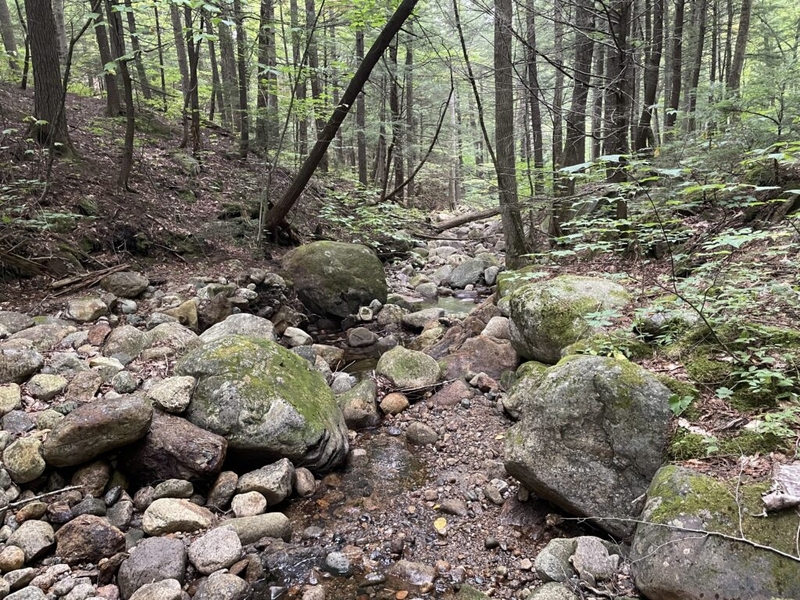
The Wheeler Brook stream bed with low water levels on Sept. 9, 2026. The Maine Drought Task Force reports that the state never fully recovered from the 2025 drought, which is now worsening drought conditions across the state. (Photo by Kaitlyn Budion/Maine Morning Star)
The latest precipitation across the state still was not enough to alleviate Maine’s statewide drought, according to the Maine Drought Task Force.
The task force convenes when abnormally dry conditions in the state compound with the aim of increasing communication and awareness. Members from state and federal agencies met Friday for the second time this year.
Since the task force last met in early September, drought conditions have expanded, now reaching all areas of the state. The latest report from the U.S. Drought Monitor, with data from Tuesday, had 4.64% of the state in extreme drought conditions, 43.10% in severe drought and the remaining 52.26% in moderate drought.
The conditions are already affecting the fall harvest for farmers, and there has been a rise in the number of dry well reports.
The midcoast region is experiencing extreme drought, with severe drought spreading wider across that area as well as much of Northern Maine.
Sarah Jamison with the National Weather Service said the current drought might feel different from last year’s, which came on more suddenly, but that doesn’t mean it isn’t as severe.
“What’s very different from this drought compared to the same time last year is you could step outside and see it and feel it,” Jamison said. “Now if you drive around and you look at the lakes and the streams, you can see it. But generally, your lawns aren’t too bad.”
But, Jamison continued, “if you look under the hood, that’s where the problem lies.”
Groundwater conditions
Nick Stasulis with the U.S. Geological Survey said that while the recent rain this week has boosted water levels in streams, it has not been enough to replenish the groundwater, and that’s a problem because it never fully recovered from last year’s drought.
Two monitoring wells in Oxford and Clayton Lake hit record low levels for October, Stasulis said. And both of those wells have more than 35 years of historical data. That means the current levels are falling below the levels from the 2000s drought, which is often considered the benchmark for severe groundwater conditions.
And Stasulis said he expects other groundwater monitoring wells to follow suit.
“So without any recharge, my guess is by November there’ll be even more wells setting that period of record streak,” he said. “We’ve had a lot of droughts. We’ve met a lot over the last 10 years, and this is the first time we’re actually starting to see records be set for groundwater conditions.”
Jamison echoed his point that the recent rain just isn’t enough to improve groundwater.
“We’ve been getting rain, all very, very beneficial,” Jamison said. “We’re seeing the effects of that at the surface level. We just need to get it down into the groundwater where we really, really need it. We’re fighting the seasonal declines in our groundwater too.”
Jamison looked at precipitation levels from Oct. 1, 2025 through Sept. 30, 2026, and found that different parts of the state got 5-18 inches less precipitation than normal.
And further back, from June 2025 to the present, Jamison said only three months in that period saw above average precipitation: April, May and June of 2026. The other 13 months were below average.
Looking ahead, Jamison said the amount of rain needed to exit drought conditions varies in different parts of the state. Northern Maine would need to see 150% of normal precipitation in the next two months or before ground frost conditions, central Maine would need 180% and Southern and coastal Maine would need 200% of normal precipitation.
And her colleague at the National Weather Service, James Sinko, said that relief doesn’t seem likely to come soon. Despite the rain Friday, he said the seven-day forecast doesn’t show a high chance of additional rain.
Further out, he said, El Niño conditions could impact winter weather, which usually means warmer and wetter conditions in Maine.
“So what that typically means is more rain, sleet, freezing rain events than we see for snowfall, and it also means we struggle typically to build a snowpack,” Sinko said.
The concern in Maine is if the ground freezes, rain can’t soak into the soil to replenish groundwater, and the snow won’t be melting into the ground come spring as the ground thaws.
“And that can be devastating when you don’t get a deep snowpack, so there are still some concerns in there that we’re worried about for any potential recharge that we need,” Sinko said.
On the ground impacts
Tom Gordon with the Maine Department of Agriculture, Conservation and Forestry said the impact on farms has been significant.
“We can really see a difference between the haves and the have-not as to whether the ones that have irrigation systems have done pretty well this year, the ones without, there’s definitely been impact on yield,” Gordon said.
Gordon said he doesn’t have economic data on the impact yet, but he thinks potato and apple crops have done well despite the drought.
Tommy Higgins with the U.S. Department of Agriculture said the agency’s farmer assistance programs are triggered by the length of a drought and its intensity, and many are already available to Maine farmers.
The Emergency Livestock Assistance Program is available to farmers in all 16 Maine counties, the Livestock Forage Disaster Program is available in 13 counties and the Emergency Conservation Program is available in 10 counties.
The agency is also anticipating a secretarial disaster declaration for seven counties in the near future, Higgins said, which triggers the availability of emergency farm loans.
Paul Styslinger with the Maine Emergency Management Agency said the organization has gotten reports of 156 dry wells this year, the vast majority of those reports coming in the last month — although that may be because of increased attention to the report, rather than changing conditions.
Paul Styslinger with the Maine Emergency Management Agency said the organization has gotten reports of 156 dry wells this year, the vast majority of those reports coming in the last month — although that may be because of increased attention to the reporting service, rather than changing conditions.
“Well driller wait lists were a top item,” Styslinger said.
Other members of the task force added that many well drillers are still working on the backlog of properties that ran dry last year, and there’s just not many people licensed to drill wells — and even among those who are, some are elderly and not actively working.
The delays are a challenge for the Farmer Drought Resilience Fund, Gordon noted, which provides grants to farms to reach new sources of water. The state funding for the program typically must be spent within the two-year budget, Gordon said. So if a driller is not available, the contract could expire and the funding may not be available for that farm again.
The task force is encouraging residents to report dry wells to the Maine Emergency Management Agency and other drought conditions to the National Integrated Drought Information System. The Drought Task Force website also has a list of resources available for residents impacted by the drought.
Augusta, ME