North Dakota officials are jumpstarting next phase of effort to boost Bakken oil production
Oct 16, 2026 | 5:30 pm ET
Description
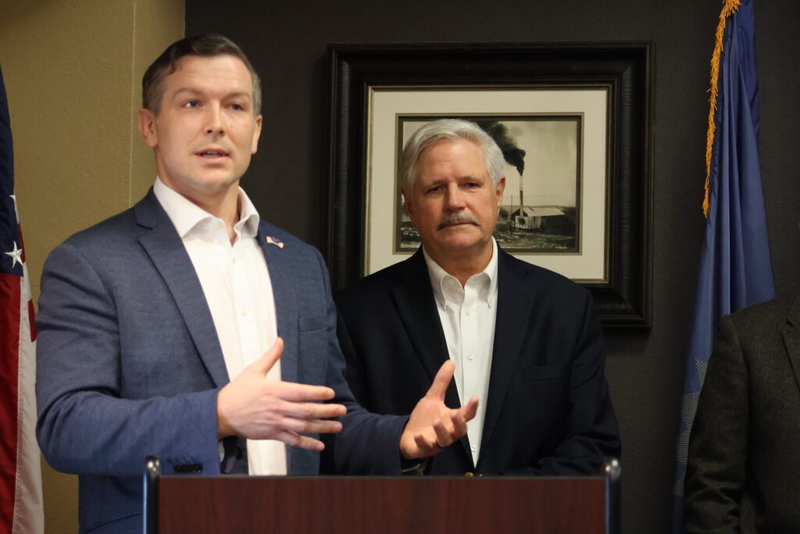
Kyle Haustveit, under secretary of energy at the U.S. Department of Energy, talks about the potential of enhanced oil recovery during a press conference hosted by the North Dakota Petroleum Council on Oct. 16, 2026. (Photo by Jacob Orledge/North Dakota Monitor)
A coalition of oil industry leaders, state officials and a U.S. senator are rallying support for the next stage of an oil field research project that could have a significant impact on North Dakota’s economic future.
The research centers on enhanced oil recovery, a collection of technologies that officials hope will double the amount of recoverable oil in North Dakota and extend the Bakken oil field’s longevity by decades.
“That’s an entire new oil boom without the infrastructure challenges,” said Gov. Kelly Armstrong. “This isn’t about the energy industry. This isn’t about western North Dakota. This is about the whole state.”
Sen. John Hoeven, R-N.D., is working with Under Secretary of Energy Kyle Haustveit, a Tioga native, to unlock $400 million in federal loan guarantees to help fund the expanded initiative.
Ron Ness, president of the North Dakota Petroleum Council, said he expects there to be an ask for state funding during the upcoming legislative session.
“This is the jumpstart for that discussion,” Ness said.
Enhanced oil recovery typically involves injecting a gas, like natural gas or carbon dioxide, into oil and gas formations underground in order to repressurize the reservoirs and increase the amount of oil that can be extracted. Oil companies have spent years testing the idea in small-scale pilot projects.
A coalition of government officials and industry leaders announced phase one of the current initiative in May. The $157 million effort involves six large scale pilot projects, planned to have 10 to 20 times the duration and volume of gas injections as earlier demonstrations, testing the technologies in the field.
Those projects are ongoing. Three of the projects are underway, a fourth has received a permit and two more are awaiting approval from regulators.
But the coalition is already working to launch the second phase of the effort. The goal is to secure funding for companies to move beyond single-well tests and implement the technology across a broader geographic area involving up to 200 oil wells.
“We can’t continue to just wait another year to see what happens on phase one wells. We think this resource is so great that we can move now, and I think that’s the essence of today,” Ness said. “Phase two is jumping over the top of phase one.”
North Dakota’s governor said they are proceeding with multiple phases concurrently, rather than a linear progression of one phase after another, in order to accelerate the development timeline.
“It’s all gas, no brakes. We need an all-of-industry approach. We need an all-of-government approach,” Armstrong said. “I can promise you that your grandkids will benefit from the decisions that get made in these projects over the next six months.”
Hoeven said the technology needs to be in widespread use by the end of 2032 because that is when a federal tax credit for the use of carbon dioxide in enhanced oil recovery projects expires.

Chord Energy, the largest operator in North Dakota and the only publicly-traded oil company that is exclusively focused on the Williston Basin, is part of the coalition of stakeholders. CEO Danny Brown said enhanced oil recovery is a fundamentally different approach to oil extraction than the techniques used in the Bakken today, such as drilling horizontally for miles and fracturing the rock formation.
“It’s another potentially 10 billion barrels and decades of flatline production as we move forward. But it’s a fundamentally different way to approach how to extract oil,” Brown said. “We think there’s tremendous potential here.”
The stakes are high for North Dakota.
“At one time, we were producing 1.5 million barrels of oil a day. Now we’re down to 1.1 million barrels of oil a day, and that’ll keep going down unless we do this enhanced oil recovery,” Hoeven said.
Armstrong said a new Bakken well can produce 1,000 barrels of oil per day when it comes online. But it declines quickly and can be producing 200 barrels of oil per day a year and a half later.
Enhanced oil recovery could create a more stable revenue stream for governments and companies alike. The governor said the technology may be able to take an aging oil well producing 30 barrels of oil per day, increase production to 100 barrels per day and hold steady for decades.
“The easiest way to explain it is like an annuity. It’s a long term investment in an oil well,” Armstrong said.
He acknowledged there is risk in moving so quickly on the initiative. But he said the reward could be half a century of economic benefits like North Dakota has enjoyed over the last 20 years.
“The opportunity cost of not doing anything is a significantly bigger risk, extraordinarily so,” Armstrong said.
North Dakota Monitor reporter Jacob Orledge can be reached at [email protected].
Bismarck, ND