Criminal justice advocates disappointed by GOP attacks, Crowley’s cancellation of jail tablets
Oct 13, 2026 | 4:15 am ET

Description
David Crowley, Milwaukee County Executive, speaks to media after he relaunches his campaign to become Wisconsin's next governor. (Photo by Isiah Holmes/Wisconsin Examiner)
For weeks, a stream of ads has attacked Milwaukee County Executive David Crowley, the Democratic candidate for governor, for allowing access to tablets in the Milwaukee County Jail. In some high-profile cases, incarcerated people used the tablets to harass people on the outside. The ads, which recycle footage of a disgruntled local judge, have kept Crowley on the defensive while casting his Republican opponent, U.S. Rep. Tom Tiffany, as a protector of crime victims.
The ads focus on individual cases of people using their jail-issued tablets to harass witnesses and victims. Many feature Milwaukee County Circuit Court Judge David Borowski, who asked, “Why is the sheriff’s office handing laptops and iPads to defendants?” Borowski was presiding over a hearing involving Thomas Zollicofer, who is accused of killing three people in a spree. Zollicofer used his tablet to tell a witness to “stop lying,” WISN 12 News reported. Some of the ads also mention Ameir Jones, who is also accused of homicide and of attempting to call a victim in his case over 1,500 times, with prosecutors saying 300 of those calls were answered.

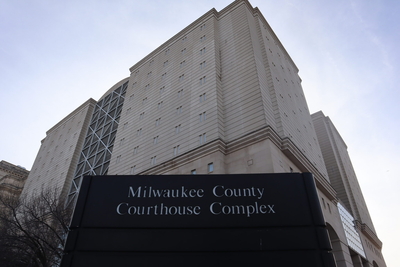
Over a short span of time, the anti-Crowley ads have made tablet access a big issue in the governor’s race. Late last week, Crowley suspended instant messaging on digital tablets at the Community Reintegration Center. The facility, formerly known as the House of Correction, is under more direct oversight by Crowley and the county board than the jail, which is overseen by the sheriff’s office.
On Monday Brian Schimming, chairman of the Wisconsin Republican Party, issued a press release accusing Crowley of protecting himself from a scandal. “This program should’ve never been allowed in the first place, and Crowley resisted ending it for months after victims were threatened and laws were broken,” said Schimming, going on to call Crowley “a craven politician who only cares about his own political future, not the safety of our state’s citizens.”
Milwaukee-based Black Leaders Organizing Communities (BLOC), which supported Crowley when he re-entered the race for governor and won the primary race, expressed disappointment at the suspension of messaging services. “We have to be careful in giving in to the narrative of Republicans and their methods to make incarcerated people as uncomfortable as possible,” their statement warned. The group added that “this form of communication seems to be the best and safest form that there is currently.”
As the political controversy over tablets grew, the sheriff’s office attempted to clear the air. Joshua Briggs, director of the Milwaukee County Jail, said that the devices are not iPads but a “generic tablet.” Briggs explained that the tablets cannot be used to make calls out of the jail, and are not connected to the internet. The devices use a network maintained by the vendor, ICSolutions, which allows for keyword flagging and other guardrails. Briggs estimated that 98% of the people held in the jail use the tablets responsibly.

The ads don’t mention that Republican-dominated counties including Waukesha and Ozaukee also give people housed in their jails access to tablets.
The tablets are important, advocates say, because they allow incarcerated people to maintain connections with loved ones and others on the outside.
“I understand what it means to have a connection to home,” Marianne Oleson, co-executive director of Ex-Incarcerated People Organizing, told the Wisconsin Examiner. Oleson, who spent four years in prison before being released in 2017, explained that tablets give incarcerated people access to recovery resources, employment preparation, parenting classes, and other rehabilitative services.
Tablet use has become commonplace in jails and prisons tablets. “This technology is being used on a significant scale,” Oleson said. “Edovo reports that its educational platform was available in 1,483 correctional institutions across 47 states in 2025, with participants completing 46 million hours of learning. Those are the provider’s reported numbers, but they show how much programming can be delivered through these tools.”
Shannon Ross, a founding member of Justice Forward, wrote in August in an op ed for Wisconsin Watch, that tablet-type devices are used in 48 state prison systems, the federal prison system and in county jails nationwide. “Correctional officials have credited tablets with reducing violence and disturbances inside correctional facilities,” Ross wrote in the August op ed. “Some jurisdictions have reported declines of up to 40%, and the director of the Federal Bureau of Prisons described the agency’s tablet program as reducing administrative burdens and allowing staff to focus more on institutional safety, not as a security risk it was forced to accept.”
“Providing tablets is an established practice today,” Oleson told the Examiner. “Wisconsin DOC says that each person residing in an adult facility will be issued an ICS tablet as its transition moves forward. Ozaukee County’s own website says that personal letters, pictures and drawings are delivered digitally through tablets available in all living units. This is happening across jurisdictions, regardless of politics.”
Other criminal justice advocates raised similar points about the use of tablets in jails and prisons. “Allowing tablets inside jail facilities is particularly important because it allows more in-depth communication with family and friends,” BLOC said in a statement to the Examiner. “Inmates can see messages and pictures from their families and loved ones. It enables them to maintain a closer connection than that of regular phone use. Sometimes, persons in custody need their families to advocate for them for their health, treatment and more that the jail staff cannot assist with immediately.”
Oleson was also disappointed by Crowley’s move. “My reaction to Crowley’s decision is concern for the people and families who are losing legitimate communication because of someone else’s misuse,” she wrote. “Victim harassment and witness intimidation are serious, and they must be addressed. We support holding people accountable for that behavior and holding facilities and vendors accountable for enforcing protections.”
Roy Rogers, a minister, board member of the Wisconsin Justice Initiative, and leader of the Onesimus Group of Milwaukee, wrote in a statement to the Examiner that electronic communication is one of the main ways his ministry can keep in touch with incarcerated people. “For us, a message is an opportunity to encourage someone, share our faith, or help them think through their next steps,” wrote Rogers. “For families, it means maintaining a connection with a parent, spouse, or child. We say ‘reentry begins with relationship’ because those connections need to grow before someone comes home.”
Rogers said that he cares about the safety and security of victims. “No one should have to fear threats or harassment through this technology,” wrote Rogers. “My understanding is that Crowley’s action pauses messaging at the CRC until stronger safeguards are in place, rather than eliminating tablets altogether. My hope is that those protections allow safe communication to continue. These tools have a meaningful place in family connection, ministry, daily facility operations, and preparation for reentry.”
“If a suspension is necessary while those changes are made, there should be a clear timeline and an explanation of what must happen for access to resume,” wrote Oleson. “I am concerned when the needs of incarcerated people and their children become talking points in a political campaign. These decisions affect real families. They should be guided by evidence, safety, and what will help people return home successfully.”

Madison, WI