The secret sauce to keeping KY election problems to a minimum
Oct 13, 2026 | 5:30 am ET
Description
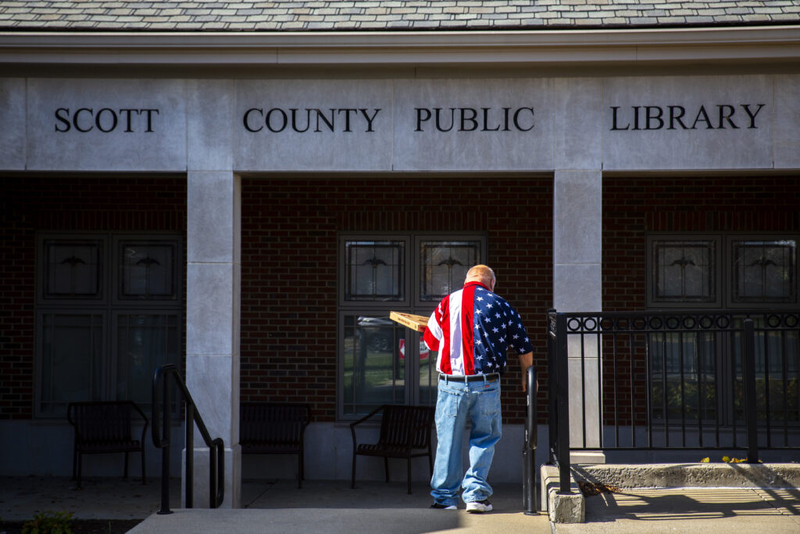
A poll workers carries his lunch into the Scott County Public Library precinct in Georgetown on Nov. 5, 2024. (Kentucky Lantern photo by Arden Barnes)
Being an election official isn’t easy these days.
In recent years, local election officials across the country, including poll workers, have faced an increase in threats and harassment.
According to a 2024 survey released by the Brennan Center for Justice, 38 percent of local election officials experienced threats, harassment or abuse for doing their job. The survey also reported more than half of local election officials reported being concerned for their and their colleague’s safety.
But as other states have experienced alarming situations at the polls in past elections, Republican Secretary of State Michael Adams said Kentucky poll workers haven’t faced those same kinds of threats while on the job.
“The vast majority of our poll workers are people who do it every single election,” Adams said. “They love it, and whenever I go around the state election day, poll workers are always in a great mood. They’re very comfortable. They’re very relaxed.”
Poll workers help make sure polling places run smoothly, which can include checking voters in, issuing ballots and setting up polling locations among other responsibilities.
The problem with battleground states
Some Kentucky election officials attribute a lack of non-competitive races to why temperatures are dialed down on election day.
Adams said in swing states, like Arizona and Georgia, tempers around the election typically tend to run hotter. So while there sometimes is misbehavior at the polls in Kentucky, Adams said it hasn’t appeared to be related to angst about the elections.
“There’s (also) just a lot less emotion in a non-presidential year, and this is not a state that’s seen as especially competitive, at least not at the statewide level,” Adams said. “So, there’s certainly downsides to that. You want interesting races to draw people to go vote, but the upside of complacency is that the temperature is just a lot lower.”
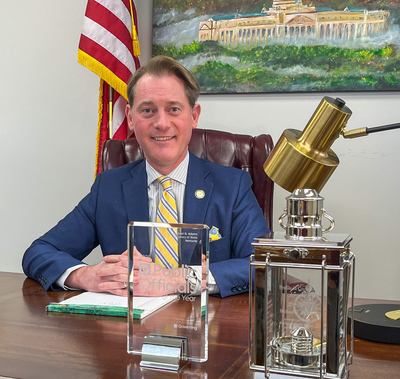
Trey Grayson, a former Kentucky Secretary of State, expressed similar thoughts to Adams, saying most problems arise in battleground states and during presidential election years. He has also been a poll worker since 2023 and said people are typically friendly and proud to participate in the Democratic process.
“I think that Kentucky, not being a big battleground state, has probably shielded us a little bit from some of the pressures,” Grayson, who is now a lobbyist for the County Clerks Association, said.
Adams said Kentucky has also taken preemptive measures to protect election officials. In 2021, the General Assembly passed House Bill 574, which significantly reformed the state’s election system. A provision in the bill included legal protections of election workers from harassment and intimidation.
“I also feel that the very careful approach that we take, the very nonpartisan approach that we take, we don’t lend people to think that the elections are rigged,” Adams said. “We don’t make election administration partisan. I feel like just taking the drama out of it helps assure voters that there’s no rigging here.”
Meanwhile, some county clerks say confidence in the election system and strong laws are reasons why county clerks can adequately staff precincts.
Fayette County Clerk Susan Lamb said Kentucky has a transparent election process, which helps boost the community’s confidence in the state’s elections. For the general election, she said Fayette County will have 1,100 election officers across 285 precincts.
She added Fayette County has not had any turmoil or major issues that cause concern for safety at the polls.
“What we need to understand is that there’s a lot of noise out there, and a lot of people want people to be up in arms,” Lamb said. “They want to put the fear into (elections) so that they might think second guess about going and voting, and I don’t want people to think that here in Fayette County.”
Clinton County Clerk Nathan Collins said he has filled the 24 poll worker spots needed in his county, and the same people typically have come back year after year.
“I’ve never really had any trouble in the past with poll workers being intimidated by people,” Collins said. “But in the case that they are, we’ve got procedures in place in our sheriff’s office that controls our three voting centers day and during early voting.”
Improvements still needed
Politicians still think there’s ways to improve the system.
While election threats and safety concerns haven’t impacted Kentucky’s elections, Adams said there’s still room to improve the system.
One idea Adams mentioned is to increase the base funding counties receive to run elections. He said county budgets pay for around 85% of the costs for running elections and believes there should be an equal sharing of costs.
In the base funding formula, Adams said counties receive 25 cents per registered voter and $255 per precinct.
“At the very least, we should be inflation-adjusting these numbers, and those numbers were in the 80s, and they’ve just not been raised,” Adams said.
For poll workers, they are paid at least $10 for attending a mandatory training session and at least $60 per election day, but the exact rate is determined at the county’s discretion, according to the State Board of Elections website.
Grayson said if the state gave more money to help offset the costs counties have to pay to run elections, counties could increase poll worker pay to help incentivize the job.
“Nobody’s getting rich being a poll worker, but an extra $50, that’s a night out, dinner out. It’s a Christmas present for somebody,” Grayson said. “It’s the kind of thing that might make a little bit of a difference on the margin.”
Frankfort