Rhode Island students’ test scores remain largely flat as school ratings reveal uneven progress
Oct 09, 2026 | 12:45 pm ET
Description
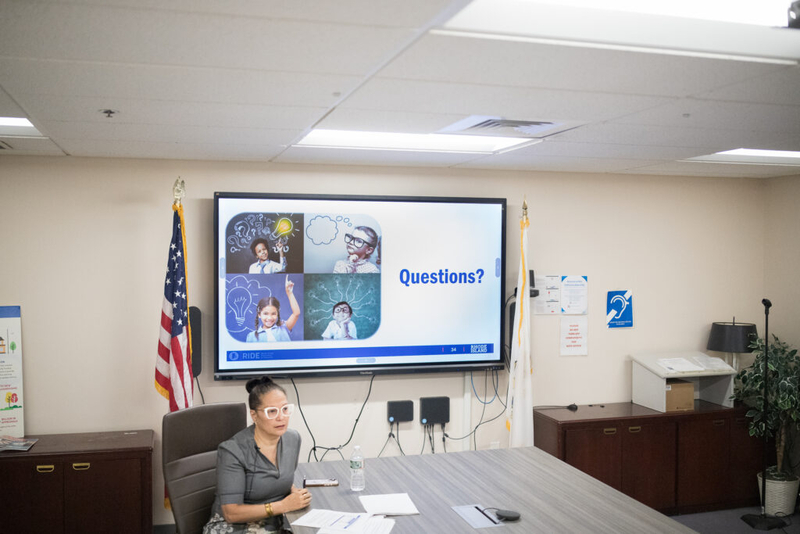
Rhode Island Education Commissioner Angélica Infante-Green discusses the state’s 2026 standardized test scores and school accountability ratings during a media briefing at the Rhode Island Department of Education on Thursday, Oct. 8, 2026. (Photo by Alexander Castro/Rhode Island Current)
There was little movement among Rhode Island students’ standardized test scores this year. Math inched up, while English language arts dipped slightly. A sharper decline could be seen in high school juniors’ SAT reading and writing scores.
The Rhode Island Department of Education is still maintaining a modest amount of hope in the latest Rhode Island Comprehensive Assessment System numbers released Friday morning.
“Real sustained gains come through consistent incremental progress year after year, and that’s what Rhode Island is doing,” education Commissioner Angélica Infante-Green told reporters during a briefing Thursday afternoon.
The release of the annual statewide standardized test scores was accompanied by the annual accountability ratings, which use a five-star scale to measure instructional quality, school culture and other metrics for public schools in the state. This is the first time the department has released the two datasets in tandem.
The assessments, which are taken by students in grades three through eight, saw about 32% of students across grade levels meet or exceed expectations in math, up from 31.4% last year.
English language arts proficiency dipped from 33.7% to 33.1%.
Neither year-over-year change was statistically significant.
Infante-Green said that, no matter how seemingly small, this is the fifth straight year that math scores have seen improvement, and the third year math scores exceeded the pre-pandemic benchmark of 29.8% proficiency from 2019.
Still trapped beneath pre-pandemic numbers, however, is English proficiency, which remains outclassed by the 38.5% proficiency level from 2019.
Infante-Green said that the state’s persistent difficulties with literacy are not unique, and that students everywhere are in the midst of a “literacy crisis.”
“We absolutely are, as a nation, and globally,” Infante-Green said, citing recent reading declines in results from a worldwide standardized assessment of 15-year-olds that pointed to “kids not having the stamina [and] not reading long passages.”
Like last year’s briefing on the assessments, Infante-Green noted that the Ocean State continues to close the gap with Massachusetts, the state from which Rhode Island cloned its own standardized test format.
Rhode Island students test scores inch up, but still chasing Massachusetts
The Bay State has traditionally been a regional and national leader in standardized test scores, but its English proficiency declined this year, and fewer than half of its students in grades three through eight met expectations in either core subject.
Massachusetts students in grades three through eight posted proficiency rates of approximately 40% in English and 41% in math this year. Rhode Island is about seven percentage points behind in English and nine points behind in math — a gap much smaller than the double-digit rifts from 2018, before Infante-Green’s tenure as commissioner, but one also informed by Massachusetts’ own shrinking scores.
When it comes to economically disadvantaged students, the gap between the neighboring states is even smaller.
Rhode Island trailed Massachusetts by just 1.4 percentage points in English and 2.7 points in math this year. In 2018, both these gaps were more than 13 points apiece.
High schoolers fared mixedly on the SATs, with 23.5% of juniors meeting the math benchmark, essentially the same as last year’s 23.3%. More significantly, student proficiency in the SAT reading and writing portions fell from 51.6% to 47.8%.
PSAT test-takers — which comprise high school sophomores — showed gains in both math and reading, with the former seeing a 2.8 percentage point increase.
As for the state assessments, Infante-Green highlighted improvements among younger students, especially those in the third grade, which is considered an important benchmark in literacy instruction. Third graders’ English proficiency rose from 36.7% to 38.5% — not statistically significant, but nevertheless evidence for Infante-Green that the state’s recent embrace of science-of-reading methods is working.
The state education department has secured $40 million over five years to strengthen science-of-reading instruction through coaching and intervention, Infante-Green said, decidedly moving the state back into curricula based in phonics and other evidence-based strategies, and far, far away from the whole language methods that dominated how reading was taught for years.
Infante-Green recalled her first year as a teacher, and assigned a word like “Halloween” for a spelling lesson.
“Do you know how many rules there are on the word ‘Halloween?’” Infante-Green said. “I wish I could go back and apologize to all those kids. I didn’t know. It was my first year.”
Receiving more training herself on methods based firmly in phonics, Infante-Green said, was a “game changer.”
Math gains told a less tidy story, with increases not distributed equally or, in some groups, at all.
Economically disadvantaged third graders saw a sizable decrease in math proficiency, falling from 25.2% to 22.7%, according to raw data from the state education department.
Among economically disadvantaged eighth graders, the opposite happened, with students’ scores in math jumping from 13.3% to 16.1%. Eighth graders who were not economically disadvantaged saw their math scores go from 44.3% to 48%, and both of these groups’ improvements were statistically significant.

School ratings highlight struggling districts with limited solutions
The Department of Education’s annual Report Cards for public schools and districts illustrate a fuller picture of the public school system with data related to academic achievement, graduation rates and other credentialing, student growth, chronic absenteeism, school quality and other measures.
The report card system runs from one to five stars, with five stars representing the highest quality schools. Out of the 305 public district and public charter schools in this year’s accountability data, 16 earned the five star designation, with four new schools added: Meadowbrook Farms School in East Greenwich, Narragansett Elementary School, Fishing Cove Elementary School in North Kingstown and Howard Hathaway School in Portsmouth.
Approximately 56% of all schools received three stars or higher. Another 90 received two stars, while 30 schools received one star. There were 15 schools with no rating this year.
Of the 16 five-star schools, Kingston Hill Academy in Saunderstown was the lone public charter school.
Separate from the star-rating system, 29 schools this year qualified for a federal designation known as Comprehensive Support and Improvement — essentially schools in need of substantive help because of repeatedly low scholastic performance or other recurring issues.
Those 29 schools enrolled approximately 13,000 students statewide as of Oct. 1, 2025, with two cities seeing the worst of it: Newport, where 59% of the district’s 1,746 students attend such schools, and Pawtucket, where 49% of 7,534 students attend one of these struggling schools.
Around a third of Woonsocket and Central Falls students attend schools that need comprehensive help, while 18% of Providence’s 19,824 students do.
Providence’s comparatively lower percentage offered some proof that the state’s seven-year takeover of the capital city’s public schools, which ended July 1, had done some good, Infante-Green said.
So would the state intervene in a similar fashion in Newport and Pawtucket? That wouldn’t be possible, Infante-Green said, because of a 2025 amendment to the Paul W. Crowley Act, the law that authorized the original takeover of Providence schools in 2019. The amendment limits the state education department to control of two schools per district at a time.
“I cannot take over a district. I can only take over a school,” Infante-Green said, adding that the Department of Education’s school improvement team continues to work with districts in need of extensive improvement.
Still, Infante-Green was concerned about Pawtucket, where she said schools have struggled with leadership turnover and lagged in training teachers up to speed with teaching based in science-of-reading methods.
Mandatory summer school under consideration
Infante-Green said the state is considering requiring summer school for younger students who have fallen behind in reading, and that the proposal involves using literacy screening assessments to identify kids who need more instruction while advancing through the early elementary grades.
Many Rhode Island districts currently lack summer programs for students in kindergarten through third grade, Infante-Green said — programs which are a staple in other states or cities with a more aggressive, proactive approach to early interventions for students struggling with reading.
The education department’s recently submitted budget request for fiscal year 2028 bundles summer school into a $20 million package for math and literacy initiatives, but does not specify the exact funding for the summer school portion of the program or whether it would be mandatory. Summer school funding would be offered via competitive grants to districts for second- and third-graders who aren’t up to reading level. If funded, the summer school money could be used beginning in summer 2028.
Infante-Green’s own future contains a measure of uncertainty with the impending change in gubernatorial administration up on Smith Hill. Appointed in 2019 by then Gov. Gina Raimondo, Infante-Green has spent most of her tenure in the education department under Gov. Dan McKee — a period marked by pandemic-driven upheaval in schools and an ongoing battle with the chronic absenteeism that resulted.
Though the ultimate occupant of the governor’s office come January remains unknown, it won’t be McKee, who was bested by Helena Buonanno Foulkes in September’s Democratic primary.
Did Infante-Green expect to remain education commissioner once a new governor arrives?
“I don’t know what’s going to happen,” she said. “I do know that I’m continuing to do the work for as long as I’m here.”
Her advice for the new governor, she added, would be to continue investing in the science of reading.
“We know it works, but we need to give the districts the funding to actually implement,” Infante-Green said.
Providence, RI