Alabama public schools expected to see another significant enrollment decrease
Oct 09, 2026 | 6:02 am ET

Description
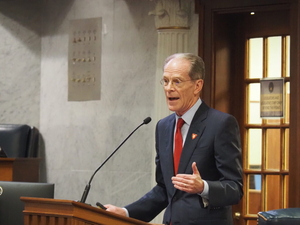
Alabama State Superintendent Eric Mackey speaks to Alabama State Board of Education members in the Gordon Persons Building after the Alabama State Board of Education meeting on July 8, 2025, in Montgomery, Alabama. Mackey told board members Thursday preliminary enrollment numbers show a 12,000 student decrease. (Anna Barrett/Alabama Reflector)
Alabama public schools may have seen another sharp enrollment decrease in the last school year, Alabama State Schools Superintendent Eric Mackey told members of the State Board of Education Thursday.
Mackey said preliminary numbers for the 2025-26 school year showed there were 702,000 students enrolled in Alabama public schools. That’s down roughly 12,000 students from the 2024-25 school year.
“We had thought it would probably stabilize this year. We didn’t know for sure, but it turns out this year’s loss is more than double, or essentially double, what last year’s was. So we’ll be digging into those data,” Mackey said after the meeting.
With a large drop in enrollment, it’s estimated that around 800 teacher units will be lost. A message seeking comment was left with the Alabama Education Association Thursday afternoon.
Rural areas in the state could be the most affected by the decrease.
“The deepest losses appear to be in rural areas, and also in one or two major counties, and so that means that as you get smaller and smaller and smaller, we now have about 10 … districts that have less than 1,000 students. Once you get to less than 1,000 students, it’s really hard to offer all the courses that are required,” Mackey said.
More densely populated areas, such as Jefferson County, could see more losses than other counties, but even rapidly growing counties, Mackey said, aren’t seeing gains in enrollment.
“I just looked at one of our 10 fastest-growing districts (and they) added six students,” Mackey said after the meeting. “So they’re essentially not growing, and then the losses, you know, are pretty much across the state.”
Mackey did not say which district he viewed enrollment numbers for.
The reasons for the decline are not clear. One possibility could be an aging population and a decline in birthrates. According to the U.S. Census Bureau, the median age in Alabama is 39.6 years, compared to 39.2 for the country as a whole.
“The kindergarten enrollment is going to be down about 2,500, which is following national trends. They’re just significantly fewer children being born, so that one is not surprising,” Mackey told board members.
While CHOOSE Act recipients made up some amount of the students no longer in public school, Mackey said those numbers don’t equate to the amount of students lost. A message seeking comment was left with the Alabama Department of Revenue Thursday.
“The CHOOSE Act numbers that the Revenue Department has posted are not anything close to that,” he said to the board. “The number of students, public school students, who have shown that they are going to a non-public school doesn’t seem to add to this number at all, unless there’s something else out there.”
Mackey said “the only elementary gain” was in 5th grade, but he could not give board members a reason for the growth.
“We’ll be looking at these data lots of different ways. For now, the big story is that even when all the errors are cleaned up, there’s no way that we don’t have a significant loss in students, and it will impact the funding, and it will impact the number of teachers units there are,” Mackey said. “And for many local districts, it will be a serious impact on the district because they’ll lose enough students that they have to start cutting staff and those kinds of things.”
District level data for enrollment is expected to be released by the end of the month.
Last year, numbers released by the Alabama Department of Education showed that K-12 enrollment dropped by 5,800 students. Of those students, 3,000 received CHOOSE Act funds and 2,100 students were unaccounted for.
Mackey said tracking enrollment was difficult due to a change in how race and ethnicity is being recorded at schools.
“We know last year some of it was we lost a lot of Hispanic students because we were able to track that,” he said. “But it was hard to track because we were also, last year, in the process of changing the way we collect race category data because the federal government changed the categories, so they weren’t exactly apples to apples from the year before.”
Montgomery