Constitutional: The amendment that could permanently protect reproductive rights in Virginia
Oct 09, 2026 | 5:28 am ET

Description
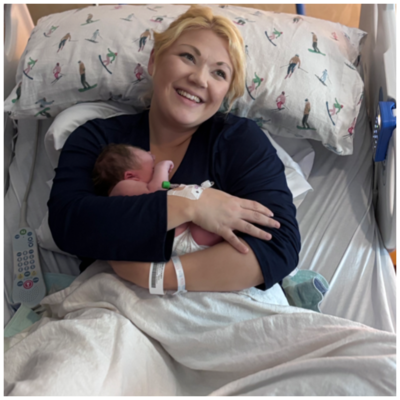
Kacia Kriener Putman, who supports Virginia's proposed reproductive rights constitutional amendment, stands outside the Bank Street entrance to the Virginia State Capitol with her children in January 2026. (Photo courtesy of Putman)
Kacia Kriener Putman credits abortion access with her ability to grow her family.
Three weeks before first pregnancy’s due date, the Alexandria resident developed pre-eclampsia, a potentially life-threatening high blood pressure condition that occurs in some pregnancies and can cause organ damage. She also developed HELLP, a syndrome that affects blood clotting and liver function.
Doctors rushed her into an emergency cesarean section. The joy of bringing her son Malcolm into the world was marked by the terror she and her husband experienced, Putman said.
It taught her firsthand how quickly things can go awry in pregnancies, and why complications sometimes require terminations to save a mother’s life.
When Putman and her husband decided to have a second child, they talked about the risks at length with her doctors.
She felt safe to try to become a two-time mom only because she knew she could get an abortion if she needed one to save her life, Putman recalled.
“It’s scary that (my daughter) might not have existed … if I didn’t have the freedom (to get an abortion),” she said.
Abortion is legal in Virginia through the 26th week of pregnancy. After that, three doctors must certify that the procedure is needed to save the life of the mother in order for the abortion to be granted.
A proposed amendment on Virginia voters’ ballots this fall could cement abortion access and other reproductive rights into the state’s constitution. It’s among three pending measures to enshrine same-sex marriage protections and restore voting rights to former felons who’ve completed their prison sentences.
What the amendment would do
If approved, the amendment would remove the three-physician threshold for late-term abortions. Beyond abortion, the measure would also protect contraception access and fertility treatments like in vitro fertilization (IVF).
IVF allowed Albemarle County resident Casey Oakley to become a surrogate for friends. Before that, an abortion saved her life when she experienced a “missed miscarriage” during one of her pregnancies.
Her body had stopped producing hormones to continue the pregnancy, but weeks later, it had not expelled the contents of her uterus.
“I was going into sepsis,” Oakley said in an interview with The Mercury this summer. “The abortion saved my life.”
State lawmaker Del. Cia Price, D-Newport News, has emphasized how contraception treats her polyendocrine metabolic ovarian syndrome (PMOS) — a disorder which can cause irregular menstrual cycles, chronic inflammation and pain.
Democratic lawmakers pushed for contraception’s inclusion in Virginia’s proposed amendment because reproductive rights could be limited in the future, Price said.
After the Supreme Court struck down abortion protections in 2022, Justice Clarence Thomas expressed interest in reconsidering cases that uphold contraception access.
The amendment only advanced thanks to Democratic majorities in the state legislature. Every Republican state lawmaker voted against advancing it to ballots, largely due to their stance on abortion.
They argued it could override existing state law that requires parental or guardian consent for minors to have surgeries including abortion. They also aired concerns that the amendment could enable infanticide.
Federal court cases have upheld parental consent and infanticide is illegal at the state and federal levels.
Varying views on third-trimester abortion
Christian advocacy group Family Foundation has a pending lawsuit that seeks to strike down the amendment if the majority of Virginians approve it.
The lawsuit argues that the ballot language is misleading and that legislative procedural steps for the amendment were not properly followed. A related case was dismissed over the summer but will be further deliberated by the Court of Appeals of Virginia.
Proponents suggest that removing the three-physician standard for late-term abortions would be helpful in emergencies and for rural patients who travel further for care.
But opponents, including VCU Health OBGYN Dr. Edward Springel, counter it would make it too easy to get an abortion. Springel also said that survival rates increase for fetuses born after 25 weeks of pregnancy and onward.
With no uniform definition of fetal viability, doctors handle pregnancies on a case-by-case basis with patients as they move through their second trimester.
Springel said that’s when parents who develop life-threatening conditions may more likely have the option to have a premature birth rather than an abortion procedure.
“The baby could be delivered alive, and then you would have two living patients,” he said.
The Richmond doctor typically doesn’t wade into politics, he said, but the pending amendment’s language spurred him to participate in the Virginia Medical Professionals For Women’s Safety campaign.
The group is an offshoot of The American Association of Pro-Life Obstetricians, a national organization that opposes abortion.
Dr. Kimi Chernoby, a Northern Virginia emergency medicine doctor who supports the amendment, emphasized that each pregnancy is different and complications vary widely.
Life-threatening conditions like the ones Putman experienced typically emerge in the third trimester, close enough to due dates that parents and doctors usually opt for an early or emergency birth, but other factors could lead to abortions beyond the second trimester.
“People are not getting third-trimester abortions for preeclampsia,” Chernoby said. “People are getting third-trimester abortions for things like fatal fetal anomalies, where they know that the fetus does not have a chance of survival.”
And while developing preeclampsia earlier in pregnancy is rare, it does happen.
“No one,” Chernoby said for example, “is doing an induction at 17 weeks and thinking that there is going to be a survivable birth.”
As a fetus cannot survive outside the mother’s body at that point of gestation, she likened it to “ending the condition of pregnancy without the intention of producing a live birth.”
Third-trimester abortions, which make up about 1% of abortions nationwide, are usually due to a late-developing, critical condition of the fetus or the pregnant person, a 2022 National Institutes of Health study indicated.
When third-trimester abortions do occur, an American Medical Association study found they’re most often performed closer to the start of the third trimester than well into it.
Though fetal anomalies are usually detected within the second trimester, some severe or lethal defects may not be apparent until the third trimester, according to another NIH study.
This year, Putman has volunteered with the Virginians For Reproductive Freedom campaign, a coalition of medical and reproductive rights groups that have banded together to boost the amendment.
She plans to vote yes to all three amendments and, as she knocks on doors to drum up support for the reproductive rights measure, she encourages others to do the same.
Though opponents argue the amendment is too broad, Putman said it ensures people will be able to maintain their bodily autonomy, no matter what kind of pregnancy complications may arise.
“We can’t legislate around every exception,” Putnam said.
Early voting runs through Oct. 31. Election Day is Nov. 3.
Read part one and part two of the Constitutional series here.

Richmond, VA