Trump administration cuts environmental reviews to fast-track Alaska oil exploration
Oct 09, 2026 | 2:40 pm ET
Description
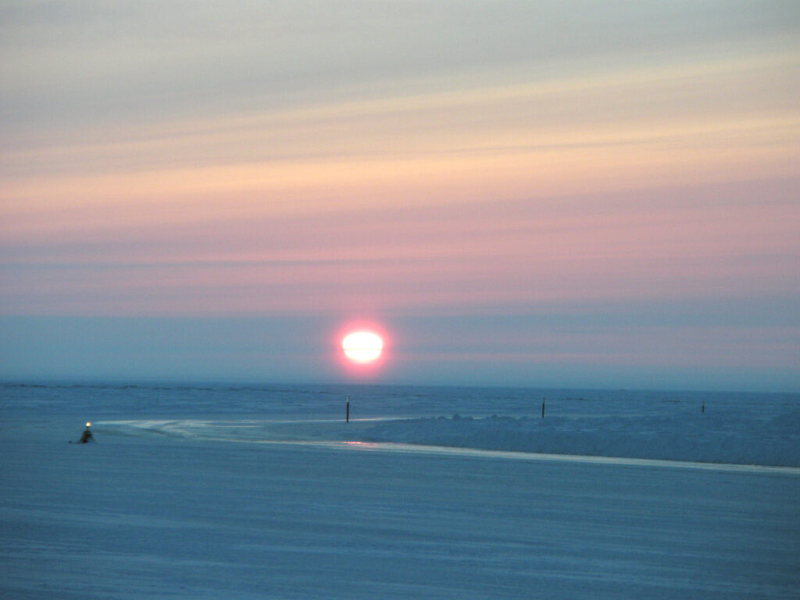
Light from the setting sun on March 21, 2008 is reflected on the surface of an ice road in the National Petroleum Reserve in Alaska. Under a new Trump administration rule, new ice roads and other oil-exploration projects in the reserve will no longer have to undergo case-by-case environmental analysis. (Photo by Wayne Svejnoha/U.S. Bureau of Land Management)
Seismic surveys, well drilling, ice road construction and other wintertime oil exploration activities on federal lands on the western North Slope will no longer be subject to case-by-case environmental evaluation, under a new rule the Trump administration announced on Thursday.
The U.S. Bureau of Land Management issued the rule for exploration activities in the National Petroleum Reserve in Alaska.
The BLM said it is granting a “categorial exclusion” to streamline permitting for most activities that would otherwise require individual environmental analysis under the National Environmental Policy Act, or NEPA. Up to now, such activities have had to be examined through environmental impact statements or environmental analyses — formal studies that adhere to federal law.
The exclusion from NEPA requirements means that past environmental studies of exploration and development activities are considered sufficient to guide future exploration work, according to the agency.
“The BLM has decades of experience analyzing the effects of exploration in the Petroleum Reserve and permitting responsible exploration,” Kevin Pendergast, the agency’s Alaska state director, said in a statement. “This categorical exclusion builds on that record to allow developers to more nimbly locate energy resources in the Petroleum Reserve, ultimately increasing domestic energy supply, leading to stable energy costs and more revenue for Alaskan communities and the American public.”
There is no public comment period on the new rule, which went into effect on Friday.
Oil and gas development backers welcomed the rule, while environmentalists criticized it.
The Alaska Oil and Gas Association, in a statement, thanked the administration “for moving this common-sense action forward.”
“Decades of environmental review and operating experience demonstrate that these activities can be conducted responsibly under well-established safeguards. BLM’s analysis of the last 28 years of winter exploration activities in the Petroleum Reserve and the judicial record are clear and decisive: winter seismic and exploratory drilling activities in the Petroleum Reserve are consistently found to cause no significant impacts,” the statement said.
“Responsible development in the Petroleum Reserve creates good-paying Alaska jobs and strengthens America’s energy and national security,” they said.
Environmental groups said the rule is part of a pattern of giving oil companies free rein to exploit public lands without regard for the consequences.
“It is no secret that the Trump administration will ignore impacts to public lands and our nation’s laws if it benefits resource extraction corporations, but recent efforts to remove any and all public review of Arctic oil extraction are particularly egregious,” Andy Moderow, senior director of policy for Alaska Wilderness League, said in a statement. “This drill first and discover the impacts later approach puts Arctic lands, waters, and wildlife at risk.”
“The administration is handing oil companies a free ride to drill and develop the Western Arctic while blocking Americans from having a say in the process or even effectively knowing about destructive oil and gas activities on our public land,” said Matt Jackson, Alaska senior manager for The Wilderness Society. “The Western Arctic is not a uniform landscape, and these are not small, routine activities. Where companies operate, how much ground they cover and what conditions exist on the tundra all matter. That’s precisely why environmental review and public engagement are important.”
The announcement about the categorial exclusion for exploration work in the petroleum reserve comes a month after the BLM announced a similar new rule for permitting development projects. That categorical exclusion for development projects had been requested in a petition submitted by the Alaska Oil and Gas Association. The public comment period is open until November 9.
In the BLM notice about the exploration categorial exclusion published in the Federal Register on Friday, the agency said the relevant winter exploration activities in the reserve “normally do not significantly affect the quality of the human environment.” Additionally, those activities “do not produce significant or lasting environmental impacts,” the notice said.
However, several scientific studies have found that North Slope exploration activities do have negative and sometimes llating environmental impacts.
University of Alaska Fairbanks scientists have found that seismic surveys can cause lasting damage to permafrost terrain. A 2022 UAF study warned that areas of the North Slope, including the petroleum reserve, may lack sufficient water in some years to support ice road networks, and that withdrawals of water from lakes to build those roads could harm fish populations.
A 2022 study by Chinese scientists found that the suitable season for building ice roads had diminished substantially since the late 1970s. And a 2020 study led by scientists at the Institute for Conservation Research at the San Diego Zoo found that denning polar bears are disturbed up to a mile away by noise from aircraft, “thumper” trucks used to conduct seismic surveys and other industrial equipment employed for exploration.
The new rule streamlining permitting for exploration is the latest Trump administration step aimed at vastly expanding oil drilling in the Indiana-sized reserve.
The administration replaced an Obama-era management plan that protected about half of the reserve with a new plan opening up more than 80% of it to oil leasing. Areas the Trump administration opened to development include Teshekpuk Lake and its surrounding wetlands. The lake, the largest in Arctic Alaska, and its adjacent lands had been off-limits to oil development for decades because of the region’s importance to migratory birds, caribou and other wildlife and to Indigenous subsistence food-gathering traditions.
The Trump Department of the Interior also overturned an agreement to protect Teshekpuk-area caribou habitat that had been struck between the Biden administration and the tribal and city governments and Native corporation in Nuiqsut, the Inupiat village closest to reserve development. That action triggered a lawsuit by the Nuiqsut parties and a U.S. District Court decision against the Trump administration. The administration appealed that ruling in June.
In March, the administration held a record lease sale in the petroleum reserve, drawing $163 million in high bids for territory that included territory in and around Teshekpuk Lake that is currently the subject of legal dispute.
Juneau