The real cost of Tom Tiffany’s debate dodge
Sep 18, 2026 | 4:00 am ET
Description
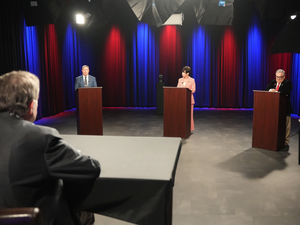
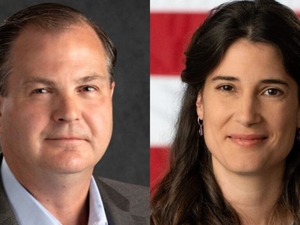
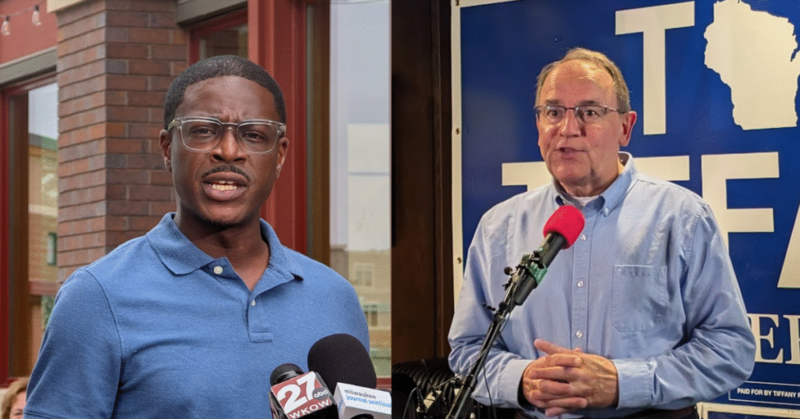
One debate cancellation after another leaves little opportunity to compare the candidates' positions on real issues that affect Wisconsinites. (Photos by Baylor Spears/Wisconsin Examiner)
U.S. Rep. Tom Tiffany, the Republican candidate for governor of Wisconsin, is skipping multiple debates with his Democratic rival, Milwaukee County Executive David Crowley.
Asked why he decided to break the Wisconsin Broadcasters Association’s 36-year streak of hosting gubernatorial candidate debates, Tiffany said, “We agreed to do one debate. In my experience in Congress as well as the state Legislature, doing one debate is sufficient.”
That’s absurd. In this high-stakes election, as Wisconsinites confront skyrocketing costs, healthcare cuts, struggling public schools, questions about election integrity, the threats posed by artificial intelligence and data centers, among many other issues, a single one-hour forum hosted by WISN on Oct. 21 cannot possibly cover their concerns in depth.
Another planned debate, hosted by the Milwaukee County Intergovernmental Cooperation Council, featuring questions gathered from mayors and community leaders around the state, was also called off this week after Tiffany indicated he would not participate.
The jilted hosts expressed their dismay in a joint statement, saying they are “deeply disappointed” and hope that the next governor will take seriously the local government issues the candidates will not be discussing on the debate stage Oct. 8.
The loss of these debates means Wisconsinites won’t have the opportunity to get answers to real people’s questions. Instead, they’ll have to settle for scripted talking points and millions of dollars in depressing negative ads.
The moderator of the Wisconsin Broadcasters Association debate, journalism professor Jill Geisler, has for years helped gather questions that are important to voters in different parts of the state. “We had someone who came from a community that had been using bottled water because of PFAS … we had someone asking about climate change’s effect on the wild rice harvest in Wisconsin,” she says, recalling some recent debate questions.
“I do think that we’re living in a more siloed era where people prefer to speak through the channels that they know are friendliest to them,” says Geisler, a professor at Loyola University Chicago. “I think what I worry about is that people think of truly well researched debates, you know, where people are asking researched questions, evidence-based questions, that that’s some kind of gotcha trap, and it’s not, you know, it is simply not that.”
The WBA team had already been hard at work planning the debate logistics and gathering issues important to local communities across the state when the debate was canceled. Before every debate, a point person does copious research on each topic, its history, legal background and the candidates’ positions and voting records. “Then we lock up for the last two days to workshop the questions,” Geisler says. After the debate, WBA publishes its questions online with links so people can read more about the issues. “We put all that out there because we think that we can’t cover it all in an hour,” Geisler says. “And people might want to do their own research, but they could see what we used.”
The broadcasters and the local government officials who were painstakingly putting together questions were planning to ask the candidates not just what they have to say about hot-button issues, but what specifically each would do as governor to address SNAP cuts, rural hospital closures, the childcare shortage and other urgent matters confronting Wisconsinites.
All of this serious, in-depth discussion has now been lost.
As President Donald Trump’s approval numbers crash and once-safe Republican congressional districts appear to be in play, Tiffany might want to avoid tough questions about his record of supporting Trump between 93% and 100% of the time while in Congress.
He seems to be leaning on an ad campaign to recast himself from MAGA warrior to folksy midwestern moderate, while relying on his supporters to attack his opponent.
“In Wisconsin and other states, it is more often Republicans than Democrats who avoid debates,” says University of Wisconsin-Madison political science professor Barry Burden. “There are sometimes exceptions, as when Mandela Barnes resisted doing more than one debate with Ron Johnson in the 2022 Senate race, but it tends to be GOP candidates who are distrustful of journalists or being they have something to lose by taking part.”
“The irony is that candidates who lost probably could have helped themselves with additional debates,” Burden adds. “Barnes’ narrow loss to Johnson might have been turned into a victory had there been another debate or two. Tiffany is currently trailing in the polls and might also benefit from more face time and opportunities to question his opponent.”
While Crowley is slightly ahead in the latest polls, Tiffany is outspending his Democratic rival on advertising by a margin of 3-to-1, according to J.R. Ross of WisPolitics. Republicans and the outside groups that support them are outspending Democrats by more than $8 million.
Even that huge financial advantage might not be enough to help Tiffany overcome his record of voting for and defending Trump’s cuts to Medicaid and food stamps, his support for the U.S. military entanglement in Iran and all the other Trump policies dragging down Republican politicians across the U.S.
It will be interesting, in the single candidate debate next month, if the candidates are pressed to talk about data centers and Flock cameras — two issues where Tiffany has, interestingly, moved to capture some of the energy that animated supporters of Francesca Hong, the democratic socialist candidate Crowley narrowly defeated at the end of the chaotic Democratic primary. Crowley has not taken as strong a stance as Hong opposing either AI data centers or Flock surveillance. Tiffany’s position sounds more assertive, but his record is complicated, since he voted for Trump’s ban on AI regulation in Congress and seems more concerned with blocking wind and solar development that might fuel data centers than the data centers themselves. On Flock, it would be interesting to hear him square his support for local law enforcement with his proposal that local government be forbidden from using state revenue for Flock contracts.
None of those nuances are going to get much airtime. Instead we will have the barrage of political advertising by shady groups, featuring grainy images and ominous music, shedding more darkness than light.
“To have something that isn’t about sloganeering … to try to have civil discourse … I think that’s what we’ll have less of,” says Geisler.
For most of us that’s a big loss.
Madison, WI