Fire crews fully contains North Texas wildfire, which continues to burn three weeks later
Sep 16, 2026 | 8:07 pm ET
Description
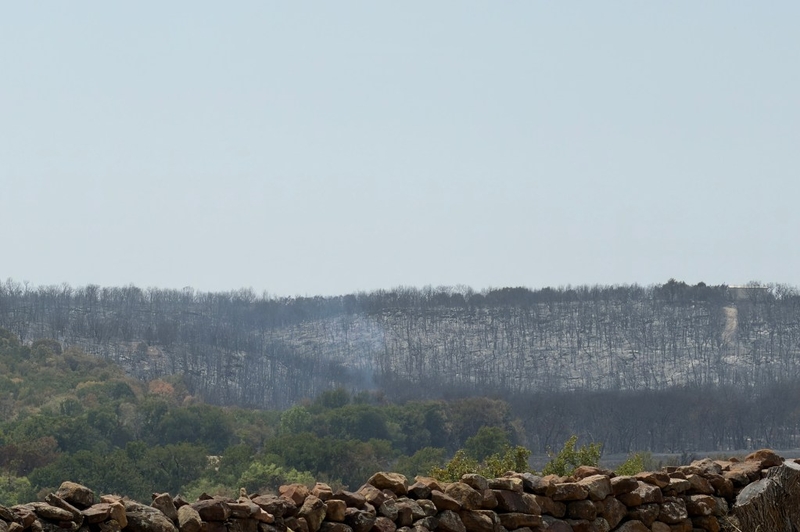
Scorched trees show the devastation from the Ross Fire in North Texas on Aug. 27, 2026. The fire has been declared 100% contained. (M. Mahurin/Texas A&M Forest Service)
FORT WORTH — What’s left of grasslands and ranch land is black ash, tree debris and smoke.
More than 23 days later, the fire in Palo Pinto and Jack counties continues to burn, but it’s fully contained, meaning response crews have eliminated all fuel along the fire’s perimeter on Wednesday, according to the Texas A&M Forest Service incident page. The Ross Fire, reported as 90,400 acres at its height, has also decreased to 89,989 acres.
More than 500 firefighters have cleared trees, dry leaves, vegetation and scraped soil down to bare dirt. Little is left to potentially catch the flame. The end might be in sight.
This is a win for the group of firefighters who have worked relentlessly to fully contain the Ross Fire by Wednesday after weeks of struggling. Crews continue to tap out flare ups and eliminate easily ignited sources.
The Ross Fire sparked on Aug. 24 near Palo Pinto and grew with extraordinary speed in the dry ranchland. By Aug. 25, officials reported that the fire had doubled in size in a few hours to about 50,000 acres. By Aug. 26, the estimate had climbed above 80,000 acres. In the first days of the fire, firefighters reported extreme fire behavior, including trees torching in groups amid strong winds.
Fire investigators with Forest Service and local law enforcement agencies determined that the fire started along a road and was caused by equipment or a vehicle, although the specific source couldn’t be determined.
The Ross Fire has taken the spot as the second-largest wildfire in the area’s history, according to the National Weather Service’s Fort Worth office, behind the Possum Kingdom Complex Fire, which burned 126,734 acres in April 2011.
The response team battling the Ross Fire includes small rural departments closest to the fire, the Texas A&M Forest Service and local fire departments around the Dallas-Fort Worth area. The steep and rocky terrain have made it hard to reach portions of the fire. The heat has been intense, forcing firefighters to take precautions, according to the Forest Service. The body can only tolerate so much.
Two injuries were reported among firefighters, said Adam Turner, a public information officer with the Forest Service, in early September. Turner said one involved a minor hand injury during a traffic collision last week, and the other was a minor eye injury that was treated on scene.
At least 167 structures, including 18 that were occupied by residents, have also been destroyed, according to an initial assessment by firefighters.
School districts had delayed operations, ranchers have herded their cattle out of harm’s way and evacuation orders were issued in portions of Palo Pinto and Jack counties. Those have since been lifted.
Weather is not helping
It’s been more than 60 days since the Dallas-Fort Worth region had seen measurable rain — the third-longest stretch on record. The North Texas region has been setting record high temperatures this month. On Sept. 15, the temperature reached 101 degrees — the hottest recorded since 1980.
A lack of measurable rainfall has dried out vegetation, making it easier to ignite and allowing wildfires to spark quickly. Several smaller fires have sparked throughout the region in September. And the gusty winds are creating elevated wildfire conditions across parts of North Texas.
Firefighters will work to keep fires contained. “Crews are identifying and mitigating any heat sources that compromise the integrity of the containment line,” according to the Forest Service.
Ground crews are working with Bridger Aerospace, which provides the state with aircrafts like so-called scoopers, which fly over rivers, lakes and streams and gather thousands of gallons of water in a matter of seconds to dump directly onto wildfires.
However, at a Sept. 14 interim hearing on wildfires, state Rep. Ken King, R-Canadian, questioned why it has taken so long to put the fire out, saying “it just seems strange to me that it’s been burning this long, and it got this big before we started sending scoopers out.
While the scooper crews have delivered more than 411,000 gallons of water and have flown over 40 hours to respond to the fire, Mel Holtz, Bridger Aerospace’s vice president of business development, said at the hearing that the air crews arrived three days after the fire began.
“Three days later, in a wildfire, three days is a catastrophe waiting to happen, and that gap is a structural problem,” he said.
King has been pushing for a statewide emergency communications system in response to destructive wildfires that started in Canadian, where he lives, and scorched more than 1 million acres in the Texas Panhandle in 2024.
State dollars have somewhat helped
It’s not clear how much the Ross Fire will cost in damages to Jack and Palo Pinto counties and residents, as well as to the fire departments that have responded.
Rural towns in Texas often rely on volunteer fire departments with limited funding.
Last year, the state appropriated $192 million — the largest single investment in history — to a rural volunteer fire department assistance program, administered by the Texas A&M Forest Service. The funds help volunteer departments update firefighting equipment or buy new fire trucks, trucks with large tanks holding thousands of gallons of water, brush trucks, and protective gear.
Volunteer fire departments in Palo Pinto and Jack counties received some of the funds.
Lake Palo Pinto Volunteer Fire Department received $25,000 for fire and rescue equipment. The Possum Kingdom Volunteer Fire Department in Palo Pinto County got $25,000 for personal protective equipment. And the Jacksboro Fire Department in Jack County got $10,000 for training aids.
Palo Pinto County Emergency Services District #1, which manages 10 volunteer fire departments in the county, said in an email funds were spent purchasing equipment for training and firefighting.
“Those funds were not directly spent towards the Rose Fire, but obviously training always improves the service a department can deliver,” the department wrote.
However, in the email, the department noted that all of the fire departments across the county will need funds for recovery and equipment repair — and those expenses will exceed their budgets.
“It’s early to know what it will cost at the end of the incident,” the department wrote, adding that to combat the Ross Fire, volunteer firefighters drove brush trucks through treacherous rugged terrain. “It’s not unusual for a truck to go through tires fighting this type of blaze. Those tires run anywhere from $700 to 1,000. It’s very expensive to fight these wildland fires.”
Austin, TX