Officials express confidence in bet on horse racing industry
Sep 16, 2026 | 8:26 pm ET
Description
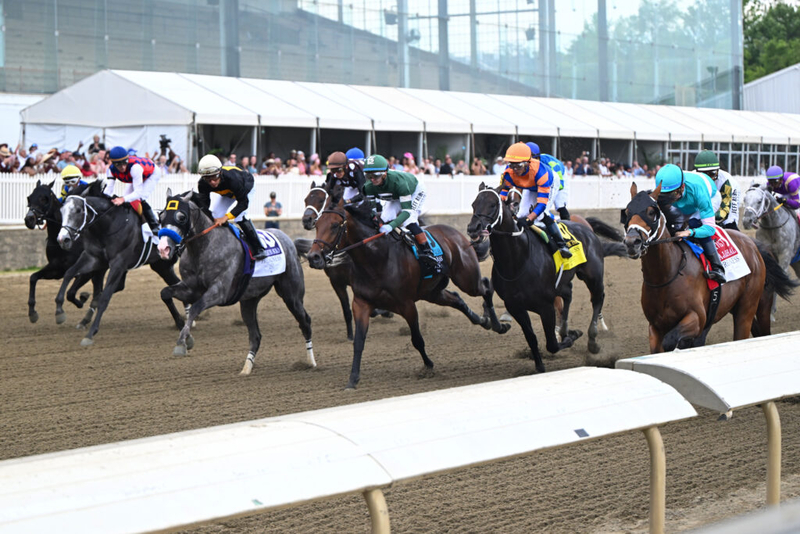
Horses on the track at Laurel Park, where the Preakness was run this year. The race is expected to return to Baltimore next spring but much of the rest of the racing schedule will remain at the Laurel venue while work continues on a new Pimlico Race Course. (Photo by Joe Andrucyk/Patrick Siebert/Office of the Governor)
State officials put a best hoof forward on behalf of the horse racing industry Wednesday, expressing confidence that efforts to prop up and preserve the industry will not be in vain.
The briefing before the House Appropriations Committee comes as Maryland horse racing faces continuing questions about its viability. Those concerns remain even as the state has pumped hundreds of millions into the industry — restoring Pimlico Race Course, buying Laurel Park and the rights to the Preakness Stakes — effectively assuming ownership.
“I really can’t underscore what an incredible moment that we’re at right now,” said David Richardson, executive director of the Maryland Thoroughbred Horsemen’s Association.
“For years and years … we’ve always had something holding us back, whether it was internal struggles or the dysfunction of the Stronach group,” he said, referring to the previous owners of the Preakness and the tracks. “We’re really at the moment where we’re responsible for our own our own future here.”
The viability of the industry remains an open question even after the state bought the intellectual property rights to the Preakness, the second leg in racing’s Triple Crown.
Kentucky Derby owner Churchill Downs had offered $85 million to buy the rights to the Preakness, which the state was leasing, from 1/ST Racing. Maryland had a right to match that offer and it did, closing the deal in July.
Preakness, Pimlico left out of new race series by Churchill Downs, Belmont
Days later, Churchill Downs and the New York Racing Authority, which owns the Belmont, announced a championship race series. The first two races in the six-race series will be the Derby and the Belmont Stakes — the bookends of thoroughbred racing’s Triple Crown.
The Preakness is not included in the series.
“I think it was very much a reaction to not being successful in acquiring the rights,” said Tom Sadowski, CEO and executive director of the Maryland Economic Development Corp.
The quasi-government agency is spearheading redevelopment efforts in the community around Pimlico, and it borrowed the money to buy the rights to the Preakness.
Some in Maryland and in the industry fear the Churchill Downs snub will mean the end of the Triple Crown, which could hurt the value of the state-owned Preakness. But Richardson was the latest to try and allay those fears.
“I heard earlier, the talk of, has the Preakness been devalued?” Richardson said. “Actually, it’s quite the contrary. The six-year deal that we’ve been able to strike with NBC Sports really that puts the value in the Preakness, and not only has it been, you know, just status quo.”
The six-year deal includes coverage of the Preakness as well as the Black-Eyed Susan Stakes and two other races — Preakness Preview Day in April and Maryland Million Day in October. It includes racing that will run both on the broadcast network as well as NBC’s streaming platforms.
Financial and other terms of the deal were not released making it difficult to assess its true value.
The survival of thoroughbred racing depends on the success of the Preakness.
“That is our by far our largest revenue source, and really what we’re counting on to make us viable,” said Bill Knauf, president and general manager of the Maryland Jockey Club. “Right now, we lose money throughout the year simply because of the large operation and all-year-round training center.”
Knauf said the operations are an “enormous economic benefit” for the horse industry in the state.
“It is a very costly endeavor to put that on,” he said. “The Preakness will chip away at those losses.”
The state in recent years has made a large bet on trying to save thoroughbred horse racing. Not all of the bets have paid off.
More than a half-billion dollars in cash and bonds are directed at rebuilding Pimlico Race Course in Baltimore and converting Laurel Park into a training facility. Bound to the success of the track is a parallel effort to revitalize the area of Northwest Baltimore City in need of economic development.
The state spent nearly $5 million for a 328-acre parcel known as Shamrock Farm, a Carroll County property envisioned as the future site of a modern training facility. Instead, the Maryland Stadium discovered problems with the site that made it unsuitable for the project. The Board of Public Works approved, without discussion Wednesday, a request by the Maryland Stadium Authority to declare Shamrock Farm surplus.
The approval clears the way for the authority to sell the property possibly as early as next year. Proceeds of the sale will go to improvements at Laurel Park, the new training facility site.
Shamrock Farm could go to a private owner or developer as no state or local government agency expressed interest in the parcel before it was declared surplus.
When the state bought the intellectual property rights to the Preakness and the Black-Eyed Susan stakes this summer for $85 million, MEDCO secured a $97 million short-term loan for the deal. The loan, which was not rated by any of the credit agencies, is currently backed only by the intellectual property rights.
MEDCO has 18 months to secure a longer-term financing deal.
Officials told the committee Wednesday they understand there is likely no more state funding.
“I heard it loud and clear over the last two sessions: Don’t come back, which is one of the reasons that we wrestle with the budget every day,” Gary McGuigan, executive vice president of capital projects development for the Maryland Stadium Authority, told committee members. “So, I do not intend on coming back for additional money.”
Annapolis, MD