Oregon isn’t on track to meet transportation emissions goals, forecast shows
Sep 16, 2026 | 4:08 pm ET
Description
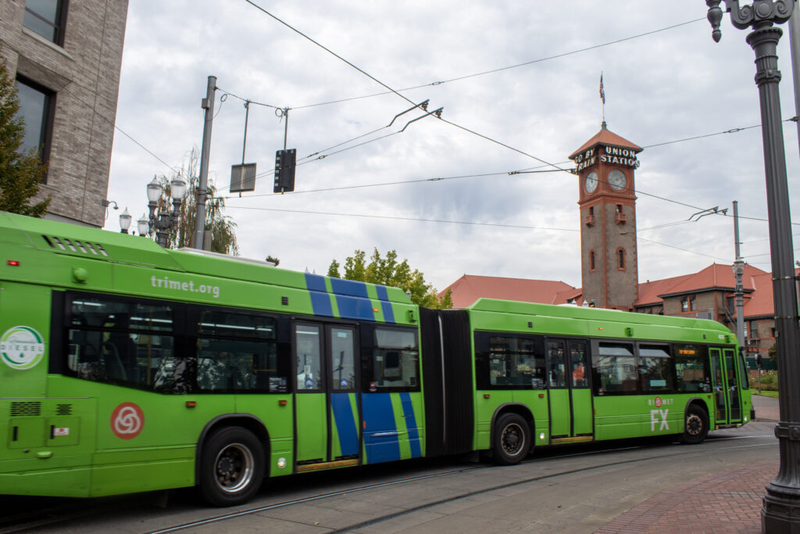
A TriMet bus drives past Union Station in Portland, Oregon. TriMet uses a mix of electric buses and renewable diesel buses. (Photo by Mia Maldonado/Oregon Capital Chronicle)
Oregon has lost much of the progress it had made toward its transportation greenhouse gas emissions goal, according to a new progress forecast.
More than a decade after state agencies set a goal to reduce transportation emissions to 80% below 1990 levels by 2050, Oregon is now projected to achieve only about a 10% reduction under current policies, state officials told the Oregon Transportation Commission on Tuesday, citing transportation funding uncertainty at the state level and changes under the Trump administration that eliminated electric vehicle tax incentives, funding for charging infrastructure and emission standards.
Oregon’s transportation sector contributes to 35% of the state’s greenhouse gas emissions, according to the Oregon Department of Transportation. The agency, along with the Oregon departments of Environmental Quality, Energy and Land Conservation and Development, in 2013 adopted a goal to reduce those emissions.
“To address climate issues and extreme weather, we need to curb transportation emissions,” said transportation department administrator Amanda Pietz. “The effect of these emissions is resulting in more extreme weather events. We’re seeing more flooding, wildfires, coastal erosion and other things that are affecting our transportation system greatly.”
ODOT staff cuts would reduce maintenance and responses to severe weather events
However, Oregon is further away from meeting emission goals than it was four years ago because of current federal policies and state funding issues, said Tara Weidner, the climate impact program lead for the transportation department who walked the commission through its progress.
“Our goal is to be transparent about our progress, what’s gone well, where we’re falling behind, and these additional details are especially helpful in identifying how to get back on track,” she said.
What happened?
The four state agencies produce a progress report on the state’s greenhouse gas emission goals for the transportation sector every four years. The first report was released in 2018.
That year, the forecast showed Oregon would reach about a 15% to 20% emissions drop below 1990 levels for cars, trucks and SUVs. Larger vehicles were not a part of this forecast.
The state subsequently directed more funding toward climate-friendly programs under former Gov. Kate Brown, including the creation of the transportation department’s climate office.
By the 2022 forecast, Oregon was on track to reach a 60% reduction in transportation emissions below 1990 levels by 2050.
“In 2024, things were looking pretty good,” Weidner said. “Oregon was aligned on an electric future. Federal and state regulations were pushing automakers to offer attractive EV options. People in Oregon were buying them with encouragement from purchase incentives and new public EV chargers that were going out on the streets.”
That progress stalled in 2025 under the Trump administration after it ended federal tax credits for buying new or used electric vehicles, funding for electric vehicle charging and automaker fines for violating fuel economy standards.
Oregon is a part of several lawsuits challenging the Trump administration’s efforts to curb transportation electrification efforts, including a lawsuit to stop the Trump administration from terminating billions in congressionally approved funding for electric vehicle infrastructure, as well as another challenging the administration’s attempts to override state rules imposing stronger vehicle emission standards — such as a 2022 Oregon law that requires all new cars, trucks and SUVs sold in Oregon to be zero emission by 2035.
“If all these federal actions hold, we will not be able to enforce Oregon’s regulations and it will be a significant challenge to find a new path to electrification and vehicle efficiency at the pace required by our goals,” Weider said.
Meanwhile, the transportation department is going into its fifth budget cycle with reductions needed to maintain current service levels. Those constraints are impacting the agency’s efforts to expand lower-emission transportation options, especially public transit.
“Without sustainable funding, we can’t make progress on providing non-driving options,” she said.
Salem, OR