North Dakota farmers increasingly rely on foreign labor
Sep 16, 2026 | 6:34 pm ET
Description
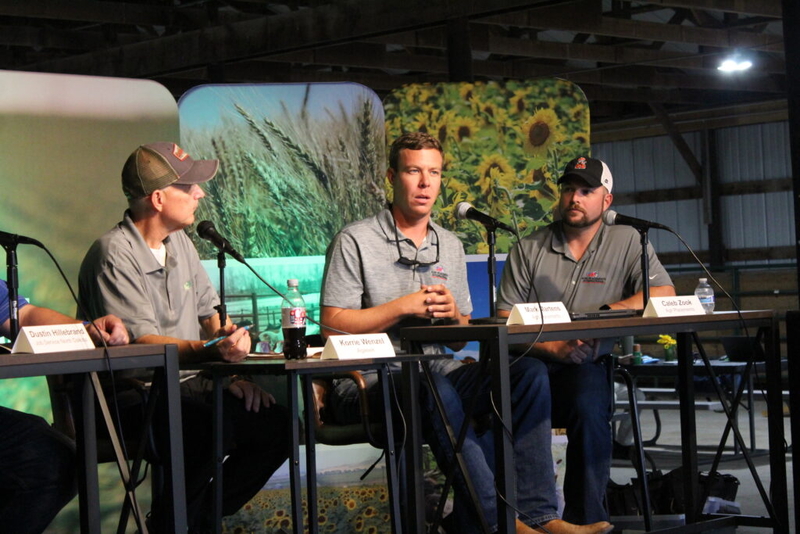
Mark Martens, center, vice president of Agri Placements International, discusses agricultural labor trends and growing demand for H-2A visa workers during a panel at the Big Iron Farm and Construction Show in West Fargo on Sept. 16, 2026. Also pictured are moderator Korrie Wenzel, left, and Caleb Zook. (Photo by Ceilidh Kern/For the North Dakota Monitor)
As demand for agricultural labor grows, North Dakota farmers are looking abroad to fill their vacant positions.
There were just under 500 unfilled agricultural jobs across North Dakota in August, according to Job Service North Dakota. Most of those positions were in the northeastern and south-central parts of the state.
So far this year, 478 employers in North Dakota were approved to hire seasonal foreign workers through the H-2A visa program, according to U.S. Citizenship and Immigration Services. The program connects agricultural employers with workers when they’re unable to fill their positions with Americans.
Those employers have hired nearly 5,000 foreign workers this year, up from just over 1,000 in 2025.
“It has grown substantially, the need for these workers, because there aren’t enough folks here in the state to go up and do that work,” said Dustin Hillebrand, a workforce center manager for Job Services North Dakota, during a Wednesday panel on agricultural labor during the Big Iron Farm and Construction Show in Fargo.
Record diesel prices hit North Dakota farmers at the wrong time
Farmers are hiring fewer North Dakotans to fill open positions in part because the state has very low unemployment and high workforce participation, meaning that most of the state’s residents already have jobs, according to Hillebrand.
Another reason, he said, is that North Dakota’s average wages aren’t competitive with other states in the region. At the end of May 2025, the average wage for North Dakota farm workers was $28,000 to $33,000, while Montana, Wyoming, Colorado, South Dakota and Nebraska saw wages ranging from $40,000 to $51,000, Hillebrand said.
Between wages, hard working conditions, the seasonal nature of farm work and competition from better-paying industries like oil and gas, many farmers in North Dakota and across the country are struggling to find American workers, said Mark Martens, vice president of Agri Placements International, a company that helps employers apply for H-2A visas.
The H-2A visa helps farmers fill this gap so they don’t have to downsize their operations, Martens said.
“It’s (also) a win for workers because they’re coming over here and earning a lot higher wages than they get in their own country,” added Caleb Zook, director of business development at Agri Placements.
How the visa process works
In order to hire H-2A visa workers, employers must first post their open positions locally and prove that they aren’t receiving applications from any qualified Americans.
Before they apply, they must also have worker housing coordinated so it can be inspected as part of the application process. That presents a challenge for many North Dakota farmers as the state reckons with a rural housing shortage, Hillebrand said.
“There isn’t enough housing in small-town North Dakota. You’re fighting against the people who want to live in those communities that aren’t in the farming (industry),” he said. “It’s a battle between the two of them, because there’s not enough housing.”
North Dakotan overseeing federal farm programs out to cut red tape, modernize
During the panel, Hillebrand mentioned the Spark Building Initiative, an effort in northeastern North Dakota to build more housing and spur growth. He told the Monitor he hopes that effort can help small-town residents move out of their rental units and open up their apartments for farm workers.
But in the meantime, many farmers who can’t find homes for their workers are providing transportation from neighboring communities, building homes or installing mobile homes on their own properties, Hillebrand said.
While the cost of hiring visa workers can vary depending on the size and type of agricultural operation, as well as other factors, Zook said an employer could expect to spend $5,000 to $10,000 per worker for application and other fees, approvals and transportation from the worker’s country to the farm.
“That’s basically just getting the worker to your farm,” he said, adding that housing, workers’ compensation and wages will increase costs further.
H-2A visa workers’ wages are set by the federal government and can vary based on location, type of work and other factors. This year, H-2A workers in North Dakota have been paid anywhere from $9.99 and under to $30 and more per hour, according to USCIS.
Bismarck, ND