Families of Arkansas children with disabilities say more action needed on waitlist
Sep 16, 2026 | 7:46 pm ET
Description
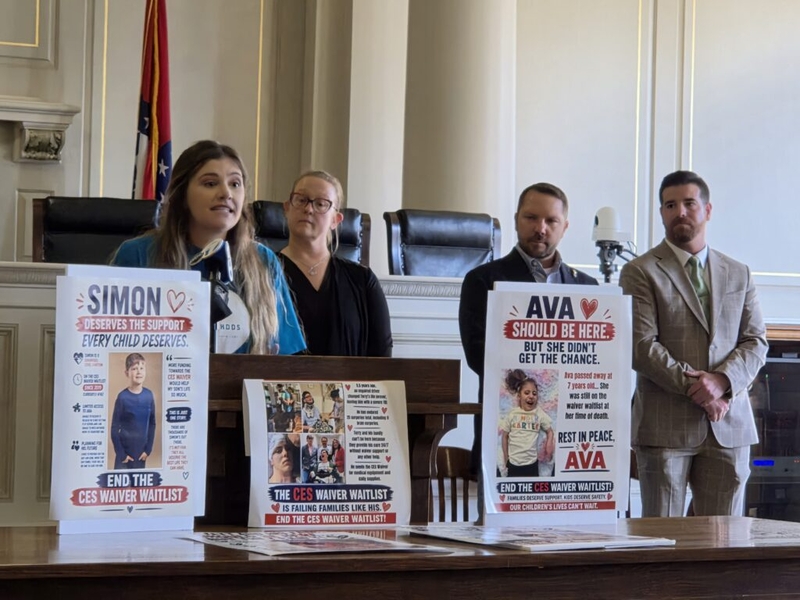
From left: Disability advocate Paige McCammon addresses a rally at the Arkansas Capitol urging Gov. Sarah Huckabee Sanders to clear the waitlist for supportive living services while Arkansas Support Network CEO Syard Evans, Libertarian gubernatorial candidate Colt Shelby and disability advocate Blake Landers listen on Sept. 16, 2026. (Photo by Tess Vrbin/Arkansas Advocate)
Families of Arkansas children with disabilities packed the Old Supreme Court room at the state Capitol on Wednesday and urged Gov. Sarah Huckabee Sanders to take further action toward clearing a waiting list for supportive services.
More than 2,400 Arkansas families are waiting for a Medicaid waiver that will help them meet their children’s complex medical and non-medical needs. A maximum of 8,233 Arkansans can receive supportive services from the waiver, and many families spend years on the waitlist.
Sanders announced Tuesday that the Department of Human Services will work to provide supportive living services to families on the waitlist starting in January.
Paige McCammon said at Wednesday’s rally that she appreciated Sanders’ effort, which came after weeks of social media posts from her and other parents sharing stories of their children’s needs.
“This was the moment Arkansas said, ‘Enough.’ This was the moment that a small group changed history, and Governor Sanders, you have a huge opportunity to help us change that,” said McCammon, whose son Turner has severe epilepsy and a neurodegenerative condition.
Sanders, a Republican, was not present at the rally. Her two opponents for reelection, Democratic state Sen. Fred Love and Libertarian Colt Shelby, were both present and among the speakers.

McCammon and other parents continued to ask Sanders to convene a special legislative session to address the waitlist. Tamerah Cooper, whose son Maceo has a neurodegenerative disorder, called the waiting families’ needs “an unbiased issue.”
“I speak for the children deteriorating while they wait,” Cooper said. “I speak for the caregivers who are not paid for the work they do, but they do it out of love. I speak for the parents who have to go to work worrying if their child’s needs will be met.”
Families on the waitlist can receive most of the services available to people on the waiver, but one of the few exceptions and the one most requested is supportive living services, or affordable in-home care for people with disabilities.
Sanders said Tuesday that it should cost about $17 million for the state’s managed-care Medicaid program to provide supportive living services to more families by January.
Sanders “will continue to look at options to improve services across the state,” her spokesperson Sam Dubke said Wednesday.
Her immediate predecessor, fellow Republican Gov. Asa Hutchinson, directed $37.6 million toward disability support services in an effort to clear the waitlist in 2021. More than 3,000 people were waiting at the time, and all received services by 2025.
Syard Evans, CEO of the disability advocacy group Arkansas Support Network, noted that caregivers are being paid the same rates they were in 2018 when the managed care program for Arkansans with disabilities began. A Department of Human Services study last year showed that supportive living services cost 23% more than what the insurers reimburse.
The law mandating the study also required the state to increase reimbursement rates, and Evans said those rates are expected to go into effect Jan. 1.
“My fear is that it’s too late for many providers and people,” Evans said. “We have seen colleagues close their waiver programs and stop providing supported living services.”
Dr. Hannah Lewis, a pediatric neurologist whose patients include Turner McCammon, said her patients often struggle to implement their treatment plans because they don’t have enough equipment, respite or insurance coverage.
“I have seen parents lose jobs, go without sleep, and lose their financial security to pay for bills or stable housing,” Lewis said. “I have seen the strain this places on marriages and on siblings, and despite all of these challenges, their goal remains simple: to keep their child at home, where they are known, loved, and cared for by their family.”
Little Rock