Pardon request 25 years after sex offense sparks discussion on purpose of clemency in South Dakota
Sep 16, 2026 | 7:05 pm ET
Description
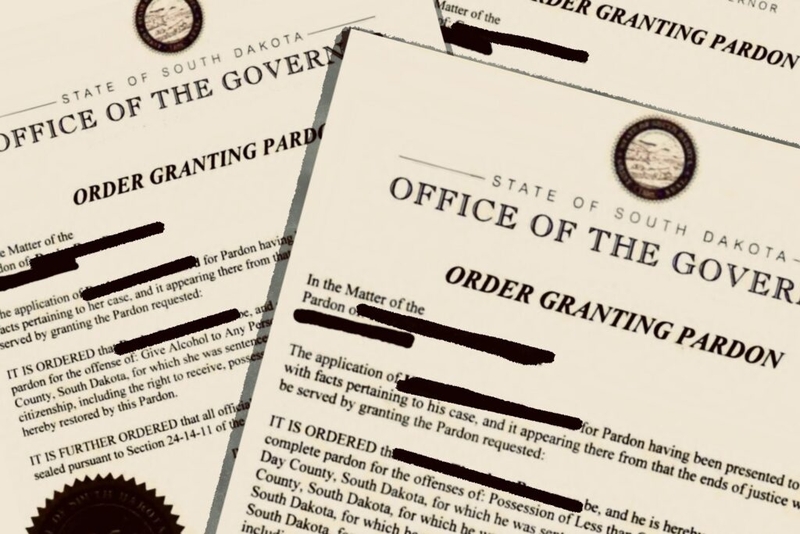
Pardons in South Dakota are granted by the governor, who may consider recommendations by the Board of Pardons and Paroles. (Illustration by Joshua Haiar/South Dakota Searchlight)
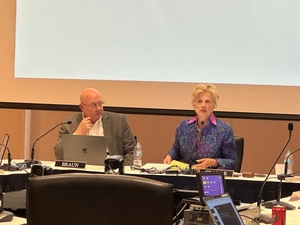
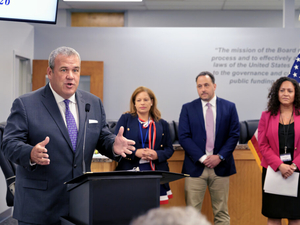
SIOUX FALLS — A request for clemency from a man convicted of a sex offense 25 years ago spurred a discussion on the purpose of a pardon Wednesday at a meeting of the South Dakota board empowered to make recommendations to the governor.
The 57-year-old who applied for the pardon hasn’t been charged with a crime since he was convicted of sexual contact with a minor.
He wants to have the 2001 offense cleared from his record, he said in his application, because he felt his actions since the crime show that he’s paid his debt to society. He also said he’d recently lost a job he’d held for years in the logging industry, and felt the conviction would make it difficult to find employment again.
More inmates denied early release as more parolees return through crackdown
His application included recommendations from family members, and a letter from the victim, who was 13 years old at the time and now says she has forgiven him.
The victim wrote that the man now requesting a pardon had “gone above and beyond to make things right with her,” Shelli Gust, administrator for the South Dakota Board of Pardons and Paroles, told board members on Wednesday.
The man, whose name and picture are listed in the South Dakota Sex Offender Registry, is a father of three who’s married to the same woman he was at the time of his conviction, Gust said. He served four years in the Marines, Gust said, and had the support of “a very large family.” He was never incarcerated for the crime, but was sentenced to 10 years on probation.
Two members of the parole board had recommended denying a pardon recommendation during an initial review process on Tuesday. The full board reviewed the request on Wednesday.
Nature of offense sparks questions
Most criminal arrests and convictions in South Dakota are part of a person’s permanent record. Unlike some states, there are no provisions of state law that automatically remove old crimes after a period of good behavior.
The legal avenues to clear a crime from the public record in South Dakota are spare.
Those convicted of a crime can ask a judge for a suspended imposition of sentence. In such situations, the crime is removed from the person’s record after a period of good behavior and meeting any other conditions imposed by a judge.
A person who’s arrested, but for whom no formal charges are filed, can ask a judge to remove an arrest from their record.
A pardon from the governor is the only other way to get a crime removed, and the pathway to a pardon typically begins with the parole board.
Aaron Pilcher, an attorney from Huron whom Rhoden appointed to the board in February, said on Wednesday that the 57-year-old’s situation didn’t stand out as deserving of a pardon recommendation.
Having a felony, Pilcher said, “isn’t convenient,” but that inconvenience alone shouldn’t be enough to qualify a person who’s behaved since their felony conviction.
He noted that the applicant had lost a job and wants a new one, but didn’t list a specific job or explain why his offense would prevent him from getting one.
“What about this guy’s offense raises it above the level of an inconvenience?” Pilcher said.
Kirsten Aasen, a defense lawyer who serves as vice chair of the board, said that Pilcher’s comments “triggered” her.
Plenty of states offer easier ways to clear a record, Aasen said, because felony convictions make it harder to get and hold down a job or find a place to live. Several states, including California and Michigan, have laws that automatically clear some convictions from a person’s record after periods of good behavior.
For people with decades of good behavior in South Dakota, Aasen said she operates on a “presumption” that a pardon is appropriate.
A felony “is more than just an embarrassing social stigma,” she said. “It’s financially debilitating.”
Kurt Hall, one of the two board members to recommend denial of the man’s pardon on Tuesday, said he understands why a person with a sex offense on their record would like to see it removed. Rau was the other member to recommend denial Tuesday.
But Hall, the Faulk County sheriff, also said the recent case of Mark Milk has made him cautious. In 2023, the board recommended a commutation for Milk, who’d been serving a life sentence for manslaughter. Former Gov. Kristi Noem granted the commutation; the board later paroled Milk.
Milk is in custody again, facing federal drug distribution charges in Iowa after police alleged he provided his teenage niece with the cocaine that killed her.
Given the scrutiny that high-profile case has placed on the board, “it’s a perfect storm to go against” a convicted sex offender’s request for clemency, Hall said.
Pilcher, in response to Aasen’s comments, said he’s also concerned about the way the applicant described the offense.
“It looks more severe or deliberate in the actual report than in how he describes what happened,” Pilcher said
Governor will decide
Board member Peter Lieberman moved to recommend a pardon. Lieberman, a former judge, said he agrees with Aasen about what qualifies a person for a pardon. Lieberman pointed to the applicant’s service in the Marines as a major factor weighing in his favor.
“I’m as tough on sex offenders as anyone, but I don’t want to see someone who served in the Corps and has stayed out of trouble for 25 years to be saddled with” the stigma of being a sex offender, Lieberman said.
The board voted 5-4 to recommend a pardon to Gov. Rhoden. Hall ultimately voted yes with Lieberman, as did Aasen, board members John Brown and Patricia Meyers. Pilcher and members Myron Rau, Vaughn Beck and Jan Steele voted against the recommendation.
Rhoden will review the man’s application. As of May, Rhoden had issued 90 pardons and two commutations since he became governor in January 2025. He’d denied four pardon requests and one commutation request by that time.
State lacks strict rules for pardon eligibility
The parole board can release inmates on parole or pull them back into prison for parole violations, but only acts as a screening panel for pardons. Under the state constitution, the governor has the exclusive authority to issue or deny pardons.
State law does not have binding rules to define who does or does not qualify for a pardon.
Sioux Falls man on parole for manslaughter is charged with providing drugs that killed his niece
The board’s administrative rules on executive clemency list seven factors that “may” be considered at a hearing on a person’s application for a pardon. Among them are the applicant’s age and medical status, a demonstration of “remarkable rehabilitation,” a showing that their sentence was excessive or “a miscarriage of justice,” or that they’re seeking “a professional career from which society can benefit, but a conviction prevents it.”
The board may also consider “the applicant’s attitude, character, capabilities, and habits; the nature and circumstances of the offense or offenses,” as well as “the effect the applicant’s clemency will have on the victims of the crime and the community.”
The administrative rules offer guidance, but are ultimately suggestions that leave room for interpretation, according to Rau, the board’s chair.
If the board recommends a pardon, the governor gets any materials offered in the person’s application, background information on a case, and audio and video of any board discussion on the person’s situation.
Gov. Larry Rhoden, in an interview with South Dakota Searchlight in 2025, said he bases his pardon decisions on his own feelings and personal judgment. When he’s denied clemency to someone for whom the board had recommended it, Rhoden said, it was mainly because he felt that not enough time had passed since a crime occurred.
A pardon clears an old crime completely from the public record, though a copy of the pardon showing the pardoned crime or crimes remains on file at the South Dakota Secretary of State’s Office. After a period of five years, the pardon document is sealed.
The governor can also grant another form of clemency called a commutation. That reduces the sentence for current inmates, typically making them eligible for parole earlier than they’d otherwise be. The board typically must vote to authorize parole after a commutation is granted — as its members did with Milk in 2024 — though a governor has the authority to issue a commutation that results in an inmate’s immediate release.

Pierre, SD