Alaska senators question legality of state land transfer for possible Mat-Su data centers
Sep 16, 2026 | 8:00 pm ET
Description
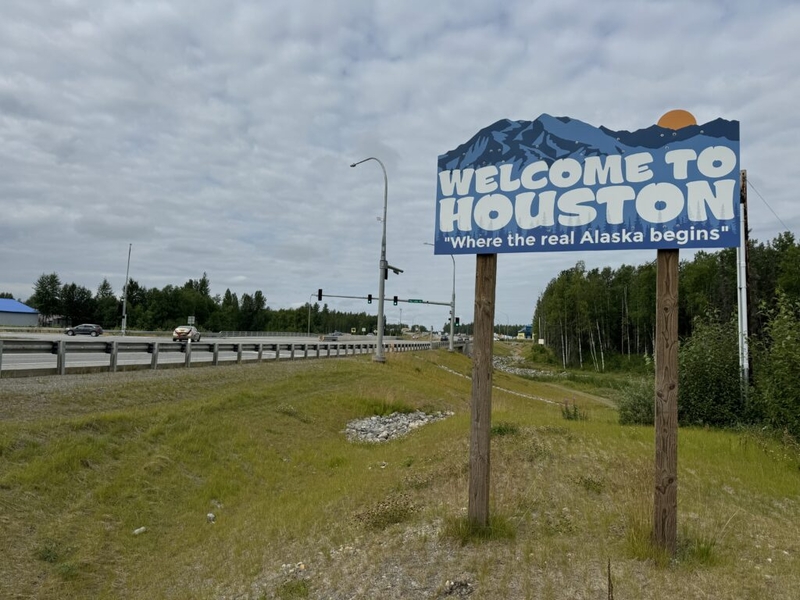
A welcome sign to the city of Houston in the Matanuska-Susitna Borough is seen in an undated photo. (Photo by Amy Bushatz)
The prospect of data centers in the Matanuska-Susitna Borough has raised public concern and scrutiny of a proposed state land transfer of nearly 20,000 acres to the Alaska Industrial Development and Export Authority. Now, Alaska lawmakers are weighing in with legal concerns about the state’s proposal.
The Alaska Department of Natural Resources issued a preliminary decision in July to convey the nearly 30 square miles of land near Houston in a non-competitive, no-cost state land transfer to AIDEA, the state-owned economic development agency, for a “multi-use industrial and energy development district,” which could include data centers.
A group of senators on the Senate Resources Committee raised a range of concerns with the proposed land transfer to AIDEA in two letters to DNR during a public comment period.
Among their concerns, senators cited a legal analysis that calls into question the legality of the land transfer to AIDEA for “public and charitable use” because under the law the state can only make such a transfer if the land serves a sufficient public purpose.
According to the legal analysis by an attorney with the non-partisan Legislative Affairs Agency, “the conveyance may raise legal issues” without a DNR review of the proposed projects for the industrial district. So far, no projects have been confirmed at the site.
“We are concerned that the uses for the AIDEA conveyance are too vaguely premised,” the senators wrote in a Sep. 9 letter to the department. “The public interest cannot be evaluated or made certain; and that DNR has not and cannot perform its legally mandated due diligence under these circumstances.”
The letters were signed by Sens. Cathy Giessel, R-Anchorage, Bill Wielechowski, D-Anchorage, Forrest Dunbar, D-Anchorage, Matt Claman, D-Anchorage, and Scott Kawasaki, D-Fairbanks, all members of the multi-partisan Senate majority coalition.
The five of the seven committee members raised its concerns to DNR during an extended public comment period which ended Sep. 14. The state’s proposal garnered more than 2,100 comments, according to department officials.
A spokesperson for DNR declined an interview request to address the concerns raised by senators about the public benefit use. In an emailed statement, DNR spokesperson Lorraine Henry noted AIDEA’s status as a public corporation and directed questions about potential developments to AIDEA. She said the department will be reviewing all public comments before making a decision. “Any final decision will address feedback from the public, agencies, and legislature,” she wrote.
AIDEA officials denied an interview request on the proposed development and the senators’ concerns, but forwarded several letters by executive director Randy Ruaro on the proposal.
He wrote that AIDEA ownership “creates flexibility” for the Mat-Su Borough and the organization will collaborate with a variety of user groups before committing to projects.
“The goal is not to impose a single concept on nearly 20,000 acres. It is to identify which ground is suitable for development, which should remain a buffer or stewardship area, which access routes must be protected, and where local ownership makes better sense,” he wrote in a letter to Mat-Su legislators.
Possible data centers under debate
In the proposal, DNR said that the project could host a variety of projects, “including but not limited to:” a logistics hub adjacent to the Alaska Railroad, energy or utility projects, gravel or rock mining, manufacturing or data centers.
The agency says AIDEA seeks to acquire the land to “catalyze private investment and create durable jobs for Mat-Su residents.”
Local lawmakers representing the Mat-Su region say they support the development if it is what the community wants.
The group of senators with the Resources Committee said DNR must ensure state lands are used for public benefit under the law, and they were “not satisfied” DNR had performed an adequate review of proposed projects. That includes negative consequences of potential data centers — their energy and water demands, and environmental and community impacts including noise pollution.
Data centers have come under intense scrutiny and public criticism nationwide as technology companies have constructed the facilities to house servers or IT infrastructure to store or manage data running to digital applications and services. Consumers are angry at rising energy bills, and concerned about environmental impacts, including water use.
Southcentral Alaska, including the Matanuska-Susitna Borough, relies on natural gas for most of its energy needs. If an energy-hungry data center is built, it could drastically increase demand where supplies are already insufficient for existing demand.
“We do not want to see our state residents and small businesses forced to compete with private data centers for supply of natural gas or their utility bills driven sky-high, anytime soon or into the future,” the senators wrote.
But AIDEA officials have denied there are plans to build data centers, saying they are a possibility, but that no actual projects have been approved or confirmed.
“Let me be clear. There is no data center project planned, nor has one ever been discussed with a project proponent,” Ruaro wrote in a letter to DNR.
Ruaro said there have been efforts by China and Democrats to oppose data center developments “for political gain.” He said energy and water use concerns are valid but do not apply to the proposed land transfer.
Ruaro said that the state holding public lands generates no income, and AIDEA has the tools to lease lands and finance eligible projects, as well as work with local cities and boroughs on development projects. In a letter to Mat-Su legislators, he said any development project will only occur with input from surrounding communities.
“Local community needs will be prioritized,” he wrote.
Anchorage Republican Sen. Cathy Giessel, chair of the Senate Resources Committee, said in an interview she hears regularly from constituents who have concerns about data centers being developed in Alaska. Plus, with a looming gas shortage in Southcentral Alaska, she is concerned about any potential data centers’ energy demands.
“We are struggling right now to make sure we have energy,” she said in a Friday interview. “This seems terribly inappropriate.”
Republican Sen. George Rauscher and Republican Rep. Kevin McCabe, whose districts include the parcel under dispute, told the Alaska Beacon that they support what the local community wants for the land.
McCabe, in an interview Tuesday, said he was frustrated with members of the Senate Resources Committee’s opposition to the proposal. He wrote a letter responding to the committee members and argued AIDEA ownership is beneficial in promoting economic development and boosting much-needed revenues for local services.
“It makes little sense to block opportunities for jobs, investment, and taxable development before the people who actually live here have even decided what they want,” he said.
McCabe said he’s not concerned about data centers, and any construction would be subject to all local and state regulations.
“As far as a data center, I could care less,” he said. “It could be a horse farm. It could be a grain field, whatever brings money, whatever business brings money to the Borough coffers, so that the property taxes don’t go up or a gas tax doesn’t go up.”
Meanwhile, the nearby Houston city council voted unanimously last month to oppose the land transfer. It also introduced a two-year moratorium on the construction of new data centers to be heard at a meeting on Oct. 8.
On Tuesday, the Mat-Su Borough Assembly unanimously opposed the proposed land transfer to AIDEA and called for “more appropriate” land for development projects in the Point McKenzie and West Susitna regions.

Juneau