Regents give initial approval for Center for Intellectual Freedom organizational plan
Sep 16, 2026 | 6:42 pm ET
Description
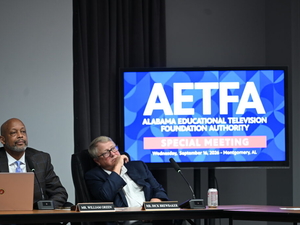
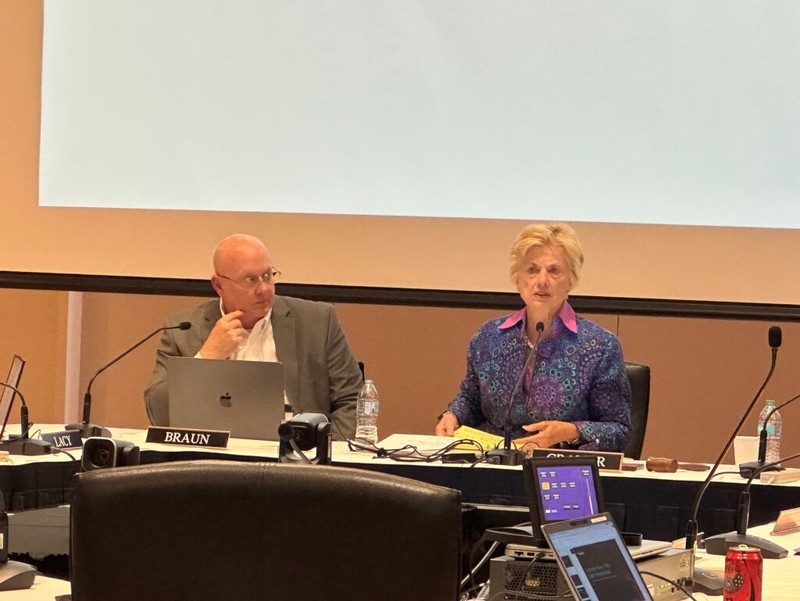
Iowa Board of Regents Executive Director Mark Braun, left, and Regent Christine Hensley attend a board meeting on Sept. 16, 2026. (Photo by Brooklyn Draisey/Iowa Capital Dispatch)
The Iowa Board of Regents Wednesday received an update from its new Center for Intellectual Freedom Committee on its search for a permanent director as the center carves out the details of its own independence from the University of Iowa.
Regent Christine Hensley, chair of the regents committee overseeing the Center for Intellectual Freedom at the University of Iowa, said the center advisory council’s executive committee has narrowed the pool of 62 center director applicants to 11 candidates. Board Executive Director Mark Braun also clarified during the meeting that no less than three, but no more than four, finalists can be brought to the full board of regents for consideration.
Advisory council executive committee members in a Sept. 1 meeting went through the applicants for the center’s executive director role and discussed the center’s interactions with the UI.
“I know, to be perfectly honest, that there will be some members of the executive committee that are not pleased with us moving forward,” Hensley said. “But it’s critical that we keep the process going. We want to notify all applicants today what their status is, whether they’re in that pool, and or whether or not they’re not going to be invited for an interview.”
Hensley said the executive committee members will meet again next week to decide whether they want to eliminate a few more of the current candidates before setting up Zoom calls in the last week of September and in-depth interviews the week of Oct. 5. Discussions of campus visits and the finalist list will take place in mid-October, she said, with the possibility of calling a special board of regents session at the end of the month to select the center’s permanent director.
Board President Robert Cramer, who also sits on the center committee alongside Regent Steve Lacy, called this work “the beginning of a reset” and said he believes the center is moving in the right direction.
Members of the center’s advisory council have said how necessary the relationship is between the center for intellectual freedom and the UI, and have expressed concerns about trying to create an academic framework and curriculum when the details of that relationship — and leadership of the center — have not been solidified.
The organizational plan released by the board of regents for the center is focused on “back of the house” operations, Hensley said, including infrastructure and assigned responsibilities. It states the chair of the center for intellectual freedom committee — Hensley — has authority to sign off on purchases and contracts totaling $25,000 or more, according to the plan, and will act as the director’s “supervisor of record in University of Iowa systems and hold approval authority in those systems on behalf of the Board.”
Whoever becomes the center director will have signature authority on purchases less than $25,000, the plan stated. They will have “sole and exclusive authority” over recruitment, hiring and firing of center staff and will supervise all personnel, including approving time off and work situations outside of the norm, like a hybrid format.
Hensley in her role as committee chair will also initiate annual budget reviews and submit them to the board of regents, serve as the board’s administrative contact for human resources transactions, and work with university HR and other departments for special payments. She will also approve the director’s “time and attendance,” as well as trip requests, and serve as the director’s supervisor for administrative processes in university systems.
Advisory council members pushed back against restrictions on director travel at the Sept. 1 meeting, after interim director Luciano de Castro said the board committee didn’t allow him to travel to different conferences.
“I’ll be real honest with you right now; they’re not satisfied with the document, but they are an advisory committee, and the board of regents has final authority to approve that,” Hensley said.
She added that the executive committee members were given “the opportunity to provide additional comments” after the meeting, but none were provided.
A memorandum of understanding is also in the process of being developed, Hensley said, but those involved have decided that it needs input from whoever the permanent center director will be before it is finalized. The memorandum will outline the academic side of interactions between the university and center.
According to the organizational plan, the center director will be in charge of negotiating and implementing the memorandum when it comes to information technology services, as well as facilities-use agreements.
“The university will still be playing a role because we will be utilizing the systems and IT at the university,” Hensley said. “I mean, we can’t have; they can’t be completely independent … we’ve got to rely on the university providing that support.”
Des Moines, IA