Iowa universities propose new programs for academic and workforce demand
Sep 16, 2026 | 5:42 pm ET
Description
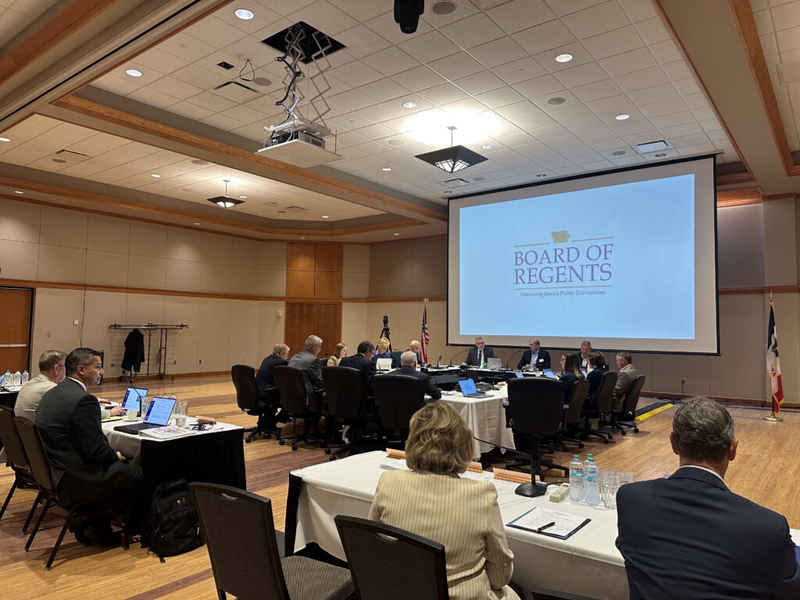
The Iowa Board of Regents meets at the University of Northern Iowa on Sept. 16, 2026. (Photo by Brooklyn Draisey/Iowa Capital Dispatch)
The Iowa Board of Regents Wednesday provided initial approval for a slate of new programs and university initiatives, focusing on health and data sciences and centers to provide increased collaboration and projects across campus.
Iowa State University
Iowa State University was the only institution to bring programs to the board for closure — its master of science and arts degrees in interdisciplinary graduate studies, the Research Institute for Studies in Education and the Midwest Transportation Center.
Housed in ISU’s Institute for Transportation, funding for the Midwest Transportation Center ended in 2018 and currently there are no financial or project ties to the center, according to board documents.
The interdisciplinary programs have very low enrollment, board documents stated, and the research institute will instead become a subunit of the university’s School of Education. ISU Provost Jason Keith said these programs are the first of those identified through the university’s program vitality review to come to the board for closure.
Only three degrees have been conferred in the graduate programs since 2021, Keith said, and any students in the programs now will be able to finish their studies through teach-out plans.
The Ames university also requested approval to create a new machine learning master’s degree and an international program in partnership with a Greek institution. ISU has worked with the American Farm School University of Science and Technology in Thessaloniki, Greece, for more than 30 years, board documents stated, and ISU programs that would be offered in Greece through the new partnership include bachelor’s and master’s degrees in agricultural business and economics, biochemistry, food science and horticulture.
Ann Marie VanDerZanden, ISU’s associate provost for academic programs, said during the meeting that throughout the two institutions’ relationship, they’ve exchanged more than 300 students, 40 faculty members and multiple academic leaders.
“We know that Iowa State already has a strong international presence and appeal, and we think that we’ll be able to continue to grow on that once we have this new entity in place,” VanDerZanden said.
If approved, the program could see as many as 320 enrolled undergraduate students and 40 enrolled graduate students in its fourth year, according to the document. ISU will establish the degree requirements, provide curricular maps and syllabi, oversee assessment standards and send out transcripts and degree conferrals, while the American Farm School will provide instruction and student supports and handle recruitment and admissions.
She said the program would launch in fall 2027 if approved by the board. A portion of tuition revenue will go to ISU, projected to reach $360,000 in the academic year beginning in 2030.
The new master of science in machine learning and data engineering, set to be provided in a hybrid format if approved by the full board Sept. 17, will train students in forming data-driven solutions to engineering problems and the use of different software tools. According to board documents, enrollment by year five is predicted to reach 40 students, alongside 30 “non-major” students.
Keith said the program would be of interest for computer engineering, computer science and data science students.
“There is a need for engineers who can work with, create, and extract value from large sets of data across nearly every industry, but especially including energy distribution, transportation, agricultural systems, and artificial intelligence,” Keith said.
University of Iowa
The University of Iowa is requesting to form a new center focused on cancer drug development. UI Executive Vice President and Provost Kevin Kregel said Wednesday the Institute for Cancer Drug Discovery and Development, or CANDID, would bring together separate research streams and provide needed education and training for workforce needs.
CANDID would create a formal partnership between the UI’s Holden Comprehensive Cancer Center and College of Pharmacy, as well as coordinate with other university centers and units, board documents stated, to create a cancer drug development pipeline that can more readily respond to medical and pharmaceutical needs in Iowa.
The institute would employ an institute director, other “core directors” and administrative staff, and complete a “strategic cluster hire” of faculty hailing from areas like artificial intelligence-enabled drug discovery, drug delivery and clinical pharmacology.
Funding for the center would come from the cancer center and college of pharmacy, donations, funding reallocations from other departments and “institutional strategic resources,” board documents stated. The UI would also work to secure external funding from federal sources, external partnerships and opportunities for commercialization. According to board documents, the first year will require $1.5 million, then $1 million each year after.
Kregel said many of the pieces are already in Iowa City, with strengths in pharmaceutical sciences, clinical trials and biomanufacturing, and the center will “bring these capabilities together around a common purpose.” The center is also needed as Iowa continues to struggle with high cancer rates, he said.
“This could be a distinctive capability for the University of Iowa and for the state, as CANDID has a specific focus on moving cancer discoveries all the way toward early clinical translation, and that would set us apart nationally,” Kregel said.
The UI also brought forward three new academic programs for board approval, including a master of science in engineering management, doctor of medical science and bachelor of science in health administration.
Tanya Uden-Holman, associate provost for undergraduate education and university college dean, said students enrolled in the health administration program will complete coursework in both public health and health economics, as well as some business classes. She said a market assessment showed “sustained employment demands” in a range of healthcare careers, from hospitals to outpatient clinics and insurance.
Seventy students are expected to be enrolled in the program by its fifth year, Uden-Holman said. The UI will need to hire one “50% instructional faculty,” she said, an expense of more than $59,000 annually, and the program should break even in its second year of operation and reach close to $296,000 in net revenue by year five.
“Exploration of the program was initiated in response to feedback from the UI Office of Admissions, which identified strong interest in a health administration major among prospective students,” Uden-Holman said.
Those who have already earned a master’s-level degree in physician assistance are the target group for the post-professional doctor of medical science program, according to board documents. The program will take place completely online and will have full- or part-time options for students working as well as learning, and with board approval would start in January.
Saba Ali, UI associate provost for graduate and professional education and graduate college dean, said the program will “leverage advanced standing from the University of Iowa Master of Physician Assistant Studies clinical phase,” totaling 48 semester hours, with an additional requirement of 24 semester hours of doctoral coursework delivered over the course of eight weeks.
Enrollment in the online program is expected to reach 60 students in its third year, drawing from UI alumni and other groups through recruitment efforts. Three-quarters of the UI students and alumni who responded to a needs assessment for the program said they were interested, Ali said.
The program is expected to break even in its first year and have $284,000 in net revenue by its fifth year. Total expenses come to $148,000, Ali said, paid for by university reallocations and tuition revenue.
“This focus strengthens the university’s capacity to prepare advanced healthcare leaders rather than expanding clinical instruction,” Ali said.
Students who will enroll in the master’s program in engineering management, if it is approved, will also complete their education entirely online, according to board documents. Ali said the program involves both the engineering and business colleges, with each area developing curriculum for students.
Annual expenses are expected to total $130,000, Ali said, with the program set to break even in year two and have $216,000 in net revenue in its fifth year. The UI predicted that the program would see 75 enrolled students in year five.
“The program will provide education and training in system level engineering and technology leadership and management for individuals seeking roles such as project manager, technical manager, product manager, or engineering director,” Ali said.
University of Northern Iowa
The University of Northern Iowa is working to develop a center that will serve as a repository for important political documents and act as a campuswide resource for civic education, public engagement, leadership development and historical learning.
U.S. Sen. Chuck Grassley and his wife, Barbara, committed to providing important documents from Grassley’s political career to the University of Northern Iowa in January 2024, which will add to a collection of papers already donated by the lawmaker.
UNI proposed to the board of regents Wednesday the creation of the Chuck and Barbara Grassley Center, which board documents stated would allow the university to provide the public some access to its archived materials. The center would also operate the Grassley Scholars Program for scholarship and leadership development and facilitate events and discussions for campus and the public.
Funding for the center will come from the university and its endowment earnings, as well as donations, grants, foundation support, corporate partnerships and event revenue. Board documents stated the center will start with an executive director, program coordinator and administrative assistant, with further hiring needs a possibility in the future.
The board of regents will discuss approval of the center at its Sept. 17 meeting.
Des Moines, IA