Michigan Senate passes new versions of nine bills held up in House, vetoed by Whitmer
Sep 10, 2026 | 2:24 pm ET
Description
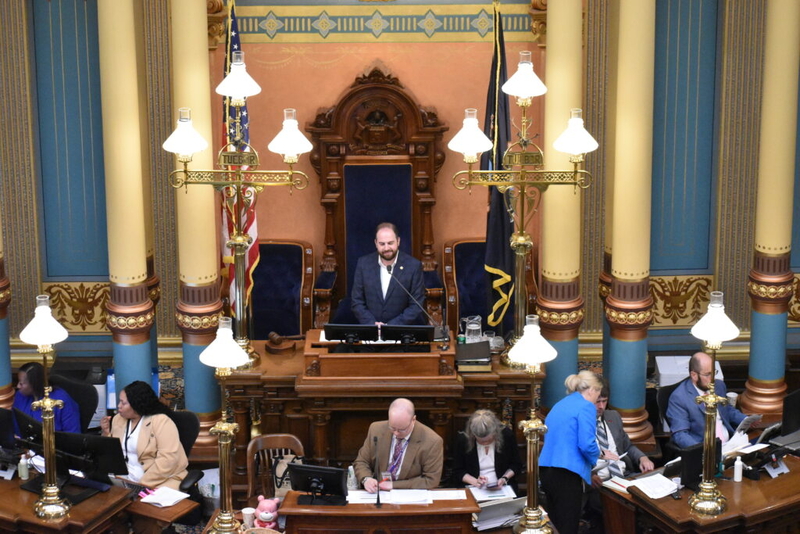
State Sen. Jeremy Moss (D-Bloomfield), presiding as Senate president pro tem, as the chamber votes through its 2026-27 budget. April 29, 2026 | Photo by Ben Solis/Michigan Advance
Members of the Michigan Senate on Thursday pushed forward with new versions of nine bills that became the subject of controversy when the legislation was prevented from reaching the desk of Gov. Gretchen Whitmer by the Republican-led House of Representatives.
The bills eventually reached Whitmer’s desk this year but she ultimately vetoed the legislation just hours after the Michigan Supreme Court ordered them to be presented to the governor. Whitmer indicated in her veto letter that she would sign new versions if they reached her desk before the end of her term.
Undeterred, the Senate passed the new versions on Thursday, but the legislation might meet another logjam in the House as Republican Speaker Matt Hall (R-Richland Township) has tied the bills moving forward to a potential deal on his languishing property tax reforms that died during negotiations on the 2026-27 fiscal year budget.
The bills in question would provide long-term economic relief to first responders, teachers, corrections officers, and others who are struggling to get by, according to Senate Democrats following passage.
“Today’s passage of these nine bills signals our unwavering support for the dedicated workers whose hard work and sacrifice sustain our great state,” said Senate Majority Leader Winnie Brinks (D-Grand Rapids). “While a lengthy legal battle and veto may have delayed the passage of this quality public policy, it did not diminish its value or our commitment to getting it across the finish line. Let’s finally get this done and deliver the much-needed relief our communities have long been calling for.”
Among the bills were priorities for unions and workers, including legislation to improve retirement benefits for state corrections officers, measures to lower healthcare costs for local public employees, and protections on assistance and benefit programs from debt collection.
Whitmer vetoes 9 bills at heart of Supreme Court case, which had been ordered to be presented
“Michigan Senate Democrats are working their tails off to put Michigan workers first — and anyone running for office should take note, because workers will determine this election,” said Ron Bieber, president of the Michigan AFL-CIO. “This legislation will lower healthcare costs for essential public servants, secure pensions and retirement for public safety professionals, and protect families from aggressive debt collection tactics. It’s about damn time.”
The bills include:
- Senate Bill 1136, sponsored by state Sen. Kevin Hertel (D-St. Clair Shores). The bill would lower health insurance costs for public employees;
- Senate Bills 1133, 1134 and 1135, sponsored by state Sens. John Cherry (D-Flint), Chedrick Greene (D-Saginaw) and Sue Shink (D-Northfield Township), respectively. The bills would allow for Michigan Department of Corrections officers and other law enforcement personnel to opt into the Michigan State Police pension plan;
- Senate Bills 1137 and 1138, sponsored by state Sens. Jeff Irwin (D-Ann Arbor) and Mary Cavanagh (D-Redford Township). These bills would exempt public assistance from garnishment and update other exemption values; and
- Senate Bills 1139, 1140 and 1141, each sponsored by state Sen. Sylvia Santana (D-Detroit). Santana’s bills would allow for millage questions on ballots to support operations of history museums.
A legal battle that brought Dems back to the drawing board
Each of the bills were reintroduced versions from their 2023-24 House counterparts that were passed during the Michigan Democratic Party’s trifecta — in which the party held majorities in each chamber of the state Legislature and the governor’s office.
In the days just after the 2024 legislative session ended, the clerk of the House and then-House Speaker Joe Tate (D-Detroit) did not transmit those nine bills to Whitmer’s office despite other bills being sent to the governor at the end of the lame duck session. The bills were still sitting there, so to speak, when current House Speaker Matt Hall (R-Richland Township) took over.
No clear explanation has ever been offered by the House or the administration as to why the bills weren’t sent when Tate still had control of the gavel, other than it just didn’t happen. Whitmer never publicly signaled or demanded that the bills be sent to her desk, either.
Hall refused to transmit the bills and questioned whether it was constitutionally or procedurally sound to send old bills from a previous session to the governor, which in turn would be signed in a new legislative session. The lawsuit at the heart of the drama followed when Senate Majority Leader Winnie Brinks (D-Grand Rapids) called on Hall to transmit the bills. He did not, and Brinks sued.
‘Stabbed in the back,’ unions said then of Whitmer’s vetoes
Over the course of that legal battle, there had been speculation that Whitmer secretly opposed the bills and had no intention of signing them in the first place. Whitmer’s communications team told the Advance, when asked on the record, that any conjecture or assertion that Whitmer had contacted Tate, the clerk of the House or Hall with instructions to hold the bills was false.
‘Stabbed in the back’: Unions, House Democrats call Whitmer’s veto of 9 bills a betrayal
The matter eventually rose to the Michigan Supreme Court, and its 6-1 Democratic Party-nominated majority ruled in favor of the Senate, ordering Hall to present the bills to Whitmer.
Within hours, Whitmer vetoed the bills due to their shelf life, saying she could not sign them into law with outdated implementation dates. Several Democratic lawmakers and the attorneys working the Senate’s case said that bucked precedent of other bills that were signed into law with older or outdated effective dates.
Bieber told the Advance then that the state’s major unions felt like Whitmer had stabbed them in the back by killing the bills after the protracted legal fight.
Hall sets conditions on the package’s fate in 2026
Whitmer, for her part, said she would sign the bills if new versions reached her desk, but with a caveat — Whitmer’s term ends in December, and a new governor will take her place following the November election.
The focus is now on Hall and his House Republicans, who seem wary to pass the legislation before the current House session ends.
In a statement to the Advance, Hall said that his Democratic Party colleagues had “two years to bring these bills back and negotiate with me after they blew it, but they chose to wait and pull a campaign stunt.”
“I’m the best deal maker in Lansing, and they could have come to me anytime,” Hall said. “If Democrats actually want these bills to move, they need to be ready to make a real deal on our plans to eliminate state property taxes, lower electric rates and create the health care cost review board.”
Each of those items were priorities Hall had pushed during the most recent budget fight but did not see movement on. Democrats are banking on success at the polls this year in the November general election due to President Donald Trump’s poor approval ratings and it potentially being a bad year for GOP candidates associated with him. Hall is a loyal devotee of Trump and his policies.
With the potential for losing the House this year, Republicans may try to use every lever they can to get their priorities across the board. Hall has also prided himself on being able to work well with Whitmer on balancing the two figureheads’ respective legislative wins, so this may be an opportunity for Hall to give the Democrats a win while also carving out a path for his property tax, utility rate and health care cost review board items.
“Democrats want to play politics with these bills, but I’m more interested in passing major reforms that actually lower people’s costs,” Hall said.
Lansing, MI