Federal appeals court upholds Oklahoma HB 1775 but narrows its meaning
Sep 10, 2026 | 4:23 pm ET

Description
A classroom sits empty at Mayo Demonstration School in Tulsa Public Schools on April 8, 2024. The Tenth Circuit Court of Appeals upheld an Oklahoma law banning certain race and gender concepts from being taught in public schools. (Photo by Nuria Martinez-Keel/Oklahoma Voice)
OKLAHOMA CITY — A federal appeals court has upheld and limited the interpretation of a controversial Oklahoma law impacting public school teaching on race and gender.
In a split decision Wednesday, the Tenth Circuit Court of Appeals decided House Bill 1775 appropriately bars Oklahoma public schools from teaching certain discriminatory concepts as if they are facts. The decision overturned a 2024 preliminary injunction from a U.S. district judge in Oklahoma City federal court, who had blocked a few portions of the law for vagueness.
A group of Oklahoma students, teachers, college professors and activists who sued to overturn the 2021 law contended HB 1775 is overly vague and unconstitutionally censors classroom discussions.
The law prohibits schools from requiring or making part of a course concepts such as one race being superior to another race, that individuals bear responsibility for past actions by others of their race or sex, and that students should feel discomfort or guilt over their race or sex.
Schools face a downgrade to their accreditation and teachers risk a certification penalty for violating HB 1775.
To violate the law, a teacher would have to present the banned concepts as fact, Tenth Circuit judges Gregory A. Phillips and Harris L. Hartz decided in their majority opinion.
“Apart from any prohibited racist or sexist editorializing, teachers remain free to instruct about historical or popular issues, and students remain free to draw their own conclusions,” Phillips wrote.
The third member of the three-judge appellate panel, Nancy L. Moritz, said the law should have been struck down “in full.” The majority opinion “impermissibly rewrites the statute” to clarify an unconstitutionally vague law, she wrote in her dissenting opinion.
The text of HB 1775 doesn’t specify that to violate the law educators must endorse a prohibited statement, Moritz wrote. Teachers could unintentionally make a banned concept part of a course “through discussion, by responding to questions, and in myriad other ways, any of which could violate the law,” she wrote.
Attorneys on both sides of the case celebrated the Tenth Circuit’s majority opinion.
The American Civil Liberties Union, representing the plaintiffs, said the judges’ narrow interpretation of the law means HB 1775 no longer impedes inclusive classroom discussions on race and gender.
“Oklahoma students deserve a nuanced education of race, gender, and American history,” ACLU of Oklahoma legal director Megan Lambert said. “This ruling narrowed Oklahoma’s censorship law out of existence by interpreting it to only prohibit educators from affirmatively encouraging discrimination.”
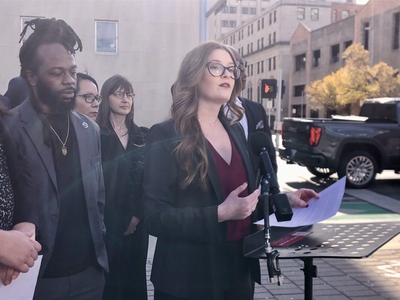
Attorney General Gentner Drummond, whose office defended the law, called the decision a first-in-the-nation appellate victory.
“This is a significant win for Oklahoma and affirms a simple principle: every Oklahoma student deserves to be treated as an individual, not defined or divided by race or sex,” he said. “Oklahoma teachers do important work every day, and the court has given them clarity to keep doing it well.”
With the Tenth Circuit decision on the preliminary injunction entered, the case now returns to Oklahoma City federal court.

Oklahoma City, OK