Cooper maintains lead over Whatley as pocketbook issues dominate NC’s critical US Senate race
Sep 10, 2026 | 3:52 pm ET
Description
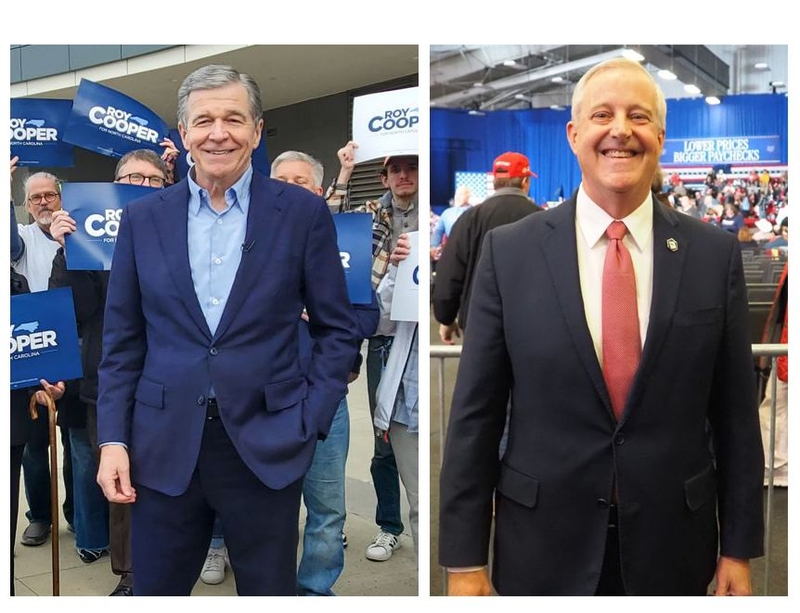
Former Governor Roy Cooper (pictured left) and Republican Senate candidate Michael Whatley (right) (Photos: NC Newsline)
With just over a month until early in-person voting begins on October 15, North Carolinians are squarely focused on pocketbook issues.
According to a new Elon University poll released Thursday, 86% of registered voters surveyed said inflation and the cost of living are “very important” issues, with 73% describing the general economy and healthcare as most important issues this fall.
Husser said that probably won’t help Republicans in competitive races in November.
“President Trump largely was re-elected because people thought he was going to handle the economy better than [Kamala] Harris,” said Jason Husser, director of the Elon University Poll. “But what we’re finding in North Carolina is that most people don’t think the economy is doing well at all.”
The survey of 800 voters conducted the last 10 days of August found that 49% of registered voters gave the nation’s economy grades of “D” and “F”, with 30% assigning a “C” grade. Only 22% said the nation’s economy earned “A” or “B” grades.
Half of the voters surveyed said they view the war in Iran as being very important when thinking about how they will vote in November. Husser said the average voter does not feel impacted by the distant conflict until they go to the gas station to fill up their vehicle.
“People are really thinking about how do they make ends meet right now,” Husser told NC Newsline. “They are expecting whoever is going to be our next U.S. senator to go to Washington with an agenda to deal with the economy.”
Candidates look to connect on affordability
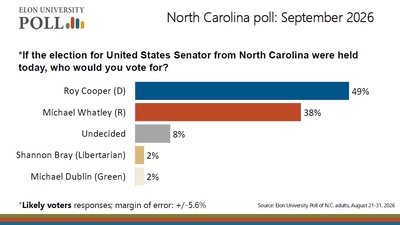
The Elon poll found that former North Carolina Democratic Gov. Roy Cooper holds an 11% lead over Republican Michael Whatley, 49% to 38%, among likely voters in the race for U.S. Senate. Only 8% of those surveyed are undecided at this point.
This week, Whatley traveled to Dallas, Texas to step into the national spotlight of the GOP’s two-day midterm convention. Whatley said under Trump’s leadership, North Carolina households have paid $5,700 less in taxes under the Working Families Tax Cut Act, which is what Republicans are calling last year’s “One Big Beautiful Bill” spending and tax cut package
Cooper continued his “Make Stuff Cost Less” tour, holding an event in Goldsboro Thursday to discuss his plans for lowering the cost of food and groceries, health care and utilities if elected to the Senate.
Husser said while those events are a chance for candidates to connect with undecided voters, the midterms will likely be a referendum on the president.
Trump’s approval rating in the survey was 31%, the lowest recorded by the Elon University Poll since Trump took office in January 2025.
In a sign that the president may be aware of those faltering numbers, Trump pledged Wednesday night that if Republicans retain the U.S. House and Senate in the midterms, every adult American would receive a ‘Trump Dividend’ of $5,000.
“I doubt we see many voters saying, ‘I’m going to go vote this particular way because if Republicans win, we’re going to get paid,’” said Husser. “I imagine many voters would be quite skeptical of that.”
At midterm convention, Trump pledges cash to voters if Republicans hold Congress
One thing that is clear from the Elon poll is that North Carolina voters are ready to vote.
Over half (51%) of the registered voters said they plan to cast their ballots in person during the early voting period that runs the last two weeks of October. Thirty-five percent plan to vote in-person at the polls on November 3. Only 8% of those surveyed said they intend to cast their votes by mail this year.
A majority of voters said they were satisfied with the length of the state’s early voting period. Last month, Gov. Josh Stein vetoed a bill passed by the Republican-controlled legislature to reduce the number of early voting days for primary elections in the state. In this month’s Elon poll, 56% of poll respondents said the length of the early voting period in statewide elections is about right, with 11% saying early voting is too short, and 11% saying the early voting period is too long.
Raleigh, NC