Private gas plants to power data centers would skirt state’s renewable energy law
Sep 01, 2026 | 8:00 am ET
Description
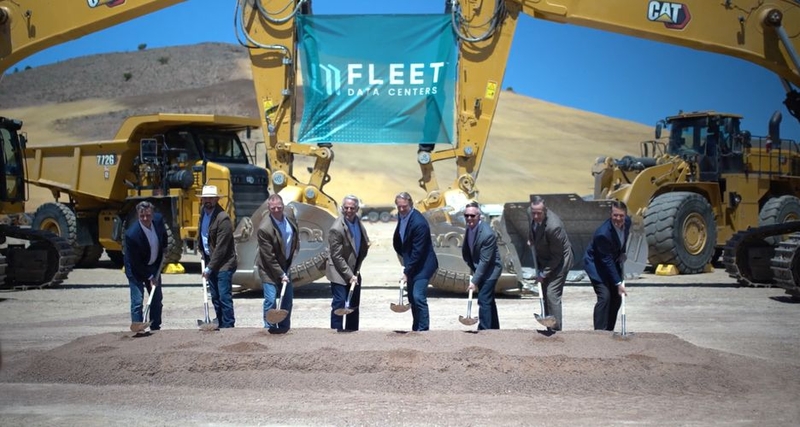
Gov. Joe Lombardo, fourth from left, and other state and industry officials at the groundbreaking for a Fleet Data Center in Storey County in May, 2026. (Photo posted by Fleet on LinkedIn)
A major data center developer is looking to build two private gas power plants less than 30 miles from Reno as data center growth outpaces NV Energy’s ability to supply electricity for a surge of new developments.
Denver-based Fleet Data Centers, a subsidiary of Tract Capital Management, is asking the Public Utility Commission of Nevada (PUNC) to approve their plans to build two massive gas-burning plants, which would power Fleet’s Peru Ridge and South Valley data center campuses at the Tahoe Reno Industrial Center.
If approved, the Peru Ridge and South Valley gas power plants would generate more than 360 megawatts of electricity using methane gas-fired engines, or enough power to serve about 396,000 homes, according to filings.
Once operational, the facilities would burn about three times as much methane gas as NV Energy’s entire Northern Nevada residential and commercial customer base in 2025, or enough gas to supply about 652,000 homes.
Advocates opposing the approval of the gas-burning plants say the case could effectively defeat the purpose of the state’s renewable portfolio standard, established by the Legislature in 2019, which mandates power providers utilize 50% renewable energy by 2030.
Fleet’s application is now before utility regulators at the PUCN, which will make a final decision on the gas-burning plants on Sept. 8. The proposal could be the first methane gas power supply approved specifically for data center use in Nevada.
The case is an example of data center builders increasingly turning to private fossil fuel plants in the race to build and power enough data centers to meet the surging demand for artificial intelligence services.
Since January, gas-fired power generation for data centers in the U.S. has doubled, driving a 50% increase in the amount of gas-powered electricity under development, according to a new report by Global Energy Monitor.
Data center growth in the Tahoe Reno Industrial Center is outpacing NV Energy’s ability to build permanent infrastructure to serve the industrial site, according to Fleet.
In filings, the data center developer said they expect the gas power plants to operate for about two to three years “until NV Energy can deliver permanent utility service to the site.”
NV Energy says it entered a large load electric service agreement with Fleet Data Centers subsidiary — SV RNO Property Owner 1, LLC – in May for the South Valley data center campus at the Tahoe Reno Industrial Center, and has filed a large load electric supply agreement with PUNC which is pending review and approval.
Methane gas power plants release much more greenhouse gases that drive climate change and contribute to human health issues, like asthma and heart disease.
NV Energy, the monopoly electric utility provider for the state, is required by state statute to provide a more diverse resource portfolio, including significant renewable energy sources.
In 2019, the Nevada Legislature passed SB358, requiring the state’s renewable portfolio standard (RPS) to increase each year, rising to 50% renewable power by 2030. NV Energy achieved nearly 48% RPS compliance in 2025, well above the 34% requirement as of that year.
But even in the short-term, advocacy groups say the scale of the gas-burning plants would be damaging for both local air pollution and for the climate.
In PUCN filings, Nevadans for Clean Affordable Reliable Energy said the size and capacity of the private gas power plants would nearly rival utility scale methane gas plants across the U.S., where about 80% of gas power plants average about 500 megawatts or less.
An analysis by Nevadans for Clean Affordable Reliable Energy, found that the new gas-burning plants, if built to specifications, would produce nearly 980 pounds of carbon dioxide per megawatt hour.
If the new gas-burning plants were operating in 2025, Nevada’s emissions would have increased by nearly 12%, according to Nevadans for Clean Affordable Reliable Energy’s analysis.
In filings, advocates urged public utility regulators to deny Fleet’s request to build gas power plants, pointing to the state’s renewable portfolio standard. Nevadans for Clean Affordable Reliable Energy told utility regulators that any move allowing data center developers to be excluded from the state’s renewable portfolio standard could attract more gas-burning plants.
“It will inevitably lead to thousands upon thousands of megawatts of dirty data center development in Nevada that will likely degrade regional air quality and be an effective abandonment of Nevada’s clean energy goals,” said George Cavros, on behalf of Clean Affordable Reliable Energy, during an August PUCN hearing.
The developers argued they are not subject to Nevada’s renewable portfolio standard, because they are not energy providers like NV Energy.
“I will add that there is no self-generation exemption to those statutes,” Cavros said.
Eric Gimon, a senior fellow with Energy Innovation, a non-partisan energy think tank, said in an interview that in the West private gas-burning plants are also being pushed in Wyoming, Utah, and New Mexico to provide power for data centers.
Gimon warned that “temporary” generation often remains in use longer than promised and may later support data center expansion.
“The worry is that so many of them at the same time could really put a lot of congestion on the region’s pipeline system,” Gimon said, adding that multiple projects could strain pipeline capacity during heat waves or cold snaps when demand is at its peak.
More gas-burning plants are likely to be proposed in Nevada as data center demand grows, said Gimon, adding the question is whether backlash will slow it down. A recent Gallup survey found that 70% of Americans oppose building a data center near them.
“People are pretty leery. I mean, people would rather have a nuclear plant in their backyard than a data center,” Gimon said, referring to the Gallup survey, which found about only 53% of respondents opposed building a nuclear energy plant in their area.
Both Gov. Joe Lombardo and Attorney General Aaron Ford did not respond to requests for comment about private gas plants circumventing the state’s renewable energy standards.
Las Vegas, NV