New analyses contend New Mexico US Sen. Heinrich’s permitting bill would cut emissions, costs
Nov 05, 2026 | 6:47 pm ET

Description
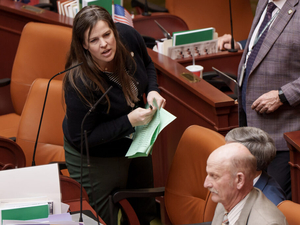
Newly released analyses of a permitting reform bill sponsored by U.S. Sen. Martin Heinrich (D-N.M.), pictured above pitching the bill in Albuquerque to solar energy developers Oct. 12, 2026, estimate the provisions it contains will cut emissions and reduce household electrical costs. (Photo by Patrick Lohmann/Source NM)
New analyses of a permitting reform bill U.S. Sen. Martin Heinrich (D-N.M.) has championed say that its provisions would reduce emissions and costs to ratepayers, as well as recover billions of dollars from data center developers.
The analyses, released separately in recent days by four independent nonprofit and industry groups, including the Center for Climate and Energy Solutions, modeled what would happen to energy transmission and green energy production with and without Heinrich’s Bipartisan American Affordability and Jobs Act in effect through 2040.
They found that the bill would lower household electricity bills by $50 to $78 annually by 2040. Moreover, it would reduce power sector emissions by about 20%, which would subsequently help prevent approximately 6,700 deaths and save $54 billion in cumulative public health costs.
Heinrich, the ranking member of the U.S. Senate’s Energy and Natural Resources Committee, announced the proposal along with Chair U.S. Sen. Mike Lee (R-Utah) and other bipartisan senators in recent weeks. He has touted the bill as a way to reform the federal permit review process to reduce delays and give renewable energy developers more certainty and quicker reviews, as well as a way to ensure data center developers don’t pass energy costs onto nearby households.
The bill has received backlash from tribal and environmentalist groups concerned it will fast-track fossil fuel production and reduce tribal input on sensitive developments. Last week, protesters from the YUCCA Alliance railed against the bill outside Heinrich’s downtown Albuquerque office.
But Heinrich has maintained the bill will prevent vital carbon-free energy and transmission projects from facing years of regulatory delays. His office has pointed to the analyses as proof the bill is necessary to achieve climate goals.
“Americans are tired of paying more in utility bills while projects that could lower costs sit stuck in the planning phase for years,” Heinrich said in a statement touting the outside reviews. “These independent analyses show exactly what we stand to gain by fixing our broken permitting system: lower electricity bills, cleaner air, healthier communities, and more reliable energy infrastructure.”
One of those reviews, released Thursday by the nonpartisan Center for Climate and Energy Solutions thinktank, found that passing the bill would reduce annual electricity bills by $2.5 billion by 2035, partially by reducing the queue that power plants, energy storage facilities and energy storage projects idle in before getting approval to connect to the grid.
“It takes years for projects to connect to the grid and be able to deliver that energy,” the center’s president, Nat Keohane, said during a virtual news conference. “When demand is growing and supply can’t keep up, costs go up.”
A separate analysis from Grid Strategies, a power sector consulting firm, evaluated provisions in the 417-page bill related to data centers. The bill would require electrical utilities to impose additional costs on data centers, funding that utilities would then use to reduce transmission costs to ratepayers.
New Mexico students walk out of classes to protest data centers, US Sen. Heinrich’s permitting bill
In total, Grid Strategies estimates that data centers would pay $55 billion to utilities over the next decade if the bill goes into effect, a figure that represents an additional $35 billion more than they would pay under existing policy.
Heinrich and his cosponsors have announced they intend to try to shepherd the bill through both chambers of Congress before the next session begins next year. U.S. Rep. Melanie Stansbury (D-N.M.) announced last week that she does not support the bill as written.
The bill sponsors’ push to pass the bill in 2026 has drawn additional criticism from the bill’s skeptics, who argue Democrats’ new majorities in the U.S. Senate and U.S. House in Tuesday’s election means a better bill can be achieved.
Moreover, in January, Heinrich may take over as chair of the U.S. Senate’s Energy and Natural Resources Committee, giving him even more power over the bill’s provisions.
However, in an emailed statement Thursday provided to Source NM, Heinrich said he still thinks the climate and country can’t wait any longer to pass the permitting reform bill. He said if he becomes committee chair that his priorities will be reducing energy costs for New Mexicans and protecting public lands, including in Chaco Canyon and the Pecos River.
“But our priority right now is passing the Bipartisan American Affordability and Jobs Act, which would make it illegal for data centers to shift the costs of their grid upgrades and infrastructure onto consumers,” he said. “We’ve been working toward permitting reform for the better part of a decade, and this is the closest we’ve come to getting something signed into law. I’m not going to wait, and I’ll negotiate in good faith, whether I’m the Chair or the Ranking Member.”
Santa Fe, NM