Swimmers weren’t warned about nearly 30 high E. coli tests at beaches this summer
Nov 05, 2026 | 7:56 pm ET
Description
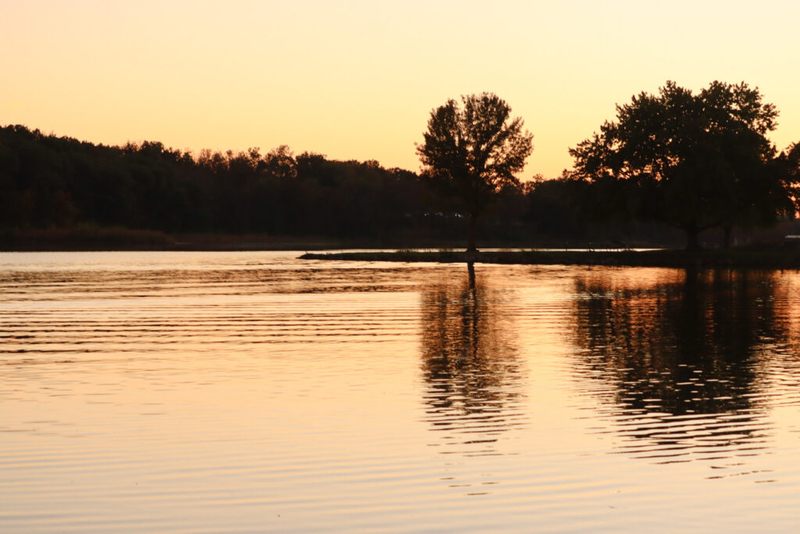
Sunset on Easter Lake in Des Moines. (Photo by Cami Koons/Iowa Capital Dispatch)
There were 27 instances this summer when a single sample test for E. coli at a state beach came back above the state standard, but state regulators did not issue a swim advisory for the beach.
The Iowa Department of Natural Resources tests lake water at state park beaches for E. coli and cyanobacteria toxins from green-blue algae, weekly from Memorial Day weekend through Labor Day weekend. The department issues swim advisories when the tested samples are above a certain threshold.
The decision to issue a swim advisory is also weighed against a five-year data point that classifies beaches as “vulnerable” “transitional” or “less-vulnerable.” Beaches with a less-vulnerable classification do not receive “swimming is not recommended” advisories when a single E. coli test at the beach comes back higher than the state’s maximum standard for the bacteria.
Beaches, regardless of classification, will receive a swim advisory if the five-week geometric mean for E. coli exceeds 126 colony forming units, or CFU per 100 milliliters of water.
Tammie Krausman, the communications director for DNR, said because of the way bacteria levels ebb and flow, and the time it takes for the department to receive results on the samples, the department posts advisories when the geometric mean is high or when it’s likely the bacteria levels will remain high at the beach, based on historical data represented in the beach classification status.
Krausman said it takes a day and a half to two days to receive lab results from the sampled beaches, during which time “levels typically return to their average.”
“Because, we are working with essentially expired information we are using more of a predictive model to indicate the likelihood of elevated risk at a beach,” Krausman said in an email. “With that said, because indicator bacteria are used to assess risk at a given time, results below the thresholds never indicate a risk of zero.”
Colleen Fowle, the water program director with Iowa Environmental Council, said the high E. coli levels in the individual tests indicate a public health risk and swimmers should be informed.
“If people swim in contaminated water with high levels of bacteria, that can cause acute sickness,” Fowle said. “… Especially when children or people with preexisting health conditions go into water bodies that are high in E. coli, they’re more at risk for those health impacts, and if they don’t even know that there was a high test because there’s not an advisory put out, that’s a public health risk.”
A beach is not closed when it has a “swimming is not recommended” advisory. Beach goers can still swim, but they are informed that water at that beach may carry a higher risk of causing things like diarrhea, nausea or other acute symptoms.
“We’re not talking about closing an entire state park because a beach has an advisory,” Fowle said “We’re just talking about a sign up at the beach, letting people know. And I don’t think that’s too much to ask, if the standard is exceeded, to put a sign up at the beach.”
How fluid are E. coli levels?
Claire Hruby, an assistant professor of environmental science at Drake University who researches water quality and E. coli, said it’s fairly normal to see individual spikes in E. coli testing.
Specific events, like a rain storm, can stir up sediment and cause the E. coli levels to jump up, but Hruby said they will “usually come back down once the water settles.”
Hruby said data points that would concern her are high, single sample tests early on in the season and those that stick around for a couple of weeks.
An analysis of DNR’s beach monitoring data, archived by Iowa Environmental Council, shows four instances in the first week of 2026 monitoring where E. coli tests were above the one-time maximum standard of 235 CFU at less vulnerable beaches.
Throughout the monitoring season, some less vulnerable beaches, like Red Haw, Lake Wapello and Springbrook beaches had back-to-back weeks with levels above the standard. No swim advisories were issued, as the geometric means remained below the threshold.
“In those situations, I think folks deserve to know that there’s a spike,” Hruby said. “But again – we don’t really know what the cause of it is.”
Hruby said warm temperatures can cause E. coli in her lab to “grow exponentially” and she’s seen samples taken immediately after a rainstorm that have several thousand CFU because of the stirred up sediment.
Another cause for the spike in bacteria could be runoff from a nearby source.
In the first week of testing, a sample from Lacey-Keosauqua Beach showed 17,000 CFU/100 mL. Another sample from Geode Lake Beach had 10,000 CFU/100 mL.
Hruby said she’s “not surprised” when there is an E. coli spike in the middle of summer, because the water is warm and the beach has been stirred up with recreation.
“But early in the year, that to me says there’s probably a source nearby, something that’s running off the surface,” Hruby said.
An early season or persistent spike, she said, “deserves some further investigation.” But she emphasized that E. coli numbers “don’t on any given day, necessarily indicate risk.”
“If we had all the resources we needed, we would go visit those systems, figure out what’s going on,” Hruby said. “… I think there’s a lot more we could do to better understand these situations, and I think DNR does a pretty darn good job of protecting public health with the process that they’re using, so I don’t want to sensationalize it.”
Beach monitoring protocol
DNR began monitoring state park beaches in 2000. While Iowa statute does not require DNR to publish beach advisories, the law specifies E. coli sample maximum and geometric mean standards with the goal of protecting recreational uses of water segments. These are the same standards used by DNR in its beach monitoring criteria.
Fowle said the statute does not mention “vulnerable” waters and it “seems to be a criterion that DNR established on their own.”
Krausman, with DNR, said the beach classification protocol was implemented in 2005 and was developed in partnership with Iowa’s public health department and the University of Iowa’s IIHR. She said the protocol has been “reevaluated on multiple occasions” since then. The beaches themselves are reclassified each year with the latest data.
Fowle said DNR should retest beaches that have high single sample results to determine if the levels went down, as it’s assumed they would have at “less vulnerable” beaches.
“Some of these E. coli spikes do last for a short period of time,” Fowle said. “So if the DNR had more staffing and more funding to perform more tests, they could do that; they could go back, they could take multiple samples.”
Krausman said that logistically, DNR does not have the capacity to retest beaches that come back with a sample above the maximum.
“Due to the distances between beaches, the location of the labs and the lag time for analysis, it would be nearly impossible to get updated information before recreation starts on the upcoming weekend,” Krausman said. “Retesting would provide more information; however, based on previous experience when the program included resampling, it would likely have a limited impact on advisory posting.”
2026 swim advisories
In total, 182 swim advisories were posted in the 2026 monitoring season and 27 of the 41 state beaches had a swim advisory posted at least one weekend between Memorial Day and Labor Day. Two beaches, Lake Keomah and Blue Lake, had a special status this year due to low lake levels or renovations and were not monitored throughout the season.
As an average and excluding the unmonitored beaches, 69% of monitored state beaches had an advisory at least once during the period, though many of the beaches had multiple advisories.
Lake Darling Beach had the highest number of swim advisories. A swim advisory was posted in 15 of the 16 weeks that were monitored.
Backbone Beach had the second highest number of swim advisories, with 14 posted throughout the monitoring season. Backbone Beach also had the highest number of swim advisories in 2025, along with Beeds Lake State Park and Pine Lake State Park beaches.
The majority of swim advisories are issued because of E. coli levels. In 2026, 166 instances of the advisories were because of E. coli bacteria levels, which serve as an indicator that other, more harmful bacteria could also be present.
Ten advisories were due to microcystin, or green-blue algae, levels and six advisories were issued because of both E. coli and microcystin.
The 2026 monitoring season had one additional week compared to 2025, but historical beach monitoring data collected by the Iowa Environmental Council shows the number of advisories issued at state park beaches increased in 2026.
Des Moines, IA