Soil health key to improving human health, RFK Jr. says in visit to North Dakota ranch
Nov 05, 2026 | 8:45 pm ET

Description
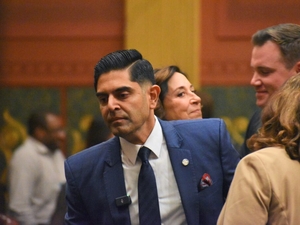
Health and Human Services Secretary Robert F. Kennedy Jr., center, speaks during a press conference next to Sen. John Hoeven, left, R-N.D., and Sen. Kevin Cramer, right, R-N.D., at the Bismarck Event Center on Nov. 5, 2026. (Photo by Michael Achterling/North Dakota Monitor)
The top U.S. health official visited a ranch near Bismarck Thursday where he talked about the importance of soil health for human health.
U.S. Health and Human Services Secretary Robert F. Kennedy Jr. spoke at a roughly 90-minute roundtable on regenerative agriculture at the Black Leg Ranch east of Bismarck. Reporters were not allowed in except for a 15-minute portion, during which Kennedy talked about how vital soil health is for the human gut, which he said dictates health, emotions, moods, energy levels and “our effectiveness in life.”
“If we can keep that healthy, we can maintain public health. It’s hard to keep it healthy if the nutrients that are supposed to be in the soils are not making it into the plants, then onto our tables or our plates,” Kennedy said.
Chemicals from farming are hurting the soil and destroying its microbiome, contributing to health issues such as increased cancer rates from nitrates linked to runoff from fertilizers and chemical pesticides, he said.
“Anything that we can do to reduce the intensity of chemical agriculture is just going to be good for the farmer all around,” Kennedy said.
The Trump administration is pursuing policies for “off-ramps” for farmers to transition to less chemical-intensive agriculture “if they want them,” Kennedy said. Farmers have to be conservative to survive and they “don’t want to do something unless they know it’s going to work,” he said.
Kennedy cited the Doan family’s Black Leg Ranch as a template of regenerative agriculture for other farmers.
Jerry Doan’s great-grandfather started the ranch in 1882. The ranch tries to mimic natural grazing patterns, “bringing back what the good Lord gave us with our natural resources,” Doan said.
“We had this abundant grassland and season-long grazing has eroded that,” Doan said in an interview. He said better grazing management can improve the diversity of species and water quality and make grasslands more lush.
Popular North Dakota conservation program could attract federal funding
Kennedy also said U.S. children are unhealthier now than when his uncle John F. Kennedy was president in the early 1960s. He said rates of Type 2 diabetes, autism and obesity have increased from decades past. He also linked “an epidemic of depression and behavioral problems” to U.S. food.
America needs to fix its food system and stop the decline in rural areas, he said.
“We all need to focus on how do we get our food again to be the highest quality in every way,” Kennedy said. “It’s going to start from good soil. Good food, good soil, good human health.”
Much of the roundtable discussion focused on how to improve soil health, said Burleigh County Soil Conservation District Manager Darrell Oswald, who attended the event. Officials and producers need to realize that “we’re working with a degraded resource,” but there are ways to fix that, he said.
“When we talk about regenerative agriculture, we’re talking about a more natural system and using the soil health principles to drive the system and build back, if you will, the carbon, the nutrients, the soil organic matter, the microbiome, the microorganisms in the soil, and that’s what regenerative agriculture is all about,” Oswald said.
The roundtable was a step forward “because when we start looking at the land as a source of life other than a resource, and that’s what regenerative ag is, it’s going to create better health for our communities and better health for our bodies,” said former Standing Rock Sioux tribal chairman Dave Archambault II, who founded Wozu, a tribal food and culture effort.
Wozu is on the Standing Rock Reservation and started with land regeneration. Wozu took on several initiatives such as returning buffalo to the land and connecting people back to the land with programs focused on cultural arts and wellness, food sovereignty and outdoor stewardship.
“I think Indigenous peoples have always had the relationship and the connection to the land, and for somebody like the secretary to come and to hear, it was just an honor,” Archambault said.
The roundtable included Kennedy, Doan, Archambault, Gov. Kelly Armstrong, U.S. Interior Secretary and former Gov. Doug Burgum, North Dakota’s three-member congressional delegation, Agriculture Commissioner Doug Goehring and others.
North Dakota to use ‘anchor partners’ to manage Rural Health grants
Later, Kennedy and the congressional delegation participated in a 30-minute rural health roundtable with former first lady Kathryn Burgum, state lawmakers and representatives of hospitals, long-term care facilities and health care associations. Reporters were allowed to attend the entire event.
They talked about focusing on ways to help people recover from addiction, seeking more flexibility for applicants for federal rural health funds and staffing rural hospitals.
Minot-based Trinity Health Vice President of Long-Term Care and Ancillary Services Wade Peterson asked about eliminating some COVID-era regulations – such as reporting cases weekly to the U.S. Centers for Disease Control and Prevention – given that Trinity has had three COVID-19 cases in the last year and no COVID-19 deaths in over three years.
“We’re still having to do a lot of COVID things. I’d like to see that probably eliminated. The health emergency’s (been) over for three years,” Peterson said.
“Make a list. Get it to me. We’ll get rid of them,” Kennedy said.
Reach North Dakota Monitor reporter Jack Dura at [email protected].
Bismarck, ND