Alabama commission recommends simplifying, standardizing court fees
Sep 01, 2026 | 6:01 am ET
Description
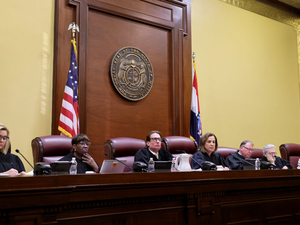
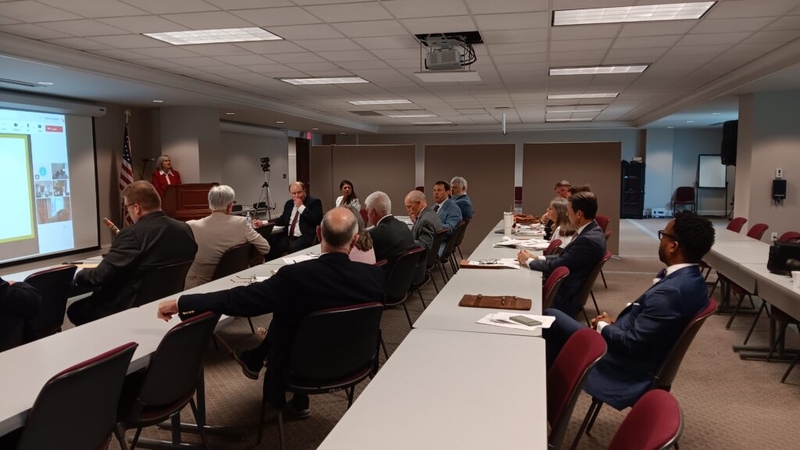
Members of the Joint Interim Study Commission on Court Costs gather to discuss ongoing issues with court-imposed fines and fees at the Alabama Supreme Court on Monday, May 19, 2025. The commission submitted a report to the Legislature that was published by PARCA that recommended lawmakers simplify and standardize fees for the courts. (Ralph Chapoco/Alabama Reflector)
A state commission late last month recommended the Alabama Legislature simplify and standardize court fees that local governments rely on but which can vary significantly from place to place.
The suggestions in the report from the Joint Interim Study Commission on Court Costs included creating a record of the local fees that fund courts; making fees more uniform; allowing local jurisdictions greater flexibility in spending the money raised, and continuing to fund the judicial branch with money appropriated by the Legislature.
“This is an incredible first step, but I think the takeaway is that there is still a lot more work to do if we want this system to be predictable, rational, effective, efficient, accountable to the public, transparent; all the things that you want in public finance,” said Leah Nelson, senior research associate with Public Affairs Research Council of Alabama, who has studied the issue before, in an interview Friday. PARCA published the report on its website on Thursday.
The state uses court fees, along with fines as punishment for crimes, to fund a large share of court costs for state and local governments.
The Legislature established the commission in 2025, requesting that officials from the judiciary branch of state government review the status of court fees and return with a report on next action steps.
The commission, led by Alabama Supreme Court Chief Justice Sarah Stewart, found that court costs accumulated over time through separate local laws and not an overall strategy. The report found that additional fees imposed by courts are derived from “250 or more separate local statutes and about 73 local constitutional amendments.”
The laws came in waves, according to the report. Fees imposed in the 1980s, for example, tended to support the construction of correctional facilities. Those levied during the 1990s usually funded law libraries and juvenile services. In the 2000s, fees were imposed to pay for mental health courts and domestic violence programs.
Fees differ by county. According to the report, the state fee for filing a civil action is $244, but the local fee can vary enormously, with an average of $30 but Madison County charging $182.
“If you are in Madison County, it is going to cost you a lot more to file a civil suit than it will in Limestone County,” Nelson said. “And at some level, if it doesn’t matter where the jurisdiction is, people might start shopping around for places where they get more bang for their buck.”
The report also said some fees may have unclear legal standing.
“At least 13 of these local fees include “sunset” language (they were supposed to expire or end once a debt was paid), and it is not clear whether those fees are still being collected today,” the report said.
Another problem is that some of the fees imposed by the court may never generate revenue. The fees for civil cases will always be collected because the case is never brought to court unless the fee is paid. In criminal cases, however, only about 20% of the fines and fees that are imposed are received by the court.
The report states that South Carolina and North Carolina have essentially a uniform fee structure while Louisiana is more fragmented.
The study commission recommended that each new local or state court cost bill require a periodic review to determine the status of the fees. They recommended a more uniform structure, but allowing local officials wider latitude to decide how to use the revenues generated from the fees.
The report also recommended tying fees to measures like the federal Consumer Price Index to account for changes in the cost of living, and requested that lawmakers direct the Legislative Services Agency and Administrative Office of Courts to “inventory of every local court cost currently on the book,” according to the report.
The commission also wanted to shift the perspective of fines and fees.
“Consider the economic feasibility of relying on often-uncollectible criminal court costs and fees assessed at the time of a criminal offender’s sentencing as a source of revenue for the courts, law enforcement, and district attorney’s offices,” the report states.
Montgomery