Idaho’s Medicaid work requirements start in January. Here’s how they will work.
Sep 01, 2026 | 6:15 am ET

Description
Hundreds of Idahoans gathered in the rotunda of the Idaho Capitol on Jan. 12, 2026, to protest budget cuts to the state's Medicaid program. The protest, organized by Idaho Voices for Children, took place before the governor's State of the State Address. (Photo by Christina Lords/Idaho Capital Sun)
In about four months, low-income Idahoans on Medicaid expansion will need to prove they are meeting new work requirements to remain on the public assistance program.
The new rules — made largely by the federal government — require people to prove they are working, going to school, or volunteering at least 80 hours a month to maintain health insurance coverage through Medicaid expansion.

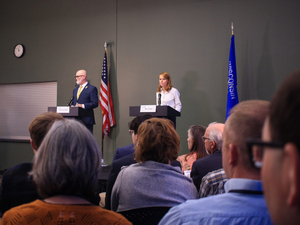
As officials with the Idaho Department of Health and Welfare prepare to implement the new rules, they fielded questions on Monday from the public.
“There probably is some anxiety about what this will actually look like, and what this will do to individuals’ coverage,” agency director Juliet Charron said. “And I just want to say here from the get-go that the team here at the Department of Health and Welfare, we have approached this very thoughtfully.”
The virtual town hall is the first of several that the state health agency that runs Medicaid plans to host in the coming months.
What is Medicaid expansion?
Medicaid expansion is a program, approved by Idaho voters through a 2018 ballot initiative, that offers health insurance coverage to a group of people commonly called the working poor. Idahoans can qualify for Medicaid expansion if their household earns up to 138% of the federal poverty level, or $29,863 for a family of two each year.
About 85,000 Idahoans receive Medicaid expansion coverage, according to figures from the Idaho Department of Health and Welfare.
How were the work requirements created?
The work requirements were part of a massive federal budget bill, called the One Big Beautiful Bill Act, passed in 2025 by Congress and signed into law by President Donald Trump.
The Idaho Legislature and Gov. Brad Little earlier this year approved the work requirements through House Bill 913. For years, Idaho lawmakers and the governor have tried to add Medicaid work requirements.
What are the new work requirements?

Under the federal law, work requirements, also called community engagement requirements, require people enrolled in Medicaid expansion to prove that they are working, doing community service or educational or training activities for at least 80 hours each month. If you can show you earn at least $580 each month, that would also work, said Tonya Standerfer, the administrator for the agency’s Division of Self-Reliance, which processes eligibility for public assistance programs.
But there are several exemptions to the work requirements, such as for:
- Women who are pregnant, or receiving postpartum Medicaid coverage.
- People who are caregivers of a child age 13 or younger, or for a person with a disability
- People who have a physical, mental, or developmental disability that “makes it hard to do daily activities,” or people who have a disabling mental health condition, or people who are blind
- People who have a substance use disorder, or are in a drug or alcohol treatment program
- People who between the ages of 19 and 25 and have aged out of foster care
- People who are Native American or Alaskan Native, or who are eligible for Indian Health Services
- People who are already required to meet work requirements for the public assistance programs called Temporary Aid for Needy Families, which is cash assistance, or the Supplemental Nutrition Assistance Program, which is also known as food stamps
- People who are incarcerated
- People who are veterans with total or 100% disability ratings.
- And people who have a “serious or complex health condition that requires regular medical care and limits or prevents your ability to work”
How do the work requirement exemptions work?
Idahoans who are ‘medically frail’ are exempt from Medicaid work requirements. How do you prove it?
Officials punted questions about one exemption meant for people with disabilities, dubbed the medically frail exemption. Standerfer said that exemption would be addressed in a future town hall. She said state officials are working with a contractor to determine how to automatically pull medical claims data to verify whether someone is medically frail. Previously, state officials said patients may need to provide a doctor’s note if the state doesn’t already have “evidence of medical frailty” in its claims system.
Asked how people can prove they qualify for exemptions, Standerfer said the state’s system already has information related to many of them. But she said the state could ask for verification.
She also said the state hasn’t decided on one possible carveout — in which the state can ask for an exemption for people who live in a county with a high rate of unemployment. She said the Department of Labor would likely make that decision in October.
How many Idahoans could lose Medicaid expansion because of work requirements?
Medicaid work requirements and other changes in the “Big Beautiful Bill” could kick 20,000 to 34,000 Idahoans off Medicaid expansion by 2028, according to an analysis by the Urban Institute and the Robert Wood Johnson Foundation. That’s lower than what some other researchers estimate.

But state health officials have said they believe that most Idahoans on Medicaid expansion already meet the work requirements. In an early review of data for all 83,000 people on the program at the time, Idaho Medicaid Administrator Sasha O’Connell told the Idaho Capital Sun in July that the state agency found that 68,400 Idahoans on Medicaid expansion met the new work requirements.
How far back do you need to prove work history under Idaho Medicaid’s work requirements?
Idaho lawmakers decided to require Medicaid expansion enrollees to prove work history for three months before their application for Medicaid. That time period, called a lookback period, is the longest allowed under the federal law.
People on Medicaid will also be required to re-apply to the program every six months, another change under the new federal law that increases the eligibility verification frequency from once a year.
What can you do if you’re on Medicaid expansion?
Right now, the state cannot remove people from Medicaid expansion for not complying with Medicaid work requirements.
But starting in January, they can.
In July, Standerfer said state officials notified all people on Medicaid expansion about how the new rules could impact them. And she said the agency’s customer service center has been taking calls and helping people navigate the new rules, including whether they may qualify for exemptions.
Standerfer urged Idahoans on Medicaid expansion to create an account through Idalink, update their communications preferences and sign up for text alerts so they can get reminders to recertify their eligibility for the program. She also recommended that people on Medicaid expansion track their hours at work and in community service.
Find more information about how the new work requirements work in Idaho, and about future town halls, online at the Department of Health and Welfare’s website.
Boise, ID