Democrat drops out of Utah Senate race, leaving Forward Party incumbent to face GOP challenger
Sep 01, 2026 | 7:03 am ET
Description
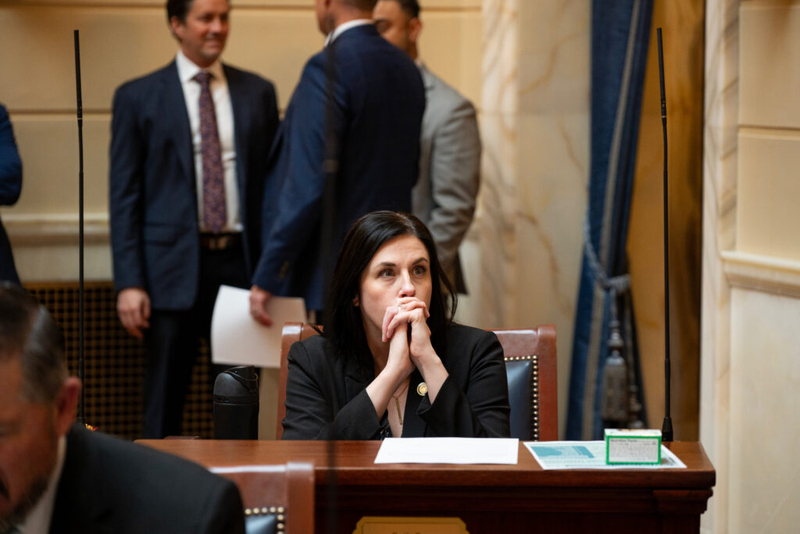
Sen. Emily Buss, a member of the Forward Party of Utah from Eagle Mountain, listens on the Senate floor of the Utah Capitol in Salt Lake City. (Courtesy of the Utah Senate)
Democrat MacKenzie Miller has dropped out of the race for Utah Senate District 11, leaving a two-way race between the Utah Legislature’s only currently elected third-party lawmaker and her GOP challenger.
Now incumbent Sen. Emily Buss — a Forward Party candidate who currently holds the party’s highest-ranking elected position in the country — is left to face Republican challenger Brooks Benson in the upcoming Nov. 3 general election.
Late last year, Buss, of Eagle Mountain, won the Forward Party of Utah’s unprecedented midterm preference poll to replace her predecessor, Sen. Dan Thatcher, of West Valley City, who resigned less than a year after he unaffiliated from the Republican Party to join the Forward Party while citing frustration with the GOP.
Utah Forward Party’s first-of-its-kind preference poll picks a winner to replace Sen. Thatcher
Buss and Benson are competing to represent a sprawling Senate district that spans across parts of the west and south sides of Salt Lake County and across rural Tooele County to the far west side of the state.
The district is expected to lean heavily Republican. But Buss, acknowledging it will be a “challenging” race given its political makeup, argues there’s more appetite in the district for a “moderate” like her than some may think.
The last time District 11 was up for election, Buss’ predecessor, Thatcher, ran unopposed as a Republican.
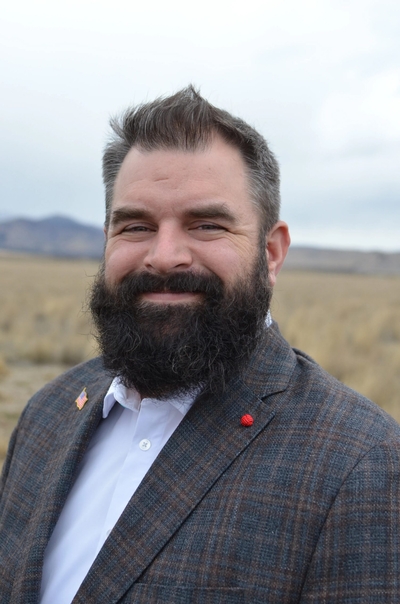
Miller, of Magna, filed his withdrawal paperwork on Friday — a step he said he decided to take after realizing a three-way race would likely mean the district would fall back under the Legislature’s Republican supermajority control, he told Utah News Dispatch on Monday.
“I’m giving Sen. Buss the best chance to win,” Miller said, adding that if both he and Buss stayed in the race, they likely “would have just destroyed” each other’s chances while handing the win to Benson.
Miller said the Forward Party and Buss didn’t pressure him to drop out — but rather he arrived at the decision himself after looking at likely outcomes of a three-way race, and it was apparent to him that Buss had no plans to withdraw.
“I don’t want me and Emily competing and kind of ruining both our chances,” Miller said. “I don’t think a supermajority is good in either direction. … Having fair representation and (ensuring) one party can’t just steamroll everything through is more important than my pride in staying in.”
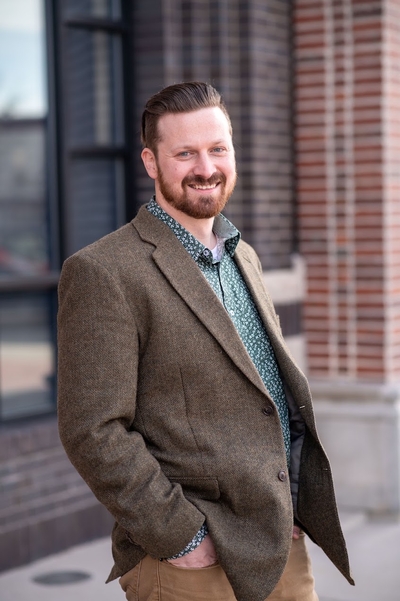
Benson, in response to a request for an interview Monday, issued a prepared statement saying he’s “focused on meeting and talking to the people of District 11 about the most important issues our communities are facing.”
“Listening to the voters is my number one priority. From my conversations, it’s clear that we need to cut government waste, lower taxes, stop government mass surveillance, and prioritize road infrastructure throughout District 11,” Benson said. “I’m prepared to serve through listening to the people who live in this district and giving them true representation.”
Buss expressed gratitude to Miller for making a “difficult decision” to step aside “to create a more competitive race.”
“This is a really, really challenging district, and it was going to be an uphill battle for either of us,” Buss said. “It’s unfortunate that in some districts, a three-way race just splits the vote so much that it is not competitive … and I’m grateful that he was able to see that in this race.”
She called District 11 a “very gerrymandered district” that’s geographically expansive and mixes highly conservative areas with liberal areas in Salt Lake County. But she also argued that especially as President Donald Trump’s approval rating sinks, “I don’t think it’s as conservative-leaning as a lot of people are banking on.”
“I’ve heard from dozens and dozens of constituents (saying) they’re a lifelong Republican, and they’re so happy to have me as their senator because they’ve never felt listened to or truly represented at the state level,” Buss said. “People are tired of politicians acting like they answer to political insiders over the people. So this is the time for something like this to succeed.”
The Forward Party of Utah issued a statement on Monday announcing that Miller’s withdrawal had major implications for the District 11 race, giving voters a chance to treat it as a “referendum” on a two-party system.
“By re-electing Sen. Emily Buss, voters have a chance to reject partisan Politics-as-usual,” the Forward Party statement said. “The two-party system is broken. The gridlock and hyperpartisanship of our two-party system actively rewards division, enforces strict loyalty, and locks out independent candidates. Something must change.”
The Forward Party pointed to a recent Gallup poll that shows confidence in U.S. Institutions remain near an all-time low, and a Deseret News poll published in April that showed 6 in 10 Utah voters don’t feel well represented by Republican or Democratic parties.
“The Forward Party has a clear mission. We are building an organized, resourced, and effective coalition of independent candidates; Sen. Buss is one of many,” the Forward Party said. “Our goal in Utah is not to replace one supermajority with another. It is to build a political system where no one party can ever hold a supermajority, ever again.”
What happens next in District 11 “is more than a competition for a single seat,” the party added. “It’s a contest between the status quo and a new vision for how our political system might work.”
The Forward Party also pointed to an analysis Brigham Young University professor Adam Brown posted on X, that showed her voting record aligns as “genuinely moderate” with an ideology score that landed squarely in the middle.
“In just her first year, Senator Buss has already begun to prove the Forward Party concept. Separated from the pressures of party politics, she was free to be herself, and she did just that,” the Forward Party said. “She showed us that a senator can put her constituents first, then work across the aisle on their behalf. Her voting record is a clear example of independence in practice.”
Now, Buss “stands in the center of something bigger than herself,” the party said, “and she won’t be standing alone. We believe that the voters will see her as a welcome alternative to the two-party system.”
Salt Lake City, UT