Independent review praises Providence response to Brown shooting but flags communication gaps
Aug 28, 2026 | 9:00 am ET
Description
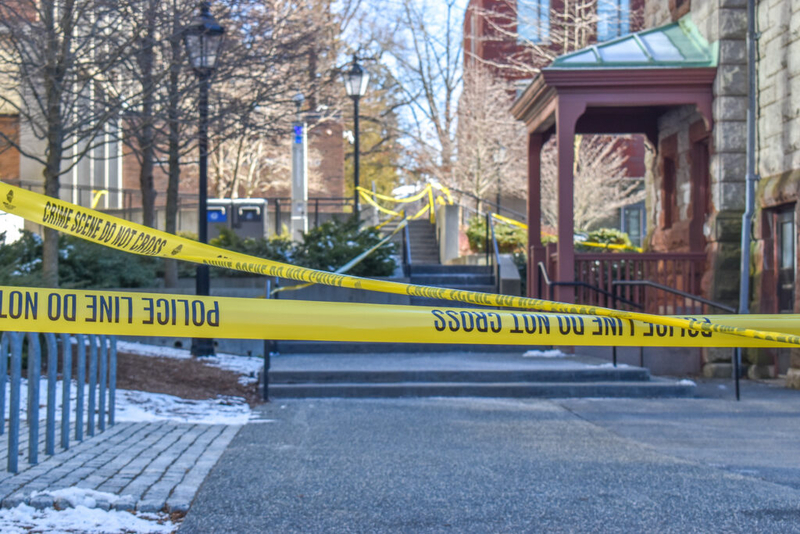
Crime scene tape surrounds an entry to the Barus & Holley engineering building at Brown University on Tuesday, Dec. 16, 2025. (Photo by Christopher Shea/Rhode Island Current)
Providence’s response to the December 2025 mass shooting at Brown University was “highly effective” and “decisive,” according to an independent review commissioned by Mayor Brett Smiley earlier this year.
But the 76-page report published Friday by the Washington, D.C.-based Police Executive Research Forum (PERF) also identified gaps in communication and coordination among local, university, state and federal law enforcement agencies that city officials should address before another large-scale emergency.
“While these issues did not undermine the response, personnel often had to rely on experience, relationships, and real-time adaptation to work through these gaps,” the report states. “Providence is well positioned not only to build on its performance in this incident but to serve as a model for other jurisdictions seeking to strengthen their preparedness for complex, high-consequence events.”
Smiley on Feb. 19 commissioned Police Executive Research Forum to conduct the assessment at a cost of $95,000, saying at the time that it would help identify “what worked well and where we must improve in training, tools, tactics and technology” after the Dec. 13 shooting killed two students and wounded nine others during an economics final review in Brown’s Barus & Holley building.
“It’s really important that the community not just hear from us, but hear from a national expert of where we did well and where we can do better,” Smiley reiterated in an interview ahead of the report’s release.
The authors of third party consultants’ report’s authors interviewed Providence police personnel, reviewed investigative materials related to the incident, and analyzed publicly available documents.
Brown University is conducting its own after-action review and campus safety and security assessment with the global consulting firm Teneo.
“Our semester begins shortly, and we are finalizing release plans and timing now,” Brian Clark, a spokesperson for the Ivy League university, said in an email.
The U.S. Department of Education launched a probe into university security measures in late December. A department spokesperson declined to comment on the status of its “ongoing” investigation.
What city got right
The report found the city’s response times “met or exceeded” national benchmarks established for active-shooter incidents.
Providence police arrived on scene less than three minutes after dispatch at 4:07 p.m. and “did not hesitate to enter the Barus & Holley building despite not knowing whether the shooter was still inside.” Officers evacuated all nonfatally injured victims by 4:23 p.m.
Active-shooter benchmarks generally call for all victims to be transported within 30 minutes, according to the report.
“Those first minutes were about one thing: saving lives,” Police Chief Col. Oscar Perez said in a statement. “Their response was swift, courageous and focused on protecting life and securing the scene in the midst of an extraordinarily dangerous situation.”
The report recommended the city maintain its Flock automated license-plate reader (LPR) camera system, even as concerns over privacy and misuse have flared up throughout the state. Smiley said he supports the suggestion, calling it a valuable tool integral to the investigation.
“But it’s a tool that needs to be used appropriately, and data sharing needs to be strictly enforced and regularly audited,” he said.
Investigators used the Flock cameras to narrow the search for the suspected shooter’s vehicle after receiving multiple tips, most notably a Dec. 15 post on Reddit directing police to look for a “grey Nissan with Florida plates, possibly a rental.”
“LPR data proved indispensable, reducing an investigative universe of thousands of potential vehicles to just two in a matter of minutes,” the report states.
Claudio Manuel Neves Valente, a Portuguese national who briefly attended Brown in 2000, walked away from the crime scene, launching a five-day manhunt that involved local, state and federal law enforcement. Neves Valente, who also shot and killed a Massachusetts Institute of Technology professor two days after the Brown shooting, was found dead in a storage locker in Salem, New Hampshire on Dec. 18.
The review also praised city officials for how they handled media inquiries, particularly after police detained a person of interest on Dec. 14, a man who was released later that same day. Perez was described as “circumspect” for sharing only verified facts and declining to label the individual as a suspect. Smiley, who oversaw each of the city’s press conferences, was seen as “measured and highly effective” with his public communication.
What went wrong
The report identified the lack of integration between Brown’s surveillance system and the city’s.
Investigators initially struggled to determine what campus cameras and other video resources were available. Which is why the Police Executive Research Forum recommends the university add its camera network into the city’s Real Time Crime Center, where detectives can access live feeds from hundreds of cameras to gather “actionable” information to rapidly respond to incidents.
Smiley said conversations with the university remain ongoing for camera connections.
Broader public communication drew criticism at the time. Some neighborhood residents lamented the lack of emergency 311 notifications during and after the shooting.
Smiley initially rebuffed criticisms, saying the city’s alert system worked as intended for everyone who signed up. The mayor now acknowledges that “some neighbors felt like they were inadequately notified” and that the city has since worked to improve communication in the event of another emergency.
He said Providence has since revamped its CodeRED notification system to push emergency messages to residents without an audible alarm. The report notes that at the time of the shooting, the system was inoperable, which led to some partner agencies not receiving timely awareness of key developments during the early phases of the response.
One example came inside the Barus & Holley building as Providence police and campus officers entered the building from different locations without initially knowing the other agency was inside. Their communications were integrated only after they physically encountered one another, a situation the report noted “carried inherent risk.”
“Obviously, that didn’t happen, and everything worked out in terms of their safety and their willingness to respond quickly,” Smiley said. “But that’s an area that we went to address and fix very quickly.”
Smiley said direct contact between Brown and local police leaders increased after former Providence Police Chief Hugh T. Clements Jr. assumed daily oversight of campus policing in late December.

Providence, RI