Missouri says its intoxicating hemp ban is clear. Industry says it’s unconstitutional.
Aug 28, 2026 | 6:50 am ET

Description
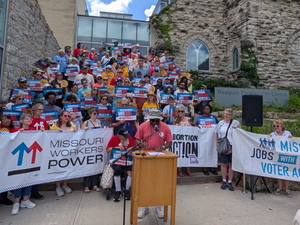
Missouri Hemp Trade Association president Jay Patel speaks during a press conference on the Missouri State Capitol steps April 14 (Annelise Hanshaw/Missouri Independent).
A federal judge is being asked to decide whether Missouri’s new law banning intoxicating hemp products is clear enough to enforce in November or so contradictory that a constitutional challenge to it should move forward.
At the center of the dispute is the question of whether Missouri calls a product legal “hemp” in one part of state law and illegal “marijuana” in another.
The plaintiffs, led by the Missouri Hemp Trade Association, said in a motion this week that the state has created overlapping definitions, leaving businesses unsure what they can legally sell when the law goes into effect on Nov. 12. They argue the case over House Bill 2641 deserves to be heard in court.
“Most judges would read [House Bill 2641] and go, ‘What is going on here?’” said Chuck Hatfield, attorney for the plaintiffs. “‘This seems like something we need to at least dig into and figure out.’ And that’s what our clients want is a day in court.”
The state says there’s no contradiction because the law specifically outlines which category controls: if it meets the definition of a hemp-derived cannabinoid product, it’s treated as marijuana. The state asked Judge M. Douglas Harpool of the U.S. District Court Western District of Missouri to dismiss the lawsuit earlier this month.
The state argues the case is part of a growing nationwide effort by the hemp industry to overturn similar state laws.
“The industry’s playbook is well established,” the motion to dismiss states, citing other federal cases where the challenges against other state legislation regulating intoxicating hemp have failed.
Plaintiffs hit back in their response this week, saying that Missouri’s law is different from the other states cited. These products will be considered marijuana in Missouri under the new law, they argue, and that’s where the legislation gets “unconstitutionally vague.”
The federal law distinguishing marijuana and hemp has brought intense debate both in the legislature and courts nationwide since Congress legalized hemp in 2018.
For Missouri, the lawsuit is the latest episode in a long saga to regulate intoxicating hemp products that, in previous years, has ended with lawmakers throwing their hands up in frustration.
When Congress legalized hemp in 2018, it opened a door for intoxicating products like hemp-derived THC beverages that are now found in grocery stores and bars throughout the state.
Congress closed that loophole in November by passing a federal ban that’s set to go into effect Nov. 12. Missouri lawmakers said they intended to mirror that language by a law passed this spring.
However, plaintiffs argue in the lawsuit that the result is “a single product is simultaneously legal ‘hemp’ and illegal ‘marijuana.’”
The state argues in its motion to dismiss that it prevented this scenario because it “enacted provisions to guard against confusion.”
“In other words, to the extent that a hemp-derived cannabinoid meets the statute’s definition of ‘hemp’ and is not included in any of the statute’s exclusions from ‘hemp,’ then the product is not a ‘hemp-derived cannabinoid product’ for purposes of HB 2641’s central mandate,” according to the state’s motion. “It is that simple.”
The bill, sponsored by Republican state Rep. Dave Hinman of O’Fallon, will prohibit hemp products from containing more than 0.4 milligrams of THC per container, which is among the limits included in a provision in the federal spending bill Congress approved last year.
Even if Congress reverses course and decides to allow the sale of these products, Hinman’s bill would only permit them to be sold in Missouri’s licensed marijuana dispensaries. And if Congress chooses to delay the ban, Missouri would still ban all products, except for intoxicating beverages.
However, plaintiffs argue beverages are not specifically stated as being exempt.
The law lists types of products that would go into effect if there was a delay, which includes “any solid candy, gummy, chewable product, tablet, capsule, oil, baked good, or other solid edible.” It also includes products “that can be smokable or vapeable in the form of raw plant material, flower, or bud material and that contain any amount of tetrahydrocannabinolic acid.”
Beverages are thought to be allowed because they aren’t on the list of things that would go into effect. However, critics have said other products might be unintentionally exempt because they are not listed here, not just beverages, and the law just creates another loophole. Plaintiffs point to the carve-out clause as further reason the law is “difficult to parse.”
This list has become a bigger focus because Congress is currently considering delaying the federal ban.
Earlier this month, the U.S. Senate approved a measure to fund federal agencies until Dec. 11, and it includes delaying the federal ban on intoxicating hemp THC products until that date. It now goes back to the U.S. House for final approval before heading to the president’s desk.

Jefferson City, MO