Alaska gubernatorial candidates highlight contrasting philosophies on oil and gas
Aug 27, 2026 | 5:32 pm ET
Description
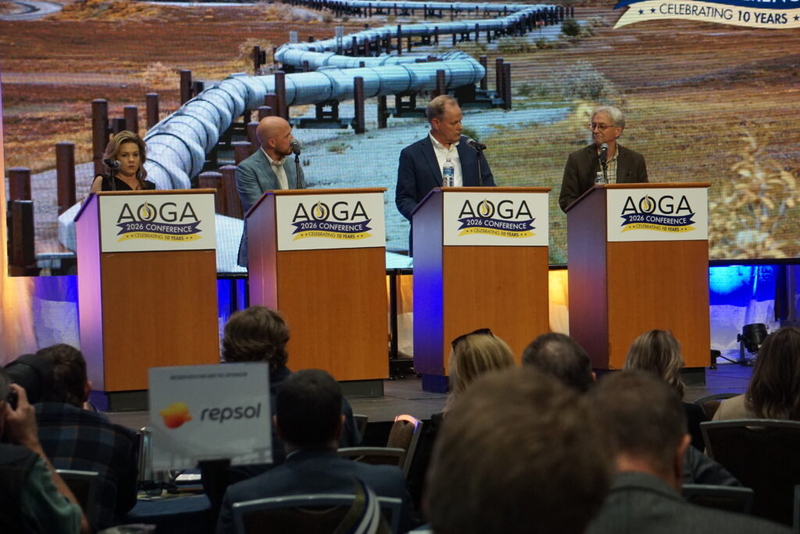
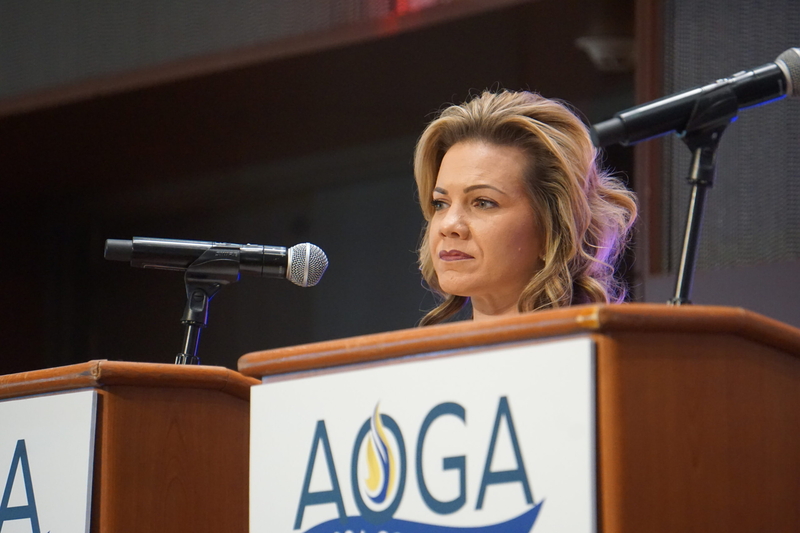
The four gubernatorial candidates emerging from Alaska's open primary gathered on the stage on Aug. 26, 2026 at the annual conference held by the Alaska Oil and Gas Association. From left are Republican Bernadette Wilson, Democrat Jonathan Kreiss-Tompkins, Republican Dave Bronson and Democrat Tom Begich. (Photo by Yereth Rosen/Alaska Beacon)
At their first candidate forum since the Aug. 18 primary election, the four remaining gubernatorial hopefuls pitched visions for the state’s future that revealed sharp political divides.
Speaking at the event, held at the Alaska Oil and Gas Association’s annual conference in Anchorage, were Democrats Jonathan Kreiss-Tomkins and Tom Begich and Republicans Bernadette Wilson and Dave Bronson. Kreiss-Tomkins has been leading in the still-ongoing primary election vote count, with 22.2 %, followed by Begich at 20.5%, Wilson at 10.2% and Bronson at 8.2%.
The four emerged as the top vote-getters among 17 candidates for governor. Alaska’s election system uses open, non-partisan primaries and ranked choice voting in the general election.
Kreiss-Tomkins and Begich, both former state legislators, presented mostly similar positions. Wilson, a talk-show host, and Bronson, a former Anchorage mayor, also presented largely similar positions that contrasted with the Democrats’ views.
Oil and gas taxes figured prominently in the event.
The main company affected by such a tax would be Hilcorp, a privately held company based in Texas that is a major Alaska producer. As of 2020, Hilcorp had acquired all of BP’s Alaska assets when that oil giant left the state, and now it operates Alaska’s largest oil field in Prudhoe Bay, among others. Unlike BP, Hilcorp pays no corporate income tax to the state. Legislative leaders have been pushing to change that.
Hilcorp is also a main sponsor of the AOGA conference.
Begich said a tax on S corporations and other changes to the state’s tax system would bring in an extra $400 million to the treasury each year.
He acknowledged that the oil industry crowd might not like those changes at first. But ultimately, “it will be forward-thinking for private investment,” he said. “If we have that revenue coming in, we can improve our education system. We can improve our economy in general and make our energy significantly more affordable up here. In doing that, you’re going to attract people to this state.”
Kreiss-Tomkins said all sectors, including the oil industry, will have to contribute taxes to correct a structural deficit problem in Alaska that, for now, threatens to wipe out the state’s savings.
“I am pro-math, and math just doesn’t lie. And balancing a budget is ultimately a math problem, and I think you have to be clear-eyed about where the state is,” he said. Compromises will be needed to address that, including compromises from the oil industry, he added.
Wilson and Bronson, in contrast, said they adamantly oppose tax changes that would wring more revenue out of the oil industry.
Wilson called for deep slashes to the state budget.
“The reality is we need to come into this budget, and we need to DOGE the heck out of it,” she said, referring to the mass firings and cuts imposed by the Trump administration through the so-called Department of Government Efficiency, or DOGE.
Bronson said Alaska has made too many changes already to its oil and gas tax system, and that “changing the rules of the game and the tax structure midway through” scares off investment.
“The reality is we don’t have a whole lot of businesses that are lining up to do business with Alaska,” he said.
Both Wilson and Bronson accused the state legislature of blocking a proposed massive natural gas pipeline that would carry product from the North Slope about 800 miles to a yet-unbuilt liquefaction plant in Southcentral Alaska, known as the AKLNG project
There have been efforts over the past half century to build such a pipeline, but none have been economic. In pushing the latest version, Gov. Mike Dunleavy called the legislature into three special sessions this summer to try to get them to approve sweeping tax concessions for the investment company now involved with the project, the Glenfarne Group. Lawmakers ultimately rejected Dunleavy’s demands.
Wilson said the Glenfarne plan pushed by Dunleavy, unlike all other plans over the past half century, made economic sense, but lawmakers blocked it.
“You had a couple of legislators specifically that are hell bent on seeing Alaska fail. That’s why you don’t have a gas line,” she said.
Bronson drew a similar conclusion.
Glenfarne, like Hilcorp, is a sponsor of the AOGA conference.
Kreiss-Tomkins and Begich, in turn, criticized Dunleavy, describing his policies as a major reason why Alaska has had more people leave the state than move to it for 13 consecutive years – the most ever recorded. They were particularly critical of his policies on education.
Under Dunleavy, they said, Alaska has stagnated.
“This governor has just set a record for the most number of vetoes by any governor in Alaska history since we became a state,” Kreiss-Tomkins said. “That is a sign of political failure, not political success.”
This year, Dunleavy set the record for the most vetoes by an Alaska governor in a single two-year Legislature, while the number of bills passed has also dropped significantly in recent years.
Candidates also discussed national politics at the forum. The two Republican candidates aligned themselves with President Donald Trump, and they portrayed themselves as hard-liners.
“I’m a hardcore conservative, and I’m proud of that,” said Bronson, who described the differences between candidates as stark.
“We’re at an inflection point in this country and in this state, in this election,” he said. “You can choose socialism. . .Or you can choose capitalism. That’s the choice in this race right now.

“The greatest policy threat is, God forbid, this state elects a Democrat to this governor’s office.” she said. Wilson said Democratic Party policies regarding oil and gas “are the greatest threat to this industry.” She urged the audience to stick with Republicans and take advantage of the next two years of the Trump administration.
In contrast, the two Democrats emphasized consensus-building.
“Beyond a doubt, I disagree with Bernadette,” Begich quipped in comments directly following those by Wilson.
More broadly, Begich spoke about his approach to governing. While the governor has a responsibility to “be an advocate for the state of Alaska at all times,” including pushing back against the federal government, if necessary, that does not mean unrelenting combativeness, he said.
“What I won’t do is use the state’s power to attack people that are not even living in our state. I think that’s ridiculous,” he said.
Kreiss-Tomkins took a similar tone. He spoke of his time serving in a bipartisan coalition in the legislature that “set aside the more fringe and polarizing issues that I think often bring government and the legislature to a standstill” and prevent progress.
“That is a North Star principle for me. . .trying to find compromise, trying to work from a common-sense, common-ground agenda and get things done to move the state forward,” he said.
Ballots are still being counted, but the top four candidates for governor are unlikely to change. The Division of Elections’ primary election schedule calls for all absentee and questioned ballots to be counted within 10 days of the primary, resulting in a deadline of Aug. 28. The results are to be certified on Aug. 31, which is also the deadline for candidates to drop out.
Juneau