Utah clerks don’t expect lawsuits over Trump’s mail-in voting rule to impact elections this year
Aug 27, 2026 | 6:15 pm ET
Description
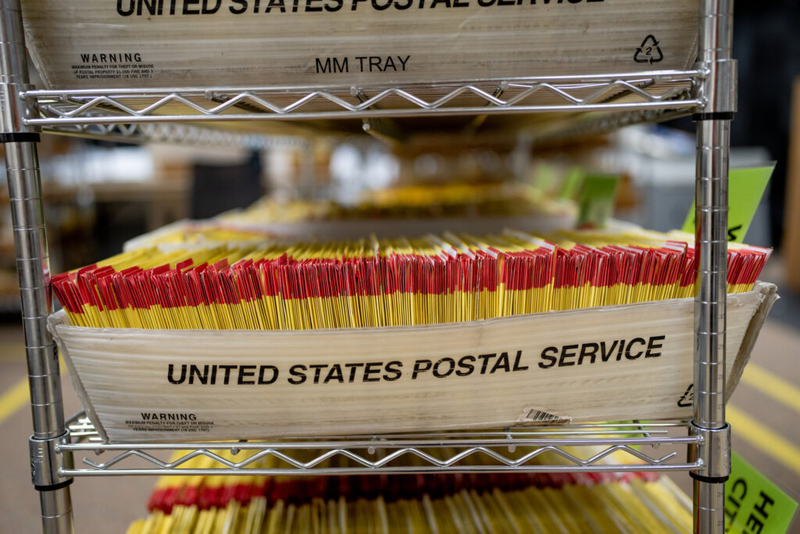
Ballots await processing at the Salt Lake County Government Center in Salt Lake City on Election Day, Tuesday, Nov. 5, 2024. (Photo by Spenser Heaps for Utah News Dispatch)
Though recent federal rulings have cast uncertainty over voting by mail with Utah’s November general elections around the corner, clerks — at least for now — are preparing for business as usual.
“Any dramatic change at this point really is extremely impractical, and it’s very risky to introduce any changes this late into the election (season),” Weber County Clerk/Auditor Ricky Hatch told Utah News Dispatch on Thursday.
A national legal fight continues over President Donald Trump’s moves to create new regulations to restrict voting by mail, though a couple of rulings this week handed procedural wins to the Trump administration.
New challenges to Trump mail-in voting order arrive after US Supreme Court ruling
A U.S. Supreme Court opinion issued Monday said that the Trump administration is likely to prevail on its argument that 23 Democratic-led states do not have standing to stop his executive order to change how the U.S. Postal Service processes mail-in ballots.Then on Wednesday, U.S. District Judge Indiria Talwani removed her nationwide preliminary injunction blocking the administration from implementing the executive order that directed the USPS to create new restrictions and standards for mail-in ballots.
The rule sets new ballot-design requirements and mandates that states collect information from voters and send that information to the federal government. It also bans the Postal Service from delivering or collecting mail-in ballots from people who haven’t been confirmed as eligible voters.
The U.S. Postal Service said on Thursday that its new requirements for mail-in voting are now in effect, requiring the post office to refrain from delivering by-mail ballots to voters deemed ineligible.
But a new round of legal challenges have been filed, including from Democratic officials in 24 states and the District of Columbia challenging the new Postal Service rule as unconstitutional. Monday’s U.S. Supreme Court ruling determined that the injunction on the rule should be lifted at least until the Postal Service had started implementing the new rule. Notably, it didn’t address the legality or constitutionality of the rule.
Too late
While those legal issues continue to play out, Hatch said given the tight timeline between now and the Nov. 3 election, logistically it’s too late for those rulings to have any impact on Utah’s elections.
“That ruling, the way I read it, it’s just a procedural hurdle that had to be cleared, and so now the Postal Service’s rule is being challenged in court, now that it’s final,” he said. “There’s certainly nothing that’s been decided.”
Postal Service pushes ahead on Trump order limiting vote-by-mail
He also pointed to a legal principle known as the Purcell principle, which makes clear that courts should not change election rules too close to an election in order to avoid voter confusion.
“And this clearly falls within the Purcell principle,” he said. “I just see tremendous risk in introducing a technology or an intermediary like the Postal Service this close to the election.”
Even though the federal lawsuit is ongoing and it’s not yet clear how it will end, Hatch said he doesn’t foresee how Utah election officials could even implement the new Postal Service rule at this point, so close to the November election.
“There are just too many question marks for us to dive in to make a risky change this late in the game,” he said.
The office for Utah’s top election official, Lt. Gov. Deidre Henderson, didn’t immediately respond to a request for comment on how this week’s rulings, including the lifting of the injunction on the Postal Service rule, would impact Utah.
Hatch said he and other clerks hadn’t yet received any guidance from the lieutenant governor’s office on next steps, but he said “their non-response kind of supports the fact this is still very much up in the air and it’s kind of a wait-and-see approach.”
An ‘unmitigated disaster’
Online, Henderson has remained a vocal critic against the Trump administration’s attempts to force states to hand over sensitive voter information while continuing to note that the Constitution clearly says states control election administration.
View on Threads
“This will be an unmitigated disaster if the injunction is lifted,” Henderson posted on social media earlier this week in response to the Postal Service’s rule. “The Postal Service could not concoct a better way than this to obliterate the last crumbs of confidence the public once had in the institution. Shameful.”
In response to Monday’s U.S. Supreme Court ruling, Henderson wrote another post that said the decision “has no effect on Utah,” noting the injunction against the rule stemming from a different lawsuit remained in place at the time.
“In the meantime, Attorney General Brown and I are in close communication as his office works through all our legal options,” Henderson wrote. “I assure all Utah voters that they will be defended. We will run a secure election in accordance with state and federal law.”
But after the injunction on the Postal Service rule was lifted Wednesday, Henderson has not responded to a request for comment.
Brown’s office declined to comment Thursday, but the attorney general told KUER on Wednesday he and his legal team are still analyzing the U.S. District Court judge’s ruling and determining what — if any — impact it will have. He also noted that the decision, like the U.S. Supreme Court opinion, was procedural and did not address the legality of Trump’s executive order.
“This is really a decision on process as opposed to the substance, and that’s really what it comes down to,” Brown told KUER.
Brown also told the radio station that he wants to ensure “predictability in terms of the system” as the November midterm elections approach.
Mail ballots will go out as normal despite Supreme Court ruling, Colorado election officials say
“Our election officials do a good job of making sure that that is the case and having secure elections,” Brown said. “Ultimately, I think that is the responsibility, and that’s the aim. And so my job as the attorney general is to work with them to make sure that they follow the laws.”
Hatch agreed with Henderson’s comments that the new Postal Service rule would bring “absolute chaos” to the upcoming election — but also create problems for future ones if it’s allowed to stand.
“The post office delivers mail. That’s their job. It’s not their job to vet who should and should not receive a ballot,” Hatch said. “They shouldn’t be involved in this at all.”
Still, because of the tight timeline, Hatch doesn’t think states or local election officials are in any practical position to adhere to the new rule ahead of November, even with the injunction lifted for the time being.
Even if the rule went into effect six months before the election, he said, there would be some “significant complications” that would need to be figured out, “one of which being this massively huge organization now needing to become a data sharing partner and intermediary between election officials and the voters.”
“That just invites all sorts of complications that aren’t necessary,” he said.
Election officials are “naturally cautious when it comes to any kind of change that could impact the voters or the election,” Hatch added. “So we’re cautious because everything is so tentative surrounding the rule and the lawsuit.”
Above all, Hatch said clerks “really want to do what’s right for the voters” and ensure the election is run “accurately, securely and fairly.”
Salt Lake City, UT