Attorney argues to force government to release more surveillance records in ‘Minnesota 15’ case
Aug 27, 2026 | 7:02 pm ET
Description
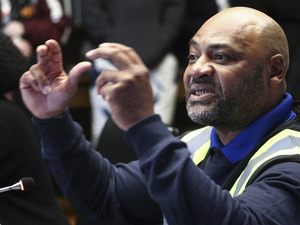
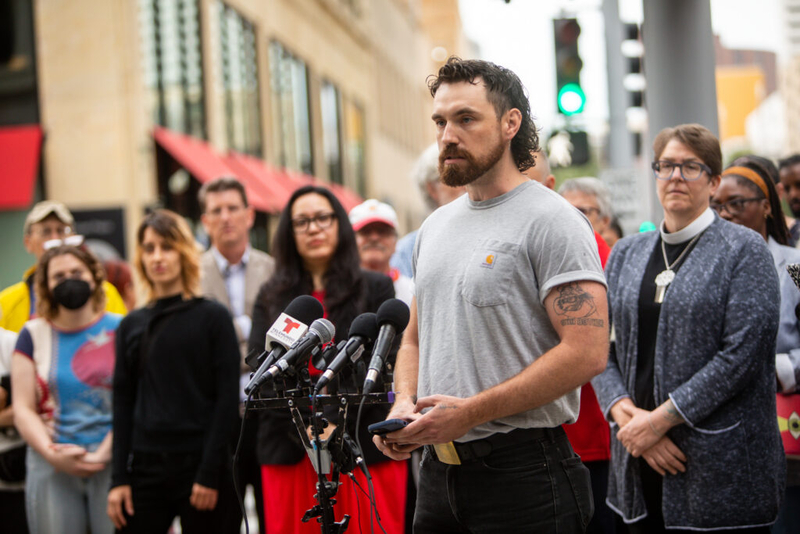
Alec Stewart, one of the 15 people federally indicted for conspiracy to impede or injure federal officers, speaks during a press conference condemning federal surveillance Tuesday, Aug. 18, 2026. (Photo by Nicole Neri/Minnesota Reformer)
A defense attorney in the conspiracy case against 15 Minnesotans asked a federal judge Thursday to order the government to release more documents related to the Department of Homeland Security’s wide-ranging surveillance campaign of anti-ICE activists, labor unions and nonprofits in Minnesota.
Attorney Kevin Riach, who represents defendant Isaac Sant, asked U.S. District Judge David Schultz to order the federal government to turn over information including downloads of undercover agents’ phones and laptops; all reports related to surveillance of Minnesota unions, nonprofit organizations and activists; and communications between local prosecutors and their bosses in Washington, D.C., among other records.
On the top floor of the federal courthouse in Minnesota — the largest courtroom in the state, according to Riach — nearly every member of the “Minnesota 15” and their attorneys crowded into the space behind the counsel tables, and supporters filled the courtroom. All 15 have pleaded not guilty to conspiracy to assault or impede federal agents.
Riach argued that the additional discovery is necessary to determine whether the federal government has selectively, or vindictively, prosecuted anti-ICE activists, and to craft defenses for his client and the other 14 defendants.
If granted, the discovery would also make public additional details of the federal government’s surveillance campaigns — potentially on a national scale.
“The purpose of this prosecution is to chill the conduct of the defendants and others and to squash dissent in this district,” Riach said.
Assistant U.S. Attorney Sommer Honeycutt argued that the government has already provided more than enough discovery materials, including terabytes of Signal chats and dozens of reports from undercover agents, and maintained that the prosecutions are based solely on criminal conduct by the defendants.
Honeycutt said the defense hadn’t cleared the high threshold required to obtain additional discovery materials on suspicion of targeted prosecution by the government.
That threshold, Riach argued, is based on the “presumption of regularity” — the assumption that agents of the government have acted in good faith.
Riach listed off a number of examples of U.S. attorneys voluntarily tossing out their own cases for lack of evidence; being called in front of the court for contempt hearings; and voluntarily dismissing cases after a judge ordered them to produce internal communications, Riach said, seemingly to avoid discovery — just in Minnesota.
“We are in times these days where that presumption — it’s evaporated,” Riach said.
Schultz said he would issue an order as soon as possible but did not provide a timeline.
Outside the courthouse, supporters and family members of the Minnesota 15 chanted “f*ck ICE.”
The 15 charged in this case were among tens of thousands of people who vehemently pushed back against President Donald Trump’s winter immigration crackdown, Operation Metro Surge. Two Americans were killed during the operation, and citizens and legal residents were arrested or injured.
Previously released DHS documents in the case describe undercover agents noting license plate numbers of cars in the parking lots of meetings of anti-ICE groups, including at churches.

Saint Paul, MN