Regulators investigate Black Hills Energy’s high number of pipeline safety violations
Aug 27, 2026 | 6:42 pm ET
Description
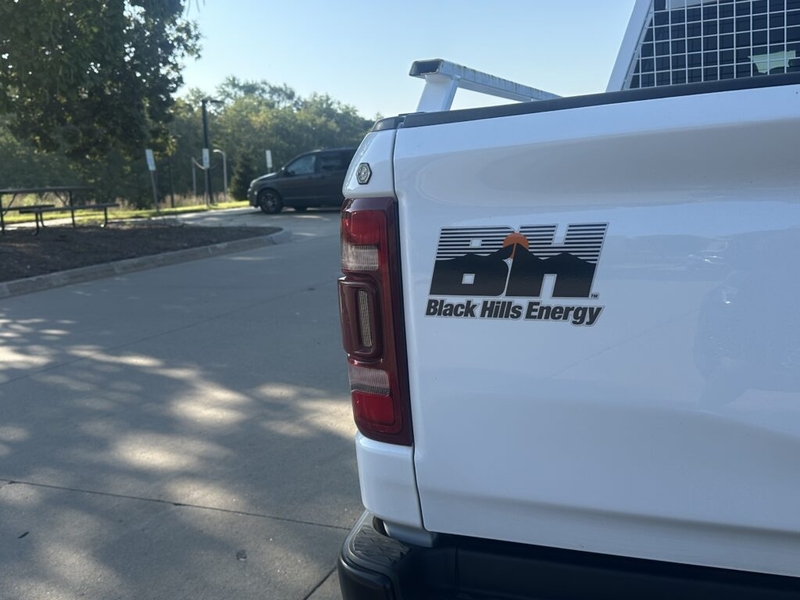
The Iowa Utilities Commission is investigating a high volume of safety violations from Black Hills Energy. (Photo by Cami Koons/Iowa Capital Dispatch)
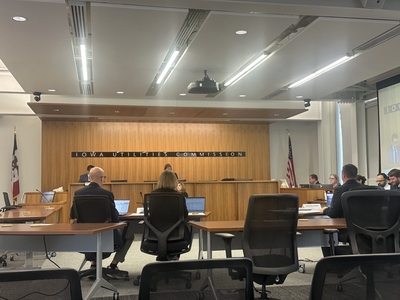
The Iowa Utilities Commission is evaluating potential penalties and corrective action for Black Hills Energy following a hearing Thursday on an investigation into the gas company’s safety and management practices in Iowa.
Routine inspections from IUC revealed Black Hills Energy had disproportionally more instances of probable violations than the other top gas providers in Iowa over the past several years. The IUC also flagged that Black Hills has significantly longer correction times for probable violations than the other major gas providers.
Black Hills representatives acknowledged that the number of probable violation instances was high in a recent audit and said the company has a “structured continuous improvement approach” to address the commission’s concerns and improve compliance.
Pete Hamell, the general manager for Black Hills Energy Iowa Gas, said that while the number of probable violations is notable, the “nature of the observations really isn’t alarming.”
Hamell said many of the probable violations observed by IUC were related to environmental, homeowner or business factors. That means things like oxidation of pipes over time, damage from homeowners doing landscaping projects or regulatory changes.
“We have alignment with the commission that the safe, reliable, and affordable delivery of gas service to our customers in all of our communities is a shared responsibility and priority for us,” Hamell said, speaking as a witness during the hearing. “We take the commission’s, not only their observations, but the commission’s partnership to heart.”
Volume of violations
In June 2025, IUC submitted a routine inspection report on Black Hills’ Spencer Unit in northwest Iowa that had more than 100 safety issues in 16 violation categories. IUC said that while the violations didn’t pose and immediate threat to the public, the high volume was cause for an investigation.
As IUC reviewed additional data with other Black Hills operations in the state, it “became increasingly concerned” about potential “company-wide safety issues” across Black Hills’ operations in the state, according to a news release from IUC.
While IUC can levy civil penalties to utilities that commit violations, the commission decided to defer its final decision on civil penalties for Black Hills until it could evaluate compliance standards through the rest of the utility’s systems in Iowa.
According to IUC, Black Hills is the smallest of the three major natural gas utilities in Iowa, behind Interstate Power and Light Company and MidAmerican Energy Company. According to data presented by IUC Thursday, Black Hills has just under 3,000 miles of main pipe in Iowa, compared to more than 4,500 miles operated by IPL and more than 11,000 miles operated by MidAmerican.
While smaller than the two other major operators, an IUC chart showed Black Hills’ instances of probable violations between 2023 and 2025 were nearly the same as MidAmerican’s. When scaled to the number of violations in the time frame per 1,000 service lines, Black Hills’ violations were nearly three times that of MidAmerican or IPL.
Adam Buhrman, corporate counsel for Black Hills Energy, said the utility was not given this data prior to the hearing to verify its accuracy.
In Black Hills’ July 29 filed response, it said certain inspection reports contained “a significant number of findings” but that “none of those findings involved active leaks or other immediate threats to public safety.”
The findings from the recent reports pertained to issues like compliance, documentation, maintenance, corrosion prevention or facility maintenance, according to Black Hills’ filing. In its response to IUC’s notice, Black Hills contended that civil penalties were “not warranted” as part of the commission’s review.
“The Company believes that continued implementation of its corrective action plan, together with ongoing reporting, collaboration, and evaluation of compliance performance, will provide a more effective means of addressing the Commission’s concerns and promoting continued improvement than the assessment of civil penalties,” Black Hills’ filing said.
Hamell said many of the instances flagged in the Spencer report that initiated the IUC’s investigation were related to what Black Hills would call “oxidation” which he said “is not necessarily bad for pipelines.”
Further discussion around oxidation and corrosion in the hearing led commissioner Joshua Byrnes to say that it seems IUC inspectors are seeing instances of corrosion while Black Hills technicians see oxidation.
“How do we get to a point where we’re all seeing the same thing?” Byrnes asked.
Matt Mangin, a senior specialist with Black Hills overseeing corrosion control, among other things, said the training would need to be equal between the agencies to properly identify the difference between oxidation and corrosion. Corrosion, he said, is an electrochemical reaction and has to present all four elements of corrosion.
Speediness
IUC also presented information comparing Black Hills’ correction times compared to other utilities from 2023 through 2025. While MidAmerican and IPL had an average time to correct issues of about 30 days, Black Hills’ average was 132 days.
Hamell said certain projects take longer to complete than others, due to things like engineering and permitting. But generally, Hamell said to his knowledge, Black Hills’ response times have not “exceeded” the standards set by the U.S. Pipeline and Hazardous Materials Safety Administration, or PHMSA.
Many of the questions from commissioners centered on staffing concerns at Black Hills, but Hamell assured commissioners that staffing was not currently a concern for the company.
In its June 29 order giving notice of possible civil penalties, IUC noted that Black Hills closed violations from the 2025 Spencer audit “faster than those found throughout the remainder of Black Hills’ gas system.” IUC said faster response time must be examined to understand why it has not been replicated in the utility’s other Iowa systems.
Black Hills, in its filed response, said past closure times “needed improvement” and that its “current trend demonstrates meaningful progress in that regard.”
Kevin Jarosz, the vice president of Black Hills’ Iowa & Nebraska gas operations, said safety is the “highest priority” at the company.
“We firmly commit safety to our employees, our customers, and communities that we serve, and we also commit to a strong compliance program, investment in our infrastructure, and continuously improving where we need to,” Jarosz said during the hearing. “We also commit to continue to work collaboratively with the commission to ensure that safe operations continue, and we will continue to provide safe, reliable service to our customers, like we have for decades and into the future.”
The Iowa Utilities Commission will review the testimony and the written responses to determine applicable civil penalties and corrective actions in the matter.

Des Moines, IA