Clean Elections set to demand $4.7M repayment from candidates amid fraud allegations
Aug 26, 2026 | 12:49 am ET
Description
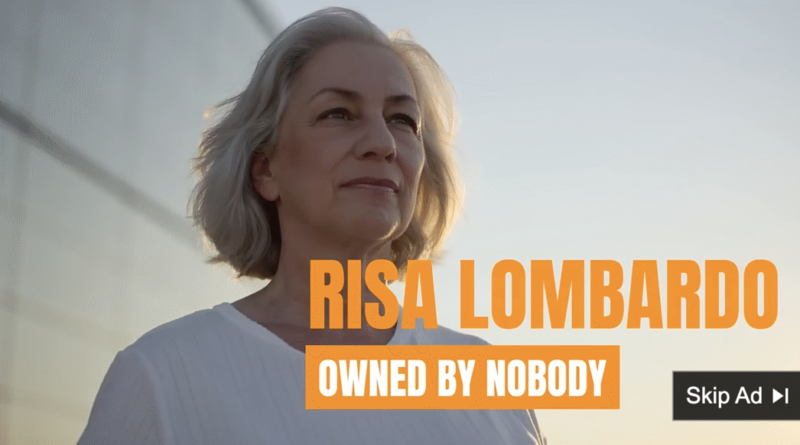
Risa Lombardo, a Green Party candidate for governor, is being accused of fraudulently qualifying for public campaign financing. On Aug. 27, 2026, the Arizona Citizens Clean Elections Commission is expected to consider asking her to repay the $2.8 million her campaign was given. (Screenshot via Google Ads Transparency Center)
The Arizona Citizens Clean Elections Commission is set on Thursday to discuss accusations that three candidates unlawfully qualified for $4.7 million in public funds and broke campaign finance rules — and it may ask them to repay the money.
In letters sent Tuesday to Green Party candidate for governor Risa Lombardo, Green Party candidate for secretary of state Duwayne Collier and Republican candidate for governor Scott Neely, Clean Elections Commission Executive Director Tom Collins told each of the candidates to seek legal counsel and to expect to be required to repay the money.
In the letters, he detailed allegations of false contributions to their campaigns and failure to adhere to Clean Elections campaign finance reporting requirements.
“All of these facts together, which as you can see are largely substantiated, represent a level of suspicious activity well beyond what I have witnessed in 16 years as the Commission’s executive director,” Collins wrote.
Those letters were sent on the same day that the Arizona Mirror published a story detailing accusations from six Arizona residents that the three candidates falsely used the voters’ names on small-dollar contributions to qualify for millions in public campaign funding.
Those $5 qualifying contributions are a requirement for candidates who wish to access public campaign financing. Every candidate participating in Clean Elections must gather a set number of the small-dollar contributions from voters — the exact number depends on what office the candidate is seeking — to unlock the larger sums of money.
In the letters, Collins describes that what he found during a monthslong investigation into the campaign finance records of the three candidates confirms the Mirror’s reporting, which he referenced in the letters.
“(T)he Arizona Mirror made blistering assertions that, frankly, corroborate my investigation thus far,” Collins wrote in the letters.
In line with the Mirror’s reporting, Collins wrote that Clean Elections staff found that a substantial number of $5 contributions recorded for Lombardo, Neely and Collier came from the same people, on the same dates and were the only contributions those people had ever made.
“Based on my experience as Executive Director, this represents a suspicious pattern of donations,” Collins wrote.
To qualify for public funding, the candidates must write a check for the total of $5 contributions they collected to the Clean Elections Commission, alongside paperwork with the names, addresses and signatures of the voters who made the donations.
Through reviews of all three campaigns’ bank accounts, Collins wrote that he found that they all deposited lump sums in amounts equal to the total of their reported $5 donations in May, on the same dates or shortly before they applied for Clean Elections funds instead of over the course of the many months each candidate claimed to have been collecting the qualifying contributions.
“Presumably, if you had been collecting $5 from individuals over the course of the qualifying period, there is no reason for those donations to arrive in the form of a single in person bank counter deposit,” Collins wrote in his letter to Lombardo. “All of this activity is highly unusual and constitutes strong evidence that you, in fact, did not collect $5 from each person who apparently signed a qualifying contribution form for your candidacy. And, in turn, this gives rise to an inference the source of the money was the deposit on May 4, not actual individual donors.”
Lombardo and Neely both received the lump sum payments on May 4, and Collier received his on May 29, according to the letter. Lombardo and Collier both applied for public funding on the same day the deposits were made, and Neely applied a week after receiving his.
Collins also referenced the Arizona Green Party’s opposition to Lombardo and Collier’s campaigns, accusing them of being Republicans in disguise, aimed at pulling votes from Gov. Katie Hobbs in the general election to benefit Republican gubernatorial hopeful Congressman Andy Biggs.
Collins wrote that party support is typically crucial to successfully collect enough qualifying contributions to receive public funding.
In the letters, Collins told Neely, Lombardo and Collier that he planned to advise the members of the Clean Elections Commission during its Thursday meeting to “initiate proceedings to impose a repayment order upon you” requiring that they all repay the public funding distributed to their campaigns.
If the commission votes to do so, Lombardo could have to repay up to $2.8 million, Collier would be on the hook for more than $739,000 and Neely would have to pay more than $1.1 million. Collier and Lombardo both received public funding for both their primary and general election campaigns, but Neely only received funding for the primary that he lost to Biggs.
Clean Elections rules require that any repayments can only come from the candidate’s personal funds, money remaining in their campaign account or money their campaign raises under the strict dollar limits imposed by the public campaign finance system.
Neely told the Mirror that he didn’t know anything about the falsely obtained $5 donations. Neither Lombardo nor Collier have responded to multiple requests for comment.
In addition to accusations of falsifying $5 contributions, Collins told Lombardo and Collier that they were also suspected of violating Clean Elections reporting requirements when they failed to list subcontractors that their campaigns used, as the Mirror reported last month.
Collins pointed out that Lombardo and Collier both made large payments to Las Vegas-based Bootstrap Campaigns for a wide range of services just weeks after the business was created.
“Most campaign shops subcontract a significant amount of work, and a new, out-of-state company would naturally use sub-vendors, especially local companies, whose work would require documentation,” Collins wrote. “And so it is with Bootstrap. For example, you attribute mailers to Bootstrap when records filed with our office show O’Neil Printing in Phoenix did those jobs.”
Additionally, Collins informed Lombardo that she submitted too few qualifying contributions to qualify for public funding in the first place. The Secretary of State’s Office, alongside the county recorders, are responsible for verifying the contributions and approving candidates for Clean Elections funding. The Secretary of State’s Office did not answer questions from the Mirror about the calculations used to certify Lombardo’s campaign for public funding.
At the close of the letters, Collins advised Lombardo, Collier and Neely to retain any records that might be used as evidence in any action taken against them, and that those records may be subpoenaed and that they may be compelled to testify in front of the commission.
Phoenix, AZ