Lawmakers discuss regionalization as a possible solution for local ambulance problems
Aug 25, 2026 | 6:43 pm ET
Description
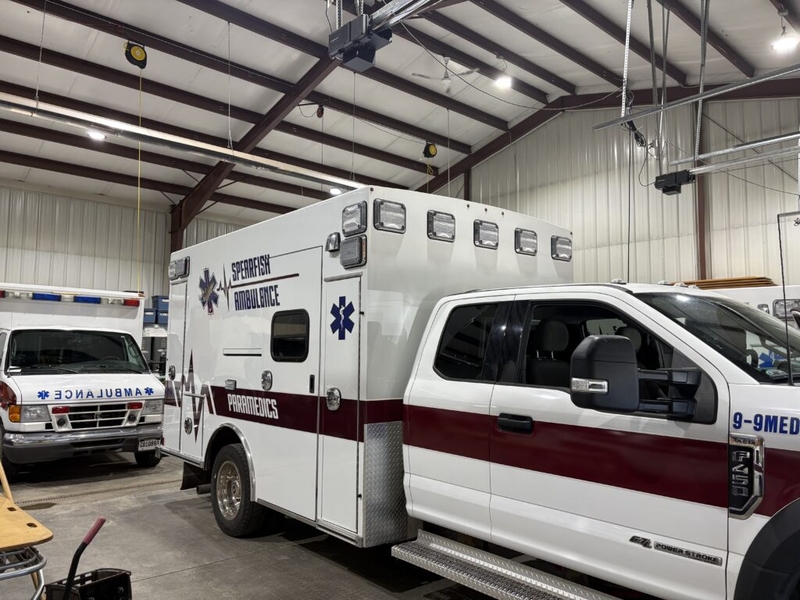
Ambulances are parked in a Spearfish Emergency Ambulance Service facility earlier this year. A task force of South Dakota lawmakers is meeting this summer to discuss ideas for supporting local ambulance service providers. (Photo by Meghan O'Brien/South Dakota Searchlight)
Listen to an audio version of this story produced by reporter Meghan O’Brien. Broadcasters: See below for a downloadable version with a host intro script.
PIERRE — State healthcare officials told South Dakota lawmakers this week that coordination among neighboring communities could strengthen local emergency medical services that are struggling with staffing and funding.
“This is truly critical to the transformation of EMS in South Dakota,” said Emily Kiel, director of the state Department of Health’s Division of Healthcare Access.
An 11-member task force of state lawmakers that met Monday is using the summer to consider ideas for legislation to support ambulance services across the state. Some services struggle with managing human resources or billing services, said Marty Link, deputy director of the Division of Healthcare Access, and regionalization could lighten the load of administrative tasks.
Regionalization involves sharing resources and functions among ambulance services across a specific geographical area, Link said. It also involves sharing recruitment and retention efforts such as training, continuing education and leadership development.
Kiel told lawmakers that regionalization could eventually lead to a stronger workforce.
Regionalization, telehealth, data-sharing: SD applies for $1 billion from federal rural health fund
“A strong workforce doesn’t simply mean obtaining a magic number of people on a roster,” she said. “A strong workforce understands a patient’s needs and anticipates downstream care priorities.”
Department officials plan to use a portion of South Dakota’s funding over the next five years from the federal government’s Rural Health Transformation Program to support regional emergency medical services hubs. South Dakota has received $189.5 million from the program so far.
Congress included the program in the One Big Beautiful Bill Act, in response to concerns that the bill’s Medicaid cuts would hurt rural health providers. Medicaid is a federal-state program that provides health insurance for people with disabilities or low incomes.
The Department of Health consulted with the South Dakota Foundation for Medical Care to design a regional hub system, which could be supported over the coming years with federal funding. But the question lawmakers must answer is how to fund that system long-term, after the rural health program funding is spent.
“We will have to come up with funding,” said Sen. Ernie Otten, R-Tea. “I think the citizens of South Dakota deserve something better than a conversation going on here in the Legislature for over 20 years, and the best that we’ve got is to come up with a model that is self-destructing in front of us.”
Coordinated efforts could lead to faster response times
Link told lawmakers he hopes to achieve a goal of “15 minutes to life” through regionalization.
“It challenges every community and region to consider how they can help ensure that, regardless of where an emergency occurs, a person can receive meaningful care within that 15 minute timeframe or less,” Link said.
An ambulance may not be able to immediately arrive at a rural emergency scene, Link said, and that isn’t the goal.
“The goal here is to really design a system where the closest, appropriately trained resource can begin life-saving action early, connect with that patient, and then enter into that broader healthcare system through EMS,” Link said. “Fifteen minutes to life is really an outcome. Regional infrastructure is what makes it possible.”
In an example of regionalization, Spink County Ambulance Director Eric Schueth told lawmakers about a secondary crew spread across the northern part of the county, called Wildcat Rescue. It’s a mix of EMTs, nurses and one paramedic.
Schueth’s service responds to 911 calls across a 1,800-square-mile area in northeastern South Dakota. Last year, it responded to 565 calls.
‘I have no reason to quit’: South Dakota EMTs still lending a hand in their 80s
Wildcat Rescue can often respond to emergencies in rural areas before the Spink County ambulance crew can arrive on scene. While Wildcat Rescue team members provide primary care, the Spink County ambulance is on its way to provide transport to a hospital if needed.
Spink County also collaborates with Clark, Hand and Faulk counties and with nearby towns such as Huron and Wolsey. After learning about the Department of Health’s vision for regional collaboration, Schueth and leaders of neighboring ambulance crews began meeting in March to learn how each agency could support one another.
“What does everybody need?” Schueth said the service’s leaders are asking. “How can we make each one of our services successful?”
For the coalition in northeastern South Dakota, the answer to that question is sharing resources such as staff, equipment and continuing education instructors. It also means operating under the same policies for patient care, Schueth said, so that “everybody functions as one.”
Some lawmakers on the task force said the success in Spink County could be a sign that regionalization works.
Chief Don Rowland of Watertown Fire Rescue told lawmakers that collaboration is difficult in areas with few volunteer services.
“We do not have another volunteer service in our county, so I provide protection to more than 17 townships in our county,” Rowland said.
Rowland said his department responds to more than 3,000 calls annually and provides service across about 730 square miles.
The task force plans to meet at least two more times over the next two months. Members hope to provide legislative proposals in November, to be considered during the 2027 legislative session that starts in January.

Pierre, SD