Wildlife groups warn not to waive protections to accommodate Louisiana SpaceX site
Aug 25, 2026 | 7:15 pm ET
Description
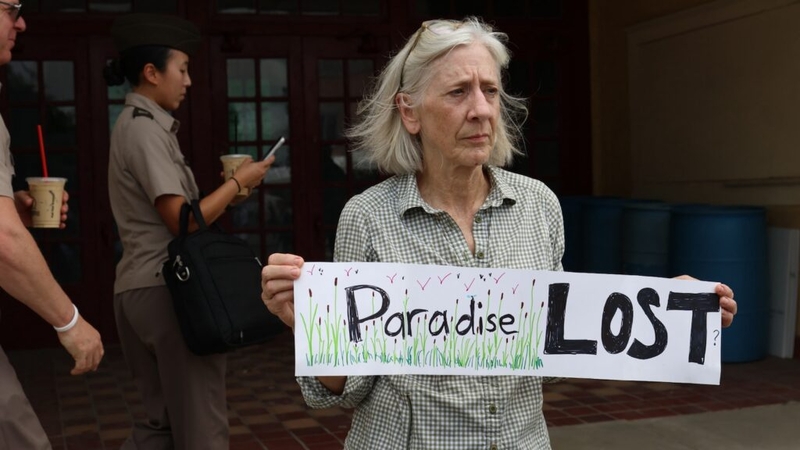
Libby Smith Nehrbass of Lafayette holds up a sign that reads, “Paradise Lost," to protest SpaceX's announcement of Spacebase Louisiana in Vermilion Parish. She and her husband, who own a hunting and fishing lodge on Pecan Island, attended the company's announcement Aug. 25, 2026, in Abbeville. (Photo by Wes Muller/Louisiana Illuminator)
SpaceX’s plans to launch thousands of rockets a year from coastal Southwest Louisiana will put habitat and hurricane protection at risk, according to three wildlife groups that oppose waivers to federal regulations aimed at expediting the development.
The Louisiana Wildlife Federation, National Wildlife Federation and Pontchartrain Conservancy filed comments on proposed rule updates with the Federal Aviation Administration, just ahead of Gov. Jeff Landry announcing the $100 billion project Tuesday in Vermilion Parish.
The revisions involve 13 wildlife, water and public health laws that the group say would be detrimental well beyond the 200-square-mile footprint for the SpaceX facility near the Freshwater Bayou Canal about 5 miles south of Pecan Island. The groups’ particular concerns center on potential threats to species, some of them endangered, that live in or migrate to the coastal wetlands as well as the loss of their habitat.
The FAA posted its proposed changes to its commercial space licensing regulations July 30, with the stated intent to “streamline the licensing process and reduce regulatory burden for applicants.
The leaders of the three wildlife groups said in a letter sent Monday to FAA Administrator Bryan Bedford that they do not oppose the space industry and recognized the economic opportunity it could offer Louisiana.
“Our concern is narrow and specific: The proposed rule would remove, at the licensing stage, the environmental review requirements that ensure launch and spaceport development accounts for its effects on wildlife, habitat, water and coastal resources,” they wrote.
The federal laws in question include the Endangered Species Act, the Marine Mammal Protection Act, the Migratory Bird Treaty Act, the Clean Water Act and the Magnuson-Stevens Fishery Conservation and Management Act.
Musk plans $100 billion SpaceX launch site in coastal Louisiana
Protected species that make their home along Vermilion’s coast and marshes include the endangered whooping crane. It also provides habitat for piping plover and Kemp’s ridley sea turtle, both near extinction in the wild. The site is also part of the Mississippi Flyway corridor that roughly 40% of all North American waterfowl and millions of migratory birds use, according to the National Wildlife Federation.
The wildlife organizations want the Federal Aviation Administration to withdraw or “substantially revise” the proposed waivers and to keep federally required environmental reviews in place for the development.
“This is precisely the setting in which project-level environmental review matters most,” the groups’ letter states. “A launch facility of the scale contemplated would involve extensive marsh filling, dredging, road and pad construction, water withdrawals and discharges, high-intensity noise and light.”
At an event in Abbeville, Landry described the SpaceX project as one that would establish Louisiana as a global hub for the aerospace industry. The company expects to provide 3,000 jobs over the next 10 years, with annual salaries averaging $92,600.
The company intends to build five launch complexes, each with two launch pads, on what will be known as Starbase Louisiana. Development plans also call for storage and production facilities for the liquid oxygen and methane mix used to power the SpaceX Starship class rockets. The facility will have its own power plant, a structure for building the vehicles being launched into space and housing for employees and their families. Construction is expected to begin next year with the first launch intended for 2029.
Starbase Louisiana will be SpaceX’s fourth and largest launch facility, joining others in Cape Canaveral, Florida; Lompoc, California; and Boca Chica on the Texas coast near Brownsville.
State officials said SpaceX will work with the Louisiana Department of Wildlife and Fisheries, the state’s Coastal Protection and Restoration Authority and other agencies to “proactively address potential impacts to wildlife, fisheries and their supporting habitats.” The company also plans to partner with local groups and experts to avoid and prevent any ecological damage.
Rebecca Triche, Louisiana Wildlife Federation executive director, said in a statement after the governor’s announcement that she was glad to hear him emphasize the importance of coastal restoration and protection. She also noted that SpaceX acknowledged the value of Louisiana’s coastal habitat and wanted to assist in coastal restoration efforts.
“We’d like to hear more about how this project would strengthen coastal resilience in ways that continue to sustain the abundance of wildlife that Sportsman’s Paradise has traditionally provided,” Triche said. “We did not see details about the reality of the footprint and impacts of launching a reusable and returnable rocket at this site.”
Details in general about the SpaceX project have been sparse leading up to Tuesday’s announcement, as many of the officials involved signed nondisclosure agreements. The use of NDAs has been a hallmark of the Landry administration’s major economic development efforts, with critics complaining they have left impacted communities in the dark and shielded negotiations involving incentives worth many millions of public dollars.
Baton Rouge, LA