US Sen. Young pushes congressional stock trading limits ahead possible 2028 primary
Aug 10, 2026 | 5:00 am ET
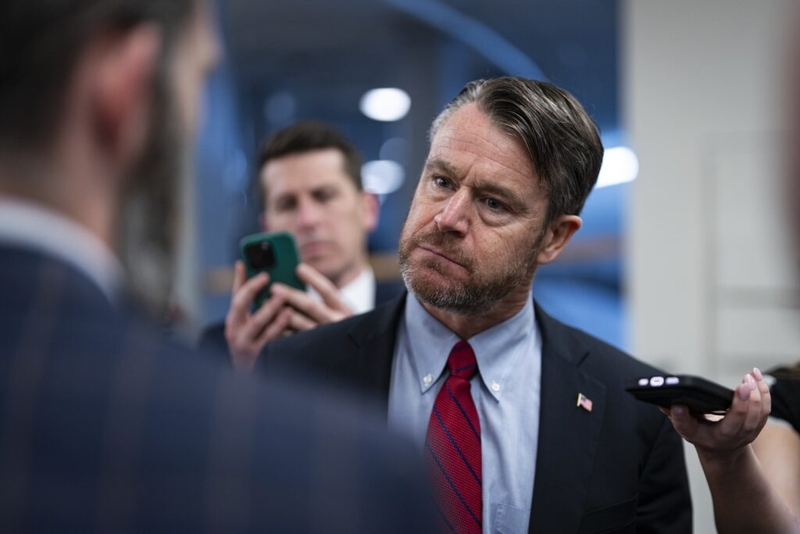
Description
U.S. Sen. Todd Young, R-Indiana, at the U.S. Capitol in Washington, D.C., on March 25, 2025. (Photo by Al Drago/Getty Images)
U.S. Sen. Todd Young sees greater limits on stock trading by members of Congress as a basic step toward restoring public trust.
The Indiana senator’s support for the Stop Insider Trading Act is the latest among issues in which he’s positioned himself as a “problem solver” rather than a hard-line partisan.
A Young-supporting political group has been promoting his stance through broadcast and online advertising as he prepares for a possible Republican primary challenge in 2028.
Bill’s Senate fate uncertain after clearing House
Versions of a congressional stock trading ban have been introduced several times in recent years but failed to advance in Congress.
The proposal gained more momentum as the House approved it last month, although few Democrats supported the measure since it was packaged with an unrelated voter identification bill.
The House-based bill would prohibit members of Congress and their spouses and close family members from buying certain stocks and require a public notice and waiting period before selling stocks.
“I have a personal belief that improper behavior is happening,” Young told the Indiana Capital Chronicle. “That is, certain members of Congress, not most, but some, are trading on non-public, market-moving information, and that’s not only unethical. It is destructive to trust in our republican system of government.”
The Senate wrapped up work early Saturday morning, leaving for a five-week recess — choosing not to take up the proposal.
Young said some in Congress have worked behind the scenes to have it sidelined.
“I think members of our leadership just haven’t prioritized it in recent history because members of Congress have not sufficiently vocalized their support for this effort,” he said. “I saw an opportunity to change that, to be very vocal on this issue, and candidly to try and stir up some popular interest in this remedy.”
Young’s allies promoting “winnable issue”
Young’s position is being highlighted in advertising by the Endless Frontier Innovation Fund, an Indianapolis nonprofit formed in 2024 by Republicans tied to Young.
The group’s website says its aim is to promote “economic and national security by supporting principled and innovative leaders who advance America’s standing in today’s technological age.”
Endless Frontier’s only apparent advertising has been to support Young on the stock trading issue, which began online with Google in May, according to Google’s ads transparency tracker.
A spokesman for the organization said “stock trading scandals have tarnished the reputation of Congress” and that “there is no more pressing issue today than passing a stock trading ban for members of Congress.”
The group isn’t required to disclose its funding sources and it did not answer questions from the Capital Chronicle about who has given it money and how much it was spending to promote Young’s position.
“Senator Young has been a champion in the effort to ban stock trading by members of Congress. We also plan to make sure Hoosiers know to thank the House members who recently voted in favor of stock ban legislation,” said a statement from group spokesman Luke Thomas, a former press secretary for the state Republican Party.
Young faced no Republican challengers when he ran for a second Senate term in 2022. But his distance from President Donald Trump’s brand of politics has led to rumblings of a primary challenge in 2028.
Young ended June with about $7.2 million in his campaign fund for an undeclared reelection bid. He has largely kept his Senate focus on non-political wedge issues such as a push to boost U.S. shipbuilding and the 2022 Chips and Science Act, which directed federal funding toward increased semiconductor chip production in the country.

Emphasizing topics such as a ban on congressional stock trading is tapping into an issue with broad public support even if it doesn’t rank as a top concern among voters, said Laura Merrifield Wilson, a University of Indianapolis political science professor.
“This is a way for Young to solidify his conservative roots to try to maybe mitigate a more conservative challenger for the Republican primary, but also on what feels like a strongly winnable issue,” Wilson told the Capital Chronicle.
Even with Young not facing reelection until 2028, it isn’t too early anymore to start solidifying support, she said.
“This is the time — you get ahead of it, because if you aren’t, you are behind it, and it’s not going to make it easier for him whether or not he gets competition,” Wilson said.
Young, for his part, said he does not yet have a reelection campaign plan “teased out.”
“I haven’t thought about exactly what I’ll be discussing, if and when I announce my re-election,” he said. “We have a lot of accomplishments to call our own in this office and a lot of things that I know Hoosiers care about.”
Congressman directed trust to sell its stocks
Progress on the stock-trading ban comes after one Indiana congressman — Republican Rep. Jefferson Shreve — showed up last year on lists of top congressional stock traders.
Shreve voted last month in support of the trading ban and said he had not personally bought or sold any individual company stock since he was first elected to the House in 2024.

Shreve said the stock trades reported in his disclosures involved a charitable trust set up by he and his wife and overseen by an investment manager.
Shreve said that last year he directed the manager to sell off any individual company stock and direct the money toward mutual funds, so later stock-sale disclosures reflected that decision.
The congressman entered politics after selling off his self-storage company for nearly $600 million in 2022.
“It’s just the appearance of the advantage that members could have from the standpoint of information,” Shreve said about his support for a trading ban. “We learn a whole lot in going about our work, and that’s our challenge and our responsibility.”
Young said he regarded Shreve as a “highly ethical and public-spirited person” and that his push for the stock-trading ban wasn’t sparked by any particular individual.
Young’s Senate financial disclosure lists no individual company stock ownership. Young said he had not bought or sold any such stock since he was first elected to the U.S. House in 2010.
Even if the stock ban legislation doesn’t make it through Congress this year, Young said he would continue to push for its passage.
“One could imagine this issue being broadly bipartisan as well at a time when people rightly question whether there are just basic good government measures that we can take across party lines that majorities can agree to,” he said.
Indianapolis, IN