Missouri voters crushed two Mike Kehoe priorities. November brings another test
Aug 10, 2026 | 6:55 am ET
Description
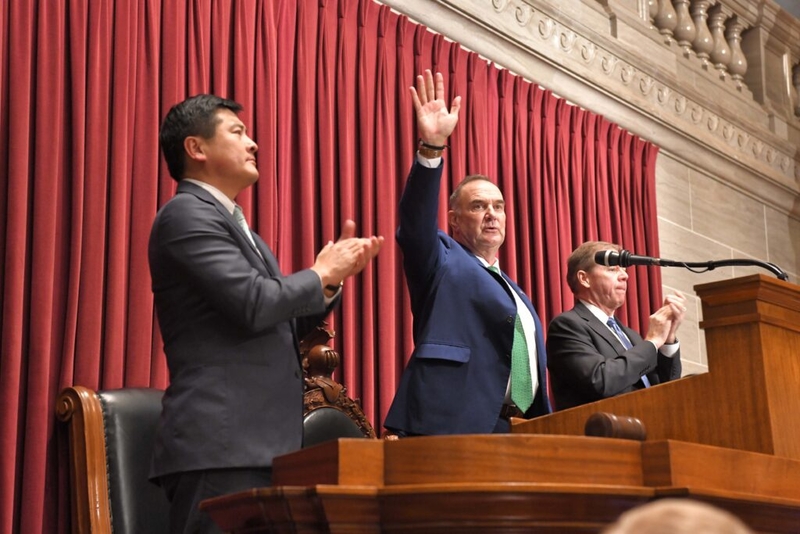
After historic defeats Tuesday, the continuing clout of Gov. Mike Kehoe is uncertain. In this photo, Kehoe waves after completing his 2026 State of the State address on Jan. 13, as House Speaker Jon Patterson claps in the foreground (Tim Bommel/Missouri House Communications).
Gov. Mike Kehoe wasn’t on the ballot Tuesday. Two of his biggest priorities were, and voters handed them a historic defeat.
Kehoe made the measure that became Amendment 5, which sought to put Missouri on a path toward eliminating its individual income tax, the centerpiece of his agenda for the year. Only two proposed constitutional amendments have fared worse in the past 118 years.
And he used the pure partisan power of the Republican supermajority to muscle Amendment 4, which would have changed how majorities are counted on constitutional amendments proposed by initiative, through the legislature in a special session last year.
For Kehoe, the question now is whether voters were rejecting two unpopular proposals on their merits or sending a broader message about his agenda.
November could offer another test.
Kehoe has put his political clout — and his wife, Claudia Kehoe — behind Amendment 3, which would make abortion illegal in MIssouri in almost all instances.
Claudia Kehoe is the treasurer of Her Health, Her Future, the political action committee formed to campaign in favor of Amendment 3. So far, the committee is lagging behind the main opposition committee, Stop the Ban, in fundraising.
Her Health, Her Future has reported about $1.1 million in donations. Stop the Ban has reported raising $6.5 million, including $1.25 million this week from former New York City Mayor Michael Bloomberg.
Bloomberg gives $1.25M to Missouri abortion rights campaign as fundraising gap grows
Tuesday’s defeats also come as Kehoe’s approval rating has narrowed during his first two years in office.
A February St. Louis University/YouGov poll found 47% of likely Missouri voters approved of Kehoe’s job performance and 42% disapproved. A year earlier, the same poll showed 50% approved and 31% disapproved.
Kehoe won office with 59% of the vote in 2024 after a bruising Republican primary that cost far more than the general election.
What Tuesday’s results mean, if anything, for Kehoe and other Republicans on the ballot in 2028, is uncertain.
“The repercussions from these two votes are going to last more than two years,” said Bob Priddy, longtime Capitol correspondent and Missouri historian. “And if I’m a Republican incumbent, not only this year but in two years, I am going to have to play a lot of defense, especially if I voted for either of these things.”
Republican campaign consultant John Hancock, whose firm advised Kehoe’s 2024 campaign, isn’t convinced.
“This will be in the distant rearview mirror at that point, and being committed to a policy of reducing taxes is not a bad place to be,” Hancock said.
Kehoe did receive one benefit from Tuesday’s results. Republican voters in St. Charles County nominated Steve Ehlmann for another term as county executive, defeating Kehoe’s closest competitor from the 2024 primary and potential 2028 rival, former state Sen. Bill Eigel.
Eliminating the income tax was one of Eigel’s signature issues in the 2024 campaign. Kehoe was the last of the three major Republican candidates to embrace the idea.
“He gets credit for attempting something big and bold,” Hancock said. “I don’t think the loss of Amendment 5 is going to have any kind of lasting impact on his political viability. And the elimination of one of his chief critics in the Republican Party is politically helpful for him.”
Whatever the political consequences, the failure of Amendment 5 leaves Kehoe facing an immediate policy challenge: Missouri’s increasingly difficult finances.
After he cast his ballot in Jefferson City on Tuesday, Kehoe said he would seek ways to cut taxes if Amendment 5 were defeated. Other Republicans have said the same thing.
Voters “like the idea of tax relief, but they didn’t like this package,” said Republican state Rep. Alex Riley of Springfield, who is in line to be House speaker next year.
Additional reductions in Missouri’s top individual income tax rate, currently 4.7%, are already written into state law but depend on revenue reaching certain thresholds.
To trigger the cuts, of one-tenth of 1% each, revenue must meet two conditions — receipts at least $200 million more than the highest of the previous three years and more than the revenue from five years prior, adjusted for inflation.
The official revenue forecast for the current fiscal year is not enough for a cut to occur Jan. 1, 2028, the next possible date. At $13.65 billion, it is enough to meet the $200 million threshold but less than the inflation-adjusted revenue from fiscal year 2022.
More immediately, projected revenue isn’t enough to cover the state’s current spending.
Kehoe vetoed and restricted $500 million in appropriations for the current year. That left a general revenue deficit of $2.3 billion after Kehoe’s vetoes, money that will come from accumulated surpluses.
Those reserves are dwindling, meaning the budget lawmakers write next year will have to align much more closely with actual revenue. And that will be Kehoe’s biggest test yet, said Sophia Shore, a Republican consultant who ran Eigel’s 2024 primary campaign.
“Until Kehoe is willing to take the state budget by the horns and clean up some of the waste, his popularity will continue to go down,” Shore said.
Democrats are eager to interpret Tuesday’s results as evidence of a broader opening in a state where they haven’t won a statewide election since 2018 and where the party’s candidates running statewide in 2024 received about 40% of the vote.
“I can’t think of a parallel in my years in Missouri politics where there’s been such a broad repudiation,” said Russ Carnahan, chairman of the Missouri Democratic Party.
Historic defeats for Missouri GOP priorities raise questions about what comes next
The bitter primaries in some state Senate districts show the fragmentation of the GOP, said state Sen. Stephen Webber, a Columbia Democrat.
“They’ve got a bigger coalition, and that coalition is hard for them to hold together, and they’re struggling with that,” Webber said.
State Rep. Betsy Fogle of Springfield, who is running for state Senate in hopes of flipping a Republican-held district, said she expects Kehoe to turn to less controversial issues rather than quickly revisit the fights that produced Amendments 4 and 5.
“If I’m Gov. Kehoe and I expended a lot of political capital to twist the arms of Republicans who knew that this wasn’t what was right, I would be very hesitant to put my teammates in a position to have to go on record as voting on it again so quickly,” Fogle said.
Voters are frustrated that Republican lawmakers worked so hard on Amendments 4 and 5 when other issues were not addressed, she said.
“What you saw,” Fogle said, “was how disconnected every single elected official who voted in support of the income tax replacement proposal is from their constituency that went to the ballot box and voted it down in every county.”
Jefferson City, MO